
Divine India · Yoga · Uttarakhand
Yoga Teacher Training in Rishikesh

By Beauty of Bharat — India travel guide, every place, every flavour.
Guides covering all 36 States and UTs, researched from official sources and checked at publish time. Corrections welcome — see About Beauty of Bharat.
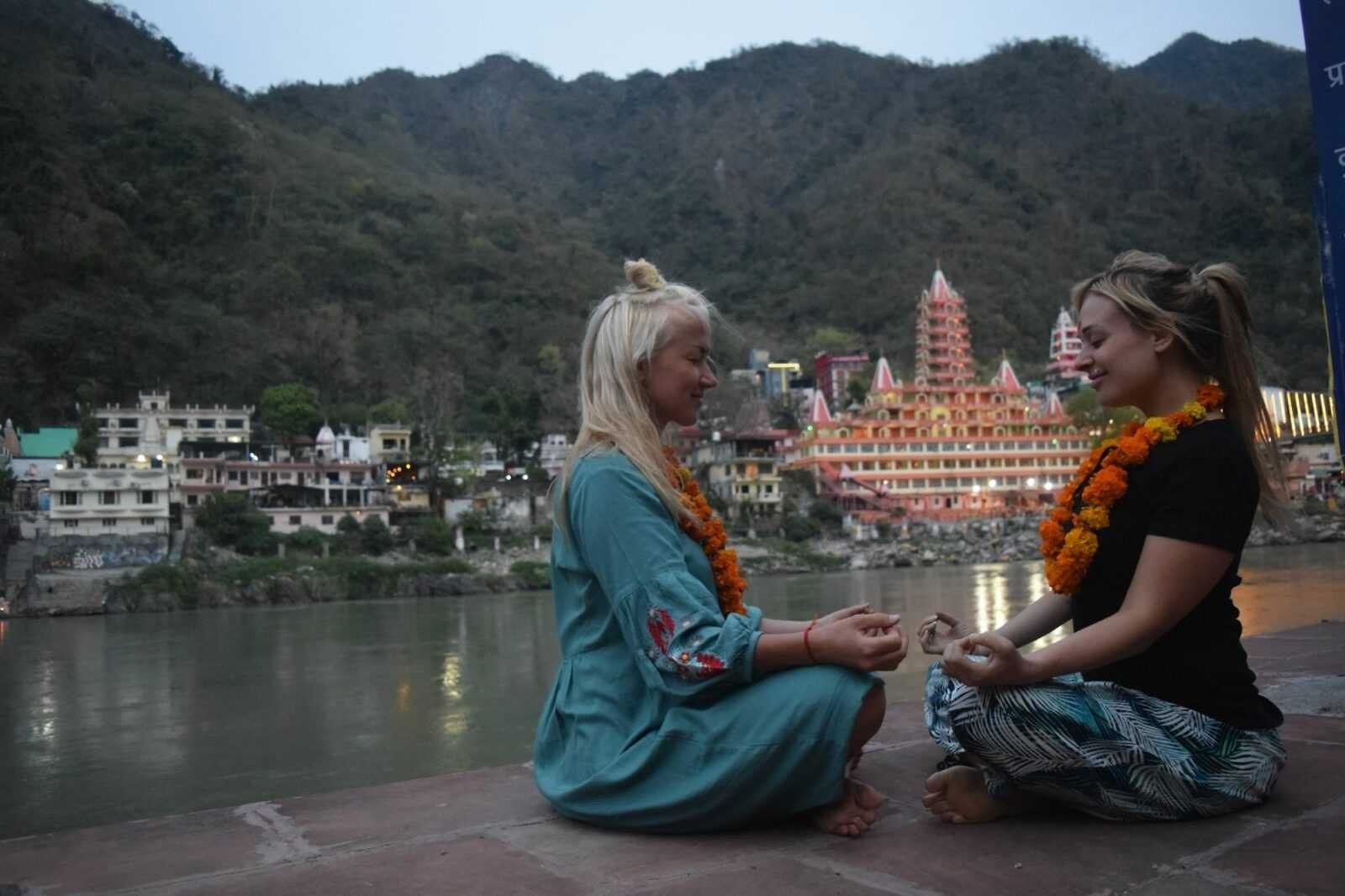
Every month, new batches of students arrive in Rishikesh from all over the world to spend about four weeks learning to teach yoga. They come for the same reason the town has drawn seekers for nearly a century: this small Himalayan town on the Ganga is where modern yoga teaching took shape, and it is still the place where the largest number of teacher-training schools in India operate side by side. If you are planning a 200-hour course, the choice is not whether Rishikesh is the right town — it is which school, at which price, on which visa.
In short: A 200-hour course in Rishikesh is typically residential, about 24 days, with monthly rolling batches taught in English. Prices are set by each school — Rishikul Yogshala lists $1,200 shared and $1,350 private. Check the school by name in the Yoga Alliance directory before paying a deposit, and ask which visa its foreign students use.
What a 200 hour yoga teacher training in Rishikesh actually is
A 200-hour teacher training course — usually shortened to TTC — is the entry-level professional qualification in the yoga world. In Rishikesh it is almost always residential: you live at the school or in a partner guesthouse for the duration, eat vegetarian meals with the group, and follow a fixed daily routine of practice, theory, and teaching practice. Most courses in town run for about 24 days, and schools run monthly rolling batches, so you can usually choose a start date in the month that suits you rather than waiting for a single annual intake.
The market is demonstrably foreign-facing. Schools describe their courses as designed especially for international students, teach in English, and commonly offer airport pickup and visa support letters. That matters for a first-timer: you are not expected to arrive fluent in Hindi or familiar with ashram life. The two International Yoga Festivals held in Rishikesh each March underline the point — the Parmarth Niketan festival in March 2026 drew nearly 2,000 participants from more than 100 countries.
But Rishikesh is not one school. It is a market of ashrams, commercial schools, and small studios, and the experience differs sharply between them. An ashram stay, such as at Parmarth Niketan or the Divine Life Society, is built around sadhana — practice, satsang, and the evening Ganga Aarti — with yoga as part of a devotional routine. A commercial TTC is built around a syllabus: asana, pranayama, anatomy, philosophy, and supervised teaching practice, ending in a certificate. Know which one you are buying before you pay.
What RYT 200 means — and what it does not
Most Rishikesh schools advertise their courses as RYT 200, and the letters are worth understanding before they influence your choice. RYT stands for Registered Yoga Teacher. You obtain RYT 200 after completing a 200-hour teacher training that is registered with Yoga Alliance, at a Registered Yoga School — an RYS 200 — and then applying to Yoga Alliance to register yourself. Multiple trainings cannot be combined to reach the 200 hours.
What RYT 200 is not matters just as much. It is a registry, not a government licence, and Yoga Alliance is not a training body — it trains nobody. The letters on a school's website are a claim about registration, not a guarantee of teaching quality.
There is also a naming trap. "Yoga Alliance International", "Canadian Yoga Alliance" and "World Yoga Alliance" are separate organisations from Yoga Alliance (yogaalliance.org), and their certificates do not count toward RYT. If a school's certificate comes from one of those bodies, it is not an RYT 200, whatever the school's marketing suggests. None of this means RYT 200 is worthless — for a teacher who wants to work in studios abroad, it is the credential most employers ask for. It means you should treat it as something to verify, not something to take on trust.
How to check a yoga school before you pay a deposit
Check before you pay anything, in this order.
First, search the school by name in the Yoga Alliance school directory on yogaalliance.org. Do not accept a badge or a certificate image on the school's own website as proof — the directory is the record. Second, check that the specific course you are buying is the registered one: a school can hold one credential and sell another course under a similar name. Third, read the school's own terms the way you would read any contract: what the fee includes, what happens if you withdraw, and whether the deposit is refundable. Fourth, look for independent evidence that the school is operating as described — recent student reviews that mention the teachers by name, and a real address in Rishikesh you can find on a map. And fifth, write to the school and judge the reply: a school that answers clearly about its registration, its teachers, and its visa guidance is a better bet than one that pressures you to pay quickly.
If the school cannot be found in the directory at all, that does not automatically make it a bad school — some respected traditional teachers work outside the Yoga Alliance system. But you cannot expect an RYT 200 at the end: ask plainly what certificate you will receive.
How much does yoga teacher training in Rishikesh cost?
There is no town-wide official price for teacher training in Rishikesh, and any guide that quotes one number for the town is inventing it. Prices are set by individual commercial schools, and they vary with the room type, the season, and what is included. The honest way to talk about cost is to name the school and quote its price.
Rishikul Yogshala lists $1,200 for a shared room and $1,350 for a private room on its 24-day, 200-hour course. Rudra Yogpeeth lists from ₹18,999, the same fee for Indian and international students. Other schools advertise above and below those figures, and what is bundled — food, accommodation, airport pickup, materials — differs, so compare like with like rather than headline prices.
What is not included is worth checking too. Ashram rooms and courses at Parmarth Niketan, for example, are not publicly priced on the ashram's official site — you book through the form on parmarth.org and the price is given on enquiry. And the cheapest course in town is not necessarily the best value: a low fee that excludes food and accommodation, or that packs forty students into a hall, can cost more in the end than a higher all-inclusive fee.
The e-Tourist visa trap for certificated teacher training
This is the single most important practical warning on this page, and it is easy to get wrong because the official wording looks reassuring at first glance. The Government of India e-Tourist Visa lists "attending a short term yoga programme" among its purposes, and many students arrive on it without difficulty. But the official definition of that purpose is narrower than the phrase suggests: it covers short courses that are not formal or structured, last no more than six months, and do not issue a qualifying certificate or diploma.
A certificated 200-hour teacher training arguably falls outside that wording: it is formal, structured, and issues a certificate. That does not mean an e-Tourist visa is definitely wrong — the wording is arguable — but never treat "tourist visa is enough" as a settled rule. Ask the school, in writing, which visa its foreign students use. This is not legal advice; re-check the official portal before you travel.
What is certain is the practical side. Apply at least four days before arrival, and apply only on the official portal, indianvisaonline.gov.in — lookalike sites charge extra for the same application. The e-Tourist visa is issued in 30-day, one-year, and five-year forms, so match the duration to the length of your stay and any travel you plan before or after the course. For the wider picture of entering India as a visitor, see our India e-Visa guide.
When to go: best time for yoga teacher training in Rishikesh
October to March is the popular window for international students, and the season most schools fill first — so if you want a particular month in that window, book early. February to April and September to November are the comfortable shoulders: warm days, cool mornings by the river, and smaller crowds than the deep-winter peak. March is festival month, when the town fills for the International Yoga Festivals. Avoid the July to August monsoon and the May to June heat for a first trip.
March mornings are cool enough to need a layer: Dehradun's long-term March normals are around 26.8°C by day and 12.2°C by night, and the riverside at dawn feels cooler still. Bring modest clothing — ashrams expect shoulders, midriff, and calves covered, and white is the dress for yoga students at Parmarth Niketan. Because courses run in monthly rolling batches, the season matters less for availability than for comfort: a batch starting in October feels very different from one starting in May, even at the same school.
What daily life on a 200-hour course looks like
Expect an early, full, and disciplined day. A residential course is not a holiday with yoga classes attached: you live where you train, eat with your batch, and follow the school's timetable from morning practice through theory, teaching practice, and evening sessions. Meals are vegetarian, and in ashram settings they are sattvic — simple, without onion, garlic, or processed food in the stricter houses — and the town itself is vegetarian and alcohol-free.
That discipline is part of what students come for, but it is worth going in with open eyes. Ashrams are not hotels: there is a fixed schedule, dress and silence rules, and an expectation that you attend the evening aarti and take part in the life of the place rather than treating it as a room with a yoga mat. If you want a free timetable or a resort-style stay, a commercial school with a clear syllabus will suit you better than an ashram.
Between sessions, the town itself is the recovery. Walk the ghats at dawn before the crowds, cross the suspension bridges on foot, and spend an evening at the aarti. Rishikesh rewards students who treat the town as part of the training, not just as the place the school happens to be.
Rishikesh beyond the training hall
Your course will teach you asana and anatomy, but the reason Rishikesh became the town for it is older than any syllabus. The Divine Life Society was founded here in 1936, Parmarth Niketan in 1942, and the Beatles' stay at Maharishi Mahesh Yogi's ashram in February to April 1968 put the town on the world map. The International Yoga Festival has been held here since 1999. Read the full story — including the correction that "Yoga Capital of the World" is a nickname, not a formal title — on our Rishikesh, Yoga Capital of the World page.
Rishikesh is also the gateway to the mountains. The road north from here runs toward Haridwar and on to the Char Dham, and many students add a few days in the hills after their course. If that appeals, start with our Char Dham Yatra guide and the Kedarnath trek guide — but plan it after the course, not during it.
Frequently asked questions
How long is a 200-hour yoga teacher training in Rishikesh?
Most 200-hour courses in Rishikesh run for about 24 days, residential, with monthly rolling batches. Rishikul Yogshala, for example, runs 24-day batches from the 7th to the 30th of the month.
How much does yoga teacher training in Rishikesh cost?
There is no town-wide price — each school sets its own fee. Rishikul Yogshala lists $1,200 for a shared room and $1,350 for a private room on its 24-day course, and Rudra Yogpeeth lists from ₹18,999, the same fee for Indian and international students.
What does RYT 200 mean?
RYT 200 means Registered Yoga Teacher at the 200-hour level. You earn it by completing a 200-hour training at a Registered Yoga School (RYS 200) and then registering with Yoga Alliance. It is a registry, not a government licence, and Yoga Alliance itself trains nobody.
How do I check a yoga school in Rishikesh before paying a deposit?
Search the school by name in the Yoga Alliance school directory on yogaalliance.org, and check that the specific course is registered at an RYS 200 — not just a badge on the school's own site.
Can I do a 200-hour teacher training in Rishikesh on an e-Tourist visa?
Do not assume so. The e-Tourist visa covers short courses that are not formal or structured, last no more than six months, and do not issue a qualifying certificate — and a certificated 200-hour course arguably falls outside that wording. Ask the school which visa its foreign students use before you book or travel.
Is Rishikesh vegetarian and alcohol-free?
Yes. Rishikesh is a vegetarian, alcohol-free town, and its ashrams are not hotels — expect a fixed schedule, modest dress, and silence rules rather than room service.
Keep exploring
For the town itself, see our Rishikesh destination guide and Haridwar, For the wider yoga picture, read our yoga in India guide, and for timing your trip, the best time to visit India. International students should also read the India e-Visa guide.
Sources: Uttarakhand Tourism (Rishikesh); Yoga Alliance (RYT 200 standards and school directory); Government of India e-Visa portal (indianvisaonline.gov.in); Rishikul Yogshala and Rudra Yogpeeth (school prices, as advertised). Prices are the schools' own advertised figures — confirm with the school before paying.