
Divine India · Punjab
Golden Temple, Amritsar

By Beauty of Bharat — India travel guide, every place, every flavour.
Guides covering all 36 States and UTs, researched from official sources and checked at publish time. Corrections welcome — see About Beauty of Bharat.
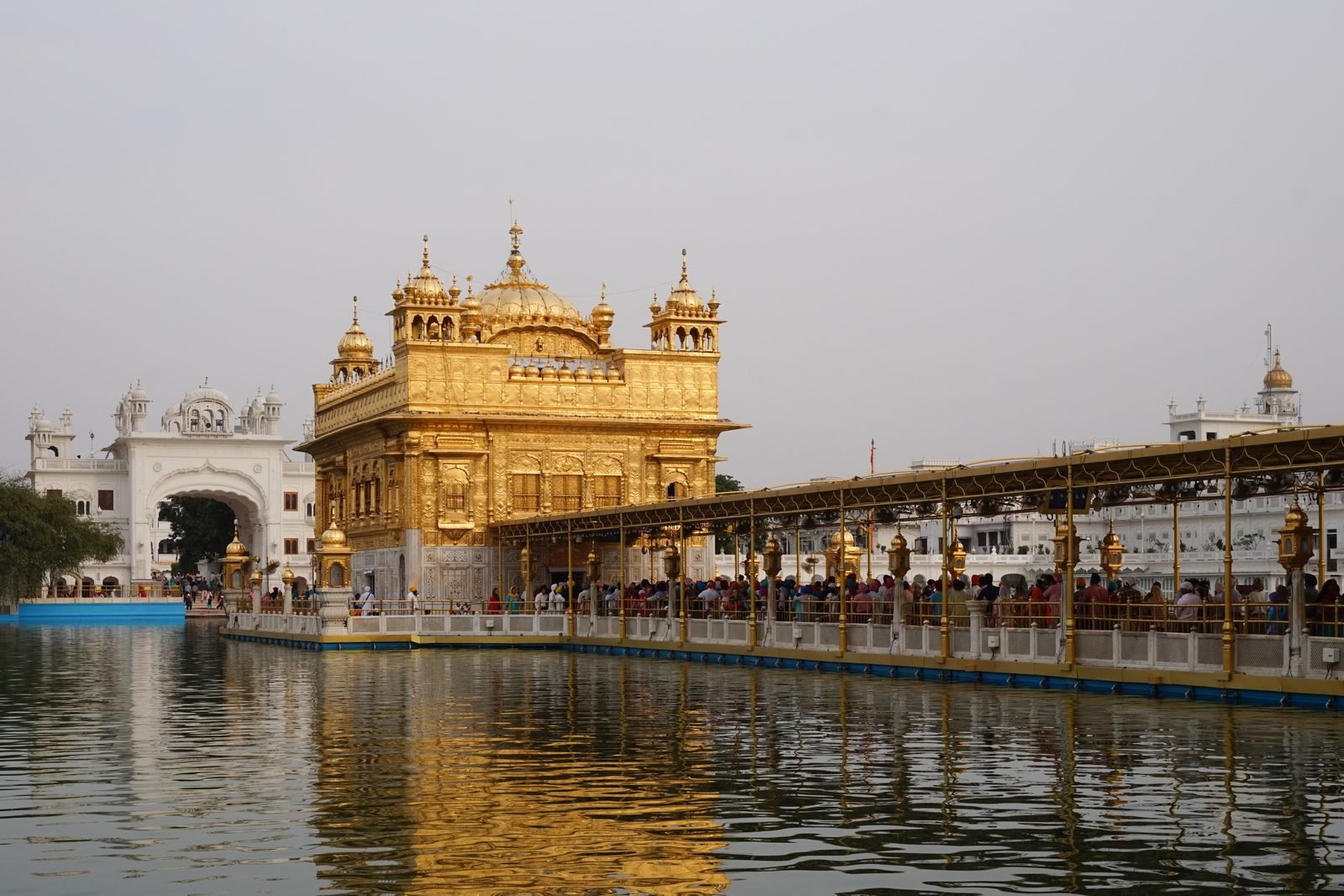
At the centre of Amritsar, in the middle of a great pool of water, stands a sanctum covered in gold leaf — the Harmandir Sahib, the Golden Temple, the spiritual heart of Sikhism. Four doors open to all four directions, and to all people. The kirtan plays continuously. And in the langar halls beside the pool, a free community kitchen feeds tens of thousands of people every day, regardless of faith, caste or background. It is, quite simply, one of the most moving places in India, and one of the most welcoming.
In short: the Golden Temple is open 24 hours a day, 365 days a year. Entry is free — there is no ticket and no booking. The langar is free. Non-Sikhs are explicitly welcome, with no permission and no faith test. Two rules matter most: cover your head, and take your shoes — and your socks — off. And one fact to get right: the Golden Temple is on UNESCO's Tentative List. It is not a World Heritage Site, and this guide does not call it one.
Open 24 hours, 365 days — and free
The complex is open 24 hours a day, 365 days a year, free, with no ticket and no booking. You can walk in at 4 in the morning or at midnight and find the sanctum open, the kirtan playing and the pool lit. The sanctum routine itself is seasonal — the times of the morning and evening ceremonies shift with the seasons — so this guide does not publish one fixed time. Check the SGPC daily routine for the month of your visit, on the SGPC's own channels, before you plan around a ceremony.
Time your visit for the quiet hours and the temple is a different place. The best hours are 04:00 to 07:00 and after 21:00, when the crowds thin, the marble cools, and the gold of the sanctum is reflected in the still water of the pool. Come at dawn and you will see the temple wake up; come after 21:00 and you will see it at its most peaceful, lit against the dark with the kirtan carrying across the water. The most crowded hours are 16:00 to 19:00, when day visitors and evening pilgrims overlap — worth knowing, and worth avoiding if you want the quiet. The best season is October to March. The temple is managed by the Shiromani Gurdwara Parbandhak Committee, the SGPC.
The pool, the sanctum and the causeway
The temple takes its setting from its name. The sanctum stands in the Amrit Sarovar — the Pool of Nectar — and the gold-leaf sanctum rises from the water at the end of a causeway, the bridge that carries visitors across the pool to the inner sanctum. The four doors of the sanctum face all four directions, so that all people may enter, and the kirtan plays continuously inside. Walk the outer parikrama first, the marble walkway around the pool, and take in the whole picture — the sanctum, the water, the gold — before you cross the causeway. The causeway itself is part of the experience: it narrows the world to a single walkway over still water, and photography is strictly prohibited on it and inside the inner sanctum, so put the camera away before you step onto it.
The langar: a free kitchen for everyone
The langar is the free community kitchen of the Golden Temple, and it feeds tens of thousands of people daily, regardless of faith. There is no charge, no ticket and no distinction between pilgrim and tourist, Sikh and non-Sikh. Eating in the langar is one of the great experiences of a visit to India, and it is open to you exactly as it is to everyone else. The langar hall is signed in English, and free English booklets about the temple are available at a stall inside the complex.
Etiquette for first-time visitors
The rules below are not suggestions — they are the conditions of entry, and they apply to everyone. Get them right and the visit is effortless.
- Cover your head. Head covering is mandatory for men and women. Free scarves and orange patkas are available at the entrances. Hats and caps are not a substitute.
- Cover your shoulders and knees. Modest dress is required throughout the complex.
- Shoes and socks off. Leave shoes and socks at the jorra ghar, the shoe house, and wash your feet at the entry pools before stepping onto the marble.
- No alcohol, tobacco or leather inside. This includes leather belts and bags — leave them outside or at your hotel.
- Phones on silent, no calls inside. Keep your phone silent throughout the complex and do not make calls inside.
Volunteers at the entrances will help you with all of this — scarves, shoe storage and the foot-washing pools are part of the arrival, not an obstacle to it. If you are unsure about anything, ask a volunteer rather than guessing.
Photography rules at the Golden Temple
Photography is allowed on the outer parikrama — the marble walkway around the pool — and that is where the famous photographs of the Golden Temple are taken, especially at dawn and after dark when the sanctum is reflected in the water. Photography is strictly prohibited inside the inner sanctum and on the causeway, the bridge that leads across the pool to the sanctum. Do not photograph people bathing in the pool or eating in the langar. The rule is simple to remember: outside the pool's edge you may photograph; on the causeway and inside the sanctum you may not.
Non-Sikhs are explicitly welcome
There is no permission to seek and no faith test to pass. Non-Sikhs are explicitly welcome at the Golden Temple — Hindus, Muslims, Christians, Buddhists, Jews, atheists and the simply curious visit every day, and the four doors of the sanctum are the symbol of that openness: they face all four directions, so that all people may enter. The kirtan is for everyone to hear, the pool is for everyone to walk around, and the langar is for everyone to eat in. Come with respect, follow the etiquette above, and you will be welcomed exactly as a Sikh pilgrim is.
Arriving is straightforward once you know the sequence. Cover your head first — free scarves and orange patkas are handed out at the entrances, and volunteers will help you put one on. Then leave your shoes and socks at the jorra ghar, wash your feet at the entry pools, and step onto the marble of the parikrama. From there the whole complex opens out in front of you: the pool, the causeway, the gold sanctum across the water. Take your time. Nobody will hurry you, and the temple rewards the unhurried — an hour on the parikrama at dawn, or an hour after dark, is worth more than a rushed circuit in the middle of the afternoon.
How to reach the Golden Temple
Amritsar's Sri Guru Ram Dass Jee International Airport (ATQ) is about 11 km from the city, and direct international flights exist — otherwise fly via Delhi. The temple sits in the old city, so expect to walk the last stretch through its lanes. See our Amritsar guide for the city, Punjab for the state, and our India e-Visa guide if you are coming from abroad.
Frequently asked questions
Is entry to the Golden Temple free?
Yes. The complex is open 24 hours a day, 365 days a year, and entry is free — there is no ticket and no booking. The langar is free too.
Do I need to book a visit to the Golden Temple?
No. There is no ticket and no booking. You can walk in at any hour. The sanctum routine is seasonal, so check the SGPC daily routine for the month of your visit if you want to attend a ceremony.
What should I wear to the Golden Temple?
Cover your head — mandatory for men and women, with free scarves and orange patkas at the entrances; hats and caps are not a substitute. Cover your shoulders and knees. Take your shoes and socks off at the jorra ghar and wash your feet at the entry pools. No alcohol, tobacco or leather inside.
Can I take photos at the Golden Temple?
Photography is allowed on the outer parikrama, the marble walkway around the pool. It is strictly prohibited inside the inner sanctum and on the causeway to the sanctum. Do not photograph people bathing or eating langar.
Can non-Sikhs visit the Golden Temple?
Yes — non-Sikhs are explicitly welcome, with no permission and no faith test. The four doors of the sanctum face all four directions so that all people may enter. Free English booklets are available inside, and the langar hall is signed in English.
More from Beauty of Bharat: Amritsar · Punjab · India e-Visa guide · Best time to visit India