
What to Eat in Kerala · State Food Guide
What to Eat in Kerala: 12 Dishes from Sadya to Malabar Biryani

By Beauty of Bharat — India travel guide, every place, every flavour.
Guides covering all 36 States and UTs, researched from official sources and checked at publish time. Corrections welcome — see About Beauty of Bharat.

Kerala's grandest meal has no plates and no menu — yet more than 25 dishes arrive in a strict order on a single banana leaf. That meal is the sadya, and it is the perfect way into the famous food of Kerala: a cuisine built on coconut, rice, curry leaves and the catch of the backwaters, where the order you eat in matters as much as what you eat. This guide covers 12 dishes that define the state — from sadya and appam with stew to Malabar biryani, karimeen pollichathu and payasam — with what each tastes like.
Kerala's food changes as you travel it: the south serves the great vegetarian feasts, the Malabar coast in the north brings biryani and seafood, and the backwaters bring the pearl spot fish. For the wider state, see our Kerala state guide, and for the national picture, our best food in India guide.
The great feast and the breakfast table
1. Sadya — the feast served on a leaf
Sadya means "banquet" in Malayalam, and it is exactly that: a traditional vegetarian feast served on a fresh banana leaf, most famously at Onam, Kerala's harvest festival, and at weddings and celebrations. Kerala Tourism describes a typical sadya as more than 25 dishes arranged in a specific order — banana chips and pickles at the top left of the leaf, thoran and avial beside them, red matta rice in the centre, and payasam to finish. The leaf is laid with its narrow end pointing left, rice is served only after the side dishes are in place, and the meal moves from sharp and sour through savoury and rich to sweet. Eating it by hand is part of the experience, not an optional extra. Our full guide: sadya.
2. Appam with stew — lace-edged hoppers, gentle coconut curry
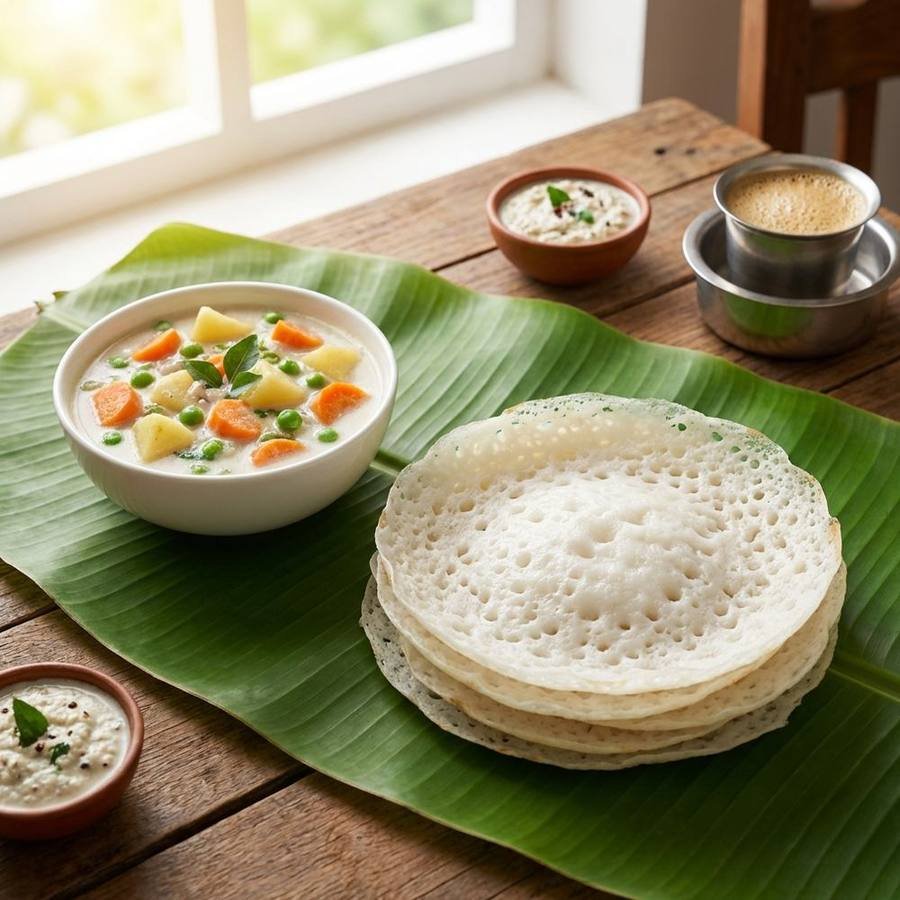
Appam is Kerala's most elegant breakfast: a fermented rice hopper cooked in a small round pan so it comes out with crisp, lacy edges and a soft, spongy centre. It is traditionally paired with a mild stew — vegetables or chicken simmered in coconut milk with whole spices, ginger and curry leaves. The stew is deliberately gentle rather than hot, so the coconut and spice come through cleanly. Scoop the stew into the soft centre and eat it like a bowl you can finish. Our full guide: appam and stew.
3. Puttu and kadala curry — Kerala's breakfast pair
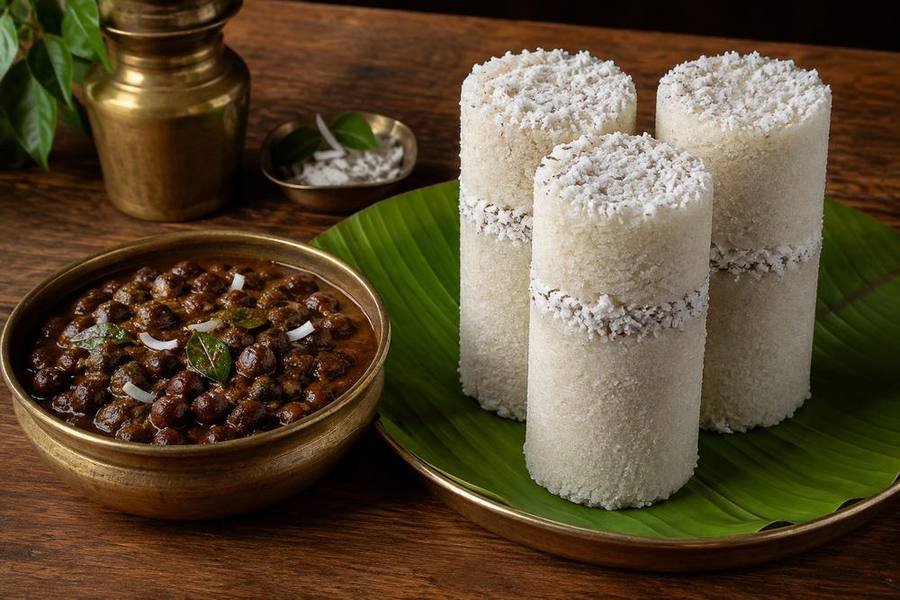
If appam is Kerala's elegant breakfast, puttu and kadala is its everyday one. Puttu is steamed cylinders of moistened rice flour layered with grated coconut — steamed without oil, so its softness comes from the flour itself — served with kadala curry, a dark, earthy curry of black chickpeas cooked with onion, tomato, coconut and spices. The puttu is mild and coconut-fragrant; the kadala is spicy and rich; crumbled together, they balance each other exactly. Our full guide: puttu and kadala.
From the Malabar coast
4. Malabar biryani — short-grain rice, gentle and golden
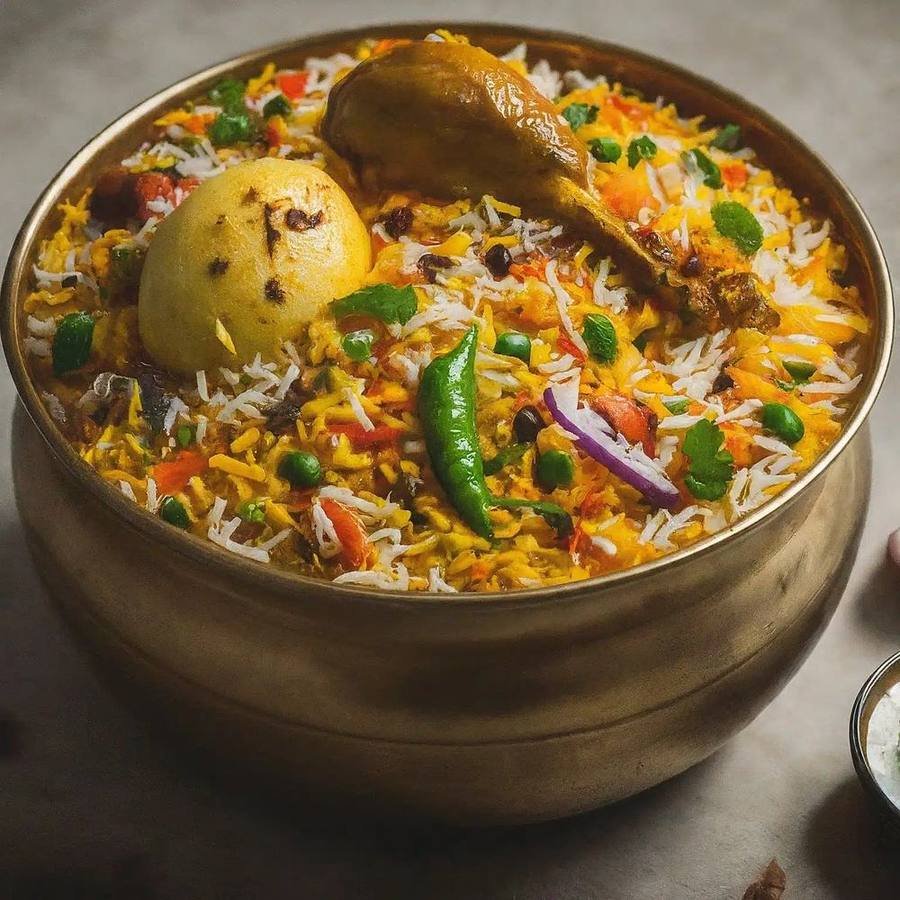
Malabar biryani is the biryani of Kerala's northern coast, and it breaks the rule most travellers expect: it uses short, fragrant kaima or jeerakasala rice, not long-grain basmati. The classic Thalassery style layers the rice with chicken or mutton, fried onions, cashews, raisins, ghee and garam masala, and the result is fragrant and moderately spiced rather than fiery. Kozhikode (Calicut), often called the food capital of Kerala, has its own beloved version. Our full guide: Malabar biryani.
5. Karimeen pollichathu — the backwaters' signature fish
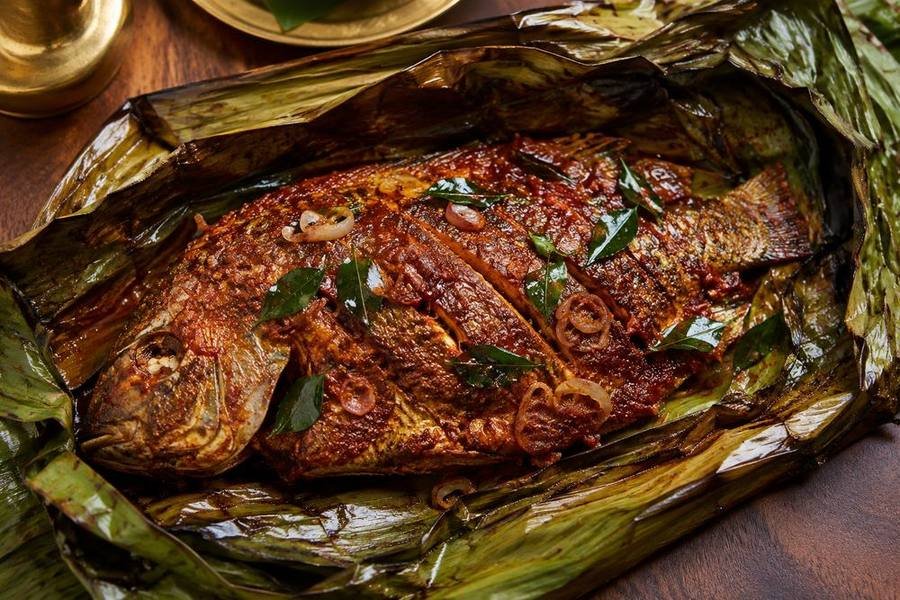
Karimeen is the pearl spot, a fish of Kerala's backwaters and lakes, and pollichathu means, in spirit, "charred in leaf". The fish is coated in a spicy onion-and-tomato masala with ginger, garlic, chilli and turmeric, wrapped in a banana leaf and pan-cooked in coconut oil, so it steams in its own spiced juices while the leaf lightly scorches. It is the signature seafood dish of the Alappuzha–Kuttanad backwaters; pair it with a trip on the water itself (see our Kerala backwaters planning guide and Alappuzha guide). Our full guide: karimeen pollichathu.
6. Banana chips — Kerala in a packet

Banana chips are Kerala's most carried-away snack: thin slices of raw nendran banana, deep-fried in coconut oil and salted, so crisp they shatter. The nendran variety matters — its firm flesh fries crisp without absorbing excess oil — and the coconut oil gives the chips a perfume no other state's version has. They are a tea-time snack, a sadya component (top left of the leaf), and the bag every traveller buys before leaving. Our full guide: banana chips.
Everyday Kerala cooking
7. Avial — the mixed-vegetable curry that holds the sadya together
Avial is the dish that explains Kerala's vegetable cooking in one bowl: many vegetables — drumstick, carrot, beans, raw banana, yam, ash gourd — cooked together with coconut, yoghurt and curry leaves, finished with raw coconut oil. It is thick, not soupy, mildly sour from the yoghurt, and fragrant rather than hot. Avial appears on the sadya leaf and on everyday lunch plates alike. Every household has its own mix of vegetables; the coconut-yoghurt base is what makes it avial.
8. Thoran — dry, coconut-stirred vegetables
Thoran is the simplest Kerala vegetable dish and one of the most eaten: finely chopped vegetables — cabbage, beans, carrot, beetroot — stir-fried dry with grated coconut, mustard seed, curry leaves and a little chilli. There is no gravy; the coconut coats the vegetables. It sits on the sadya leaf next to avial, and the contrast — dry thoran, creamy avial — is exactly how a sadya is built.
9. Payasam — the sweet that closes the feast
No sadya is complete without payasam, and often more than one kind is served. The family is wide: ada pradhaman (rice flakes with jaggery and coconut milk), palada payasam (milk-based rice pudding), pazham pradhaman (ripe banana and jaggery), and parippu payasam (lentils, coconut milk and jaggery). What they share is coconut milk and jaggery rather than refined sugar. Payasam is also served at temples and celebrations beyond the sadya — try ada pradhaman first.
10. Malabar parotta — flaky layers from the north
Malabar parotta is Kerala's flaky, layered flatbread, famous in the north of the state: dough stretched thin, folded and coiled, then pan-fried so it separates into crisp, soft layers. It is the partner of rich curries — egg curry, chicken curry, or Kerala beef fry — and tearing it open at the table is half the pleasure. In Kozhikode and Thalassery it is a late-night institution as much as a meal.
11. Idiyappam — string hoppers, soft as steamed rice
Idiyappam, also called nool puttu, is rice-flour dough pressed into fine noodle nests and steamed — soft, delicate strings that soak up whatever they are served with. The classic pairing is egg curry or vegetable stew, both coconut-based, and in the south it is also eaten with sweetened coconut milk for breakfast. It is light where puttu is dense.
12. Kappa and meen curry — the fisherman's plate
Kappa is boiled, mashed tapioca, and meen curry is Kerala's fiery red fish curry, soured with kokum or tamarind and coloured with chilli. Together they are the fisherman's plate of the coast — humble, filling, and fiercely flavoured. The tapioca cools and grounds the curry's heat; the curry gives the mild kappa its purpose. Order it near Kochi (see our Kochi guide) for the real thing.
Watch & feel the place
Before you plan the eating, watch a banana-leaf sadya being eaten and a Malabar biryani being built in Kozhikode.
Frequently asked questions
What is the most famous food of Kerala?
The sadya is Kerala's most famous meal — a vegetarian feast of 25 or more dishes served in a set order on a banana leaf, most famously at Onam. For everyday eating, appam with stew, puttu and kadala curry, and Malabar biryani are the dishes travellers remember most.
Is Kerala food very spicy?
Some of it is, but much of it is gentle. The sadya, appam with stew and avial are mild and coconut-based, while Malabar biryani is fragrant rather than fiery. The real heat sits in dishes like karimeen pollichathu and Kerala fish curries.
What is the difference between Malabar biryani and other biryanis?
Malabar biryani uses short, fragrant kaima or jeerakasala rice instead of long-grain basmati, and it is gentler and more ghee- and fried-onion-rich than Hyderabadi biryani. The classic Thalassery style fries the meat first.
What should vegetarians eat in Kerala?
Kerala is very easy for vegetarians: the sadya itself is fully vegetarian, and so are appam with vegetable stew, puttu and kadala curry, avial, thoran, payasam and banana chips.
When is the best time to eat a sadya in Kerala?
Onam, Kerala's harvest festival in August–September, is the classic occasion. But many restaurants in Kochi, Thiruvananthapuram and Kozhikode serve sadya every day at lunch, so you do not need a festival to try it.
What is karimeen, and why is it special?
Karimeen is the pearl spot fish of Kerala's backwaters and lakes. In karimeen pollichathu it is coated in spicy masala, wrapped in a banana leaf and pan-cooked, so the fish steams in its own spiced juices.
Twelve dishes in, and Kerala still has more to give — the pathiri breads of Malabar and the toddy-shop curries of the coast are all worth a trip of their own. Next, taste the neighbouring south: read our Famous Food of Tamil Nadu guide, and if you are planning when to go, our Kerala in December guide pairs the food with the season.
Plan Your Kerala Food Trip
Start with a sadya on a banana leaf, appam with stew for breakfast, and Malabar biryani in Kozhikode — then finish with payasam.
Browse more travel guides →