
Tripura · Food & Culture
Famous Food of Tripura: 12 Dishes to Try

By Beauty of Bharat — India travel guide, every place, every flavour.
Guides covering all 36 States and UTs, researched from official sources and checked at publish time. Corrections welcome — see About Beauty of Bharat.

In Tripura, the most famous meal is cooked with almost no oil at all. The state’s signature food, mui borok, is built on berma — a small freshwater fish, dried and fermented until it is salty, pungent and strong enough to flavour a whole pot from a single piece. That one ingredient explains nearly everything on this list: the sourness of bamboo shoot, the smoke of roasted chillies, the habit of boiling instead of frying. Tripura has two kitchens, and this guide covers both: the Tripuri hill cooking of the indigenous communities, and the Bengali cooking of the plains, which arrived with the families who settled around Agartala and Udaipur. Between them they make one of the least-known food cultures in India — and one of the most distinctive.
The answer-first version is short. If you try one thing, try mui borok. If you try four, add gudok, chakhwi and wahan mosdeng. If you have a sweet tooth, finish with Matabari pera, the temple sweet that carries a GI tag. The twelve dishes below are all genuinely Tripuri or genuinely eaten in Tripura.
What Is the Famous Food of Tripura?
Mui borok is the famous food of Tripura, and the name does double duty: it is both the traditional cuisine of the Tripuri people and the signature dish itself. In the Kokborok language, mui means rice and borok means the people — the food of the people, in the most literal sense. The classic plate is rice with a boiled dish of vegetables and berma, a mosdeng chutney on the side and often a thin broth, cooked with little or no oil and seasoned lightly so the ingredients speak. Berma is the soul of it: fermenting and drying fish preserved protein in a hot, wet climate long before refrigeration, and the flavour became a matter of identity as much as necessity. For Tripuris living away from home, its smell is the taste of belonging. See our mui borok guide and our Tripura state guide.
The 12 Dishes
1. Mui Borok
The dish that gives Tripuri cooking its name. Rice and vegetables — often bottle gourd, bamboo shoot and seasonal greens — cooked with berma and green chillies, with no oil and almost no spice beyond chilli, onion and garlic. It is mild in seasoning and bold in flavour: salty, sour and deeply savoury at once. Some versions add a little mustard oil, but the classic is boiled, not fried, and eaten the same day it is made. It is also the dish behind a real search signal: “mui borok” earns steady Search Console impressions for this site, which is why it leads this guide. See our mui borok guide.

2. Gudok
Gudok is the signature dish of the Tripuri kitchen, and the one most often cooked for guests and festivals. Vegetables — bamboo shoot, jackfruit, potato, beans and whatever the season offers — are boiled with berma, chilli and garlic, traditionally packed into a young green bamboo tube and cooked slowly over the fire, though a covered pot is more common now that the right bamboo is scarce. The bamboo version picks up a faint, woody aroma from the tube that the pot version cannot match.

3. Chakhwi
Chakhwi is the dish Tripuri families serve first at weddings, and the one most visitors remember. Bamboo shoot is boiled with berma, seasonal vegetables and a little chilli into a thin, sour, deeply savoury dish, finished with a rice-flour slurry and a dash of lime leaf that lifts the whole pot. It is the monsoon dish, made when the shoots are cut, and the clearest example of how sourness rather than fat carries flavour in this kitchen. See our chakhwi guide.

4. Muya Awandru
Muya is bamboo shoot and awandru is the thickened, porridge-like dish it becomes. Fresh shoots are boiled with berma and green chillies, then a slurry of rice flour is stirred in until the liquid turns thick and silky, with crushed garlic added in the last seconds before the pot comes off the heat. It can be made with yellow peas, mushrooms or snails instead of shoot, but the bamboo-shoot version is the classic. Eaten with rice, it is comfort food in the truest sense — soft, warm, salty and faintly sour.
5. Muya Bai Wahan Chakhwi
The pork dish that shows off the Tripuri habit of naming a dish after everything in the pot: muya (bamboo shoot), bai (with), wahan (pork) and chakhwi. Pork is cut into medium pieces and cooked with bamboo shoot, jackfruit and green papaya, seasoned with lemon leaves and chillies. It is a main course, not a side, and the dish to order if you eat pork and want one plate that sums up the cuisine.
6. Wahan Mosdeng
Wahan means pork, and mosdeng is the Tripuri style of salad: meat boiled, then chopped or minced fine and dressed raw with chilli, onion and coriander. The meat is cooked and the dressing is not, which gives the dish the sharpness of a salad and the weight of a meat dish at the same time. It is the first thing pork lovers are told to try. See our wahan mosdeng guide.
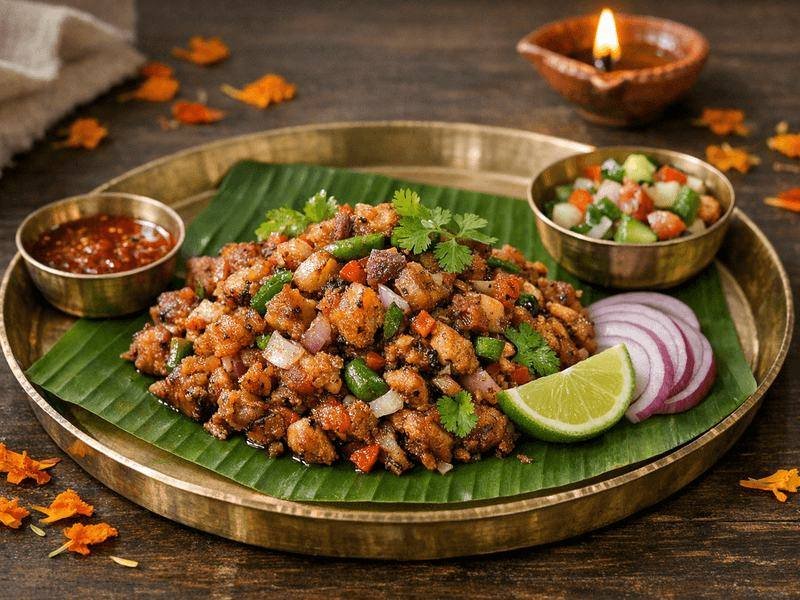
7. Mosdeng Serma
If there is one condiment that appears at almost every Tripuri meal, it is mosdeng serma: tomato pounded raw with berma, dried red chilli and garlic into a coarse, fiery chutney. The chillies are often roasted first over an open flame, which adds a smoky note. It is the version of mosdeng most visitors enjoy first, because it is familiar — a tomato chutney — with an unfamiliar, salty depth underneath. It is served with rice or roti. See our mosdeng guide.

8. Kosoi Bwtwi
Kosoi is beans and bwtwi is the slow-boiled stew, so the name is a shopping list rather than a recipe title: beans stewed with berma, garlic, onion, green chillies and turmeric until soft. French beans are the usual choice, and some versions add a few pieces of tofu. It is an everyday dish rather than a festival one, the kind of food that sits beside rice on an ordinary evening, and it is a good vegetarian-leaning entry point — though the berma means it is not vegetarian, so ask if that matters to you.
9. Bhangui
Bhangui is the rice dish Tripuri families are proudest of. Sun-dried sticky rice is mixed with ghee, ginger and onion, wrapped in a banana leaf and boiled, so the leaf keeps the nutrients in and lends the rice a gentle, green aroma. It is cooked for festivals and for guests, and it is the dish most often described in Tripura food writing as a treasure of the cuisine. See our local rice preparations guide.

10. Tohan Mosdeng
Tohan mosdeng is the chicken version of the mosdeng salad, and proof that the style works with any meat. Boiled chicken is shredded or minced and dressed with onion, green chilli and coriander, the same raw dressing as the pork version. It is lighter than wahan mosdeng and easier to find in Agartala’s markets, where chicken is the everyday meat. If pork is not for you, this is the mosdeng to order — same sharpness, less richness.
11. Panch Phoron Tarkari
This is the plains’ contribution, and it is labelled honestly here: panch phoron tarkari is a Bengali-inspired dish, not an indigenous Tripuri one. Brinjal, pumpkin, potato and other vegetables are cooked with the five-spice panch phoron blend, red and green chillies, bay leaf and turmeric, and eaten with paratha or puri. It belongs on this list because it belongs on Tripura’s tables — the Bengali community is large, and its food is part of the state’s everyday eating — but it is shared heritage, and this guide does not claim it as exclusively Tripuri.
12. Matabari Pera
The sweet to end on, and the only dish on this list with a GI tag. Matabari pera is a milk-and-sugar sweet, made from khoa and rolled into a round, slightly flattened ball with a small dent in the centre, offered as prasad at the Tripura Sundari temple in Udaipur, one of the 51 Shakti Peethas. In March 2024 it received a Geographical Indication tag, along with the handwoven pachra cloth, after an application by the Matabari women’s self-help group. A market of sweet shops outside the temple sells it to visitors, packed in bamboo boxes.
Where to Try Tripura Food in Agartala
Agartala is where the two kitchens meet, often in the same household, and it is the easiest place to eat your way through this list. Start at the mui borok counters and small kitchens around Melarmath, Nagerjala and the Old Motor Stand, where the hill dishes are served as they are cooked at home. For ingredients, walk through Battala and Maharajganj bazaars, where berma is sold by weight and bamboo shoot is piled high in season. On the plains side, the same neighbourhoods serve Bengali fish curries, fish chops, singara and jhalmuri, and the sweet shops sell rosogolla, sandesh and mishti doi. If a dish is unfamiliar, ask what is in it before ordering — many Tripuri dishes rely on fish or pork, and a good host can usually cook a vegetable version. See our Agartala guide.
Is Tripura Food Spicy?
Yes, but not in the way most visitors expect. The heat comes from fresh green chillies and dried red chillies, not from heavy spice blends, and the seasoning around them stays light: salt from berma, sourness from bamboo shoot and lime leaf, the smell of garlic and ginger. The result is food that is hot and pungent rather than rich or oily, and most dishes are boiled or steamed rather than fried. If you are vegetarian, say so at the start of the meal — berma goes into many vegetable dishes, so a dish that looks vegetarian may not be one. If the heat worries you, ask for less chilli: Tripuri cooks season by hand.
Watch & Feel the Place: Tripura’s Food on Film
Videos are by their respective creators.
Famous Food of Tripura FAQs
What is the famous food of Tripura?
Mui borok — the traditional Tripuri meal built on berma, fermented dried fish, cooked with vegetables and bamboo shoot and almost no oil. Gudok, chakhwi and wahan mosdeng are the other dishes visitors are told to try first, and the GI-tagged Matabari pera is the sweet to finish with.
What is mui borok?
Mui borok is the name of the traditional cuisine of the Tripuri people, and also of its signature dish: rice with vegetables and dry or fermented fish. Berma, the fermented dried fish at its centre, is what gives the food its salty, pungent flavour, and the cooking uses little or no oil.
What is berma in Tripura food?
Berma is fermented dried fish, traditionally made from puti, a small freshwater fish. It is the seasoning that defines Tripuri cooking — a little of it flavours a whole pot of gudok, chakhwi or mosdeng — and it is also eaten on its own as a pungent, salty accompaniment.
Is Tripura food spicy?
It is hot, but not heavily spiced. Fresh green chillies and dried red chillies give the heat, while the seasoning stays light — sourness from bamboo shoot and lime leaf, salt from berma, and the smell of garlic carry the flavour. If you ask for less chilli, a cook can usually oblige.
What sweet is Tripura famous for?
Matabari pera, the milk-and-sugar sweet offered as prasad at the Tripura Sundari temple in Udaipur. It received a Geographical Indication (GI) tag in March 2024, and a market of sweet shops outside the temple sells it to visitors.
Tripura’s food does not try to impress you — it feeds you the way the hills have always fed people: rice, a boiled dish, a sharp chutney, and a fish so well preserved that a single piece flavours the pot. Start with mui borok, work through the list, and save room for pera. Next, read our famous food of Manipur guide and our Tripura state guide.
Plan your Tripura food trip
Fermented fish, bamboo shoot and a sweet with a GI tag — Tripura’s table is the northeast’s best-kept secret, and Agartala is where to taste it.
Tripura state guide →