
Nagaland · Offbeat Spotlight
Dzukou Valley Trek: The Complete Guide to Nagaland's Hidden Valley

By Beauty of Bharat — India travel guide, every place, every flavour.
Guides covering all 36 States and UTs, researched from official sources and checked at publish time. Corrections welcome — see About Beauty of Bharat.
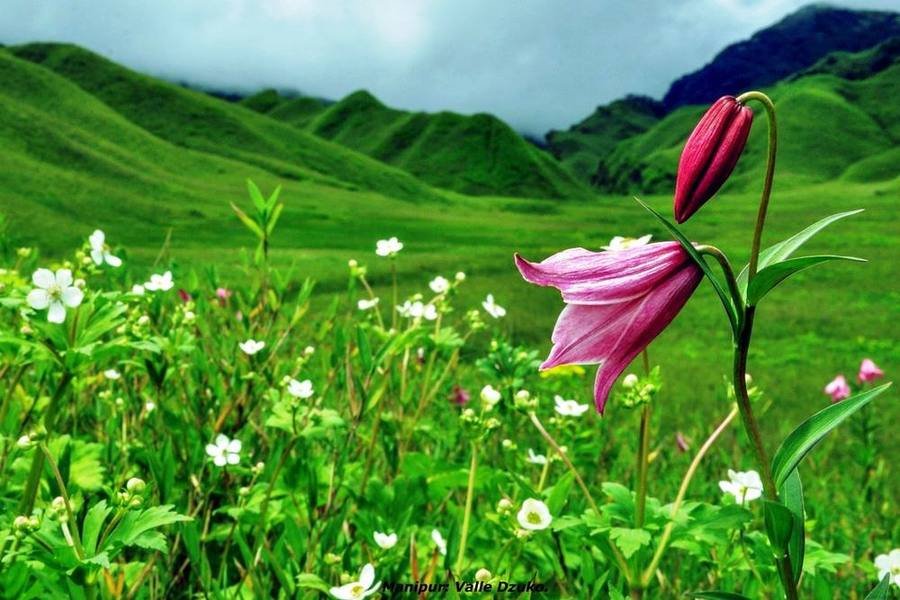
In June, Dzukou Valley is a carpet of pink lilies that grow nowhere else on Earth. In January, the same bowl of green hills is frozen, silent and dusted with frost — and you would barely believe the two photographs were taken in the same place. That is the first thing to know about the Dzukou Valley trek: you are not choosing one destination, you are choosing which of two valleys to meet. This guide covers both — the best time to visit for lilies or for the frozen winter, the Viswema and Zakhama routes, how to reach the valley from Kohima, permits, where to stay, what to pack and what it costs. See also our Dzukou Valley destination guide and the Nagaland state guide.
Dzukou Valley at a glance
| Where | High grassland valley on the Nagaland–Manipur border, about 25 km south of Kohima, behind the Japfu range |
| Altitude | About 2,452 m (8,045 ft) |
| Best time to visit | June–July for the Dzukou lily; October–November for clear post-monsoon views; December–January for the frozen valley |
| Trek distance | Viswema route about 8 km one way from the road-head, 3–5 hours; Zakhama route steeper and shorter, 3–4 hours |
| Permit | Nagaland Inner Line Permit for Indian citizens; Protected Area Permit for foreign nationals — check current rules before you go |
| Stay | Basic rest-house dormitory in the valley or camping in designated zones; Kohima as the base |
Dzukou — spelt Dzuko on the Manipur side — sits at about 2,452 metres on the border between Nagaland and Manipur, roughly 25 km south of Kohima. There is no road into it and no village inside it: you walk in from the Angami villages of Viswema or Zakhama, climb through cloud forest, and the land suddenly opens into a vast, rolling bowl of dwarf bamboo and grass, a river curling through it, with caves and rock shelters in its folds. The name is said to come from the Angami words for “cold water”, after the ice-cold streams that run through the valley. It is one of the finest short treks in India — and one of the least crowded, which is exactly why it rewards planning. For the wider region, see our best places to visit in North East India.
What is the best time to visit Dzukou Valley?
There is no single best time — there are two different valleys, and the honest answer depends on which one you want. June and July bring the flowering season: the Dzukou lily and a confetti of wildflowers spread across the green bowl, and the valley earns its nickname, the Valley of Flowers of the Northeast. The price is monsoon rain, slippery stone steps and leeches on the forest climb. October and November are the best all-round months for trekking: post-monsoon skies, clear views across the ridges, dry trails and comfortable walking. December to February is the frozen valley — frost on the grass, ice on the streams, night temperatures well below freezing (reports of around −6 °C), and a silence so complete it feels like a different destination sharing only the shape. Say it plainly: the valley does freeze in winter, but heavy snowfall is occasional, not guaranteed — do not book expecting a snowfield. April and May bring rhododendrons and warming weather, with haze on some days. Whenever you go, check the valley's status with the Southern Angami Youth Organisation (SAYO) or your guide before travelling: forest fires have closed Dzukou before, most recently in January 2026, when trekkers were evacuated.
How to reach Dzukou Valley
Every route to Dzukou runs through Kohima, and the valley itself is walk-in only. Fly or take the train to Dimapur — Dimapur Airport (DMU) is the nearest airport and Dimapur is the railhead, about 74 km from Kohima — then drive to Kohima, a climb of roughly two and a half to three hours. From Kohima, shared taxis and sumos run to the two trailhead villages: Viswema, about 25 km south on the Imphal road, and Zakhama (also spelt Jakhama), about 20 km. The drive takes 45 minutes to an hour. From there, your feet do the rest. Dzukou can also be approached from the Manipur side via Senapati, a longer trek of five to six hours, but the Nagaland routes from Kohima are the ones almost every trekker uses. See our Kohima guide for the base town.

Dzukou Valley trek distance: Viswema vs Zakhama routes
Two trails lead in, and most trekkers use one to go up and the other to come down. The Viswema route is the gentler and more popular way up: a drive up a rough road to the trailhead, then a steep climb of about an hour and a half through bamboo and forest, followed by a gentler ridge walk to the valley rim. From the road-head it is about 8 km one way and takes three to five hours for most walkers. The Zakhama route is shorter but harder — a steep climb of stone steps straight up through dense forest, three to four hours of hard walking, slippery when wet. The classic loop is up via Viswema and down via Zakhama, which is kinder on the knees going up and faster coming down, though the descent is steep. One honest note on distances: published figures vary, because some count the road stretch from Viswema village and others count only from the road-head — a taxi from the village can shorten the walk, so agree the start point with your driver or guide. Local rules also set cut-off times for starting the climb (reported as 3 pm in winter and 4 pm in summer), and a local guide has been reported as mandatory since October 2025 — confirm both with SAYO or your Kohima host before you go, as rules change. For how Dzukou compares with India's classic treks, see our best places to visit in India and the state-by-state guide.
Do I need a permit for the Dzukou Valley trek?
Yes. Indian citizens need a Nagaland Inner Line Permit (ILP) to enter the state — apply online at the Nagaland ILP portal (ilp.nagaland.gov.in) before you travel, and carry it: checks happen on the road and at the trailhead. Foreign nationals need a Protected Area Permit for Nagaland and must register on arrival — check current rules before you go, as permit rules change. On top of the state permit, a small valley entry fee is collected locally at the trail gate or rest house, and camping carries its own small fee. Reported amounts vary widely between sources and change by season, so treat any rupee figure you read online as out of date and confirm the current fee at the gate. The valley is managed by the Southern Angami Youth Organisation, which also runs the rest house; sign the entry log at the trailhead — it is mandatory and keeps search and rescue informed.
Where to stay: the Dzukou rest house and camping
Staying overnight is the point of the trek — the valley at sunrise, with mist filling the bowl and first light catching the ridges, is what the day-trippers miss. Inside the valley the only roof is the SAYO rest house (sometimes called the trekkers' hut or Pilgrim's Inn): large dormitory halls where you sleep on the floor, plus a few basic private rooms, first come first served. Expect thin mattresses, shared toilets, basic meals of rice, dal and vegetables, and no electricity — bring a power bank and a torch. Blankets and mattresses are rented separately, so in winter bring your own sleeping bag rated to at least −5 °C. Camping is allowed only in the designated zones near the rest house, to protect the valley floor — pitch your own tent there or rent one locally. Otherwise base yourself in Kohima, which has hotels, guesthouses and homestays, and trek in as a two-day, one-night trip: up on day one, a full morning in the valley, down on day two.
Dzukou Valley trip cost: what to budget
Dzukou is a cheap trek by Himalayan standards — the walking, the permit and the in-valley stay are all low-cost, and the money goes on getting to Kohima and sleeping there. Figures vary between sources and change, so treat these as reported ranges and confirm before you book:
| Valley entry fee | Small fee collected locally; reported figures range from about ₹30 to ₹200 per person — check before you go |
| Rest-house dormitory | Reported roughly ₹100–₹300 per person per night; private rooms roughly ₹1,500 where available |
| Camping | Reported roughly ₹100–₹200 per tent per night in the designated zone |
| Guide | Reported roughly ₹800–₹1,200 per day; porter roughly ₹700–₹1,000 per day |
| Two-day trek total | Reported roughly ₹2,000–₹6,000 per person, excluding travel to Kohima and your Kohima hotel |
Carry cash: UPI may or may not work at the rest house, and there are no shops in the valley. Food is basic and limited, so carry snacks and water for the trail, and carry out everything you carry in.
What to pack for Dzukou Valley
Pack for two seasons at once, whatever the month. Warm layers are essential even in summer — the valley sits 10–12 °C colder than Kohima, and nights drop sharply after dark. A sleeping bag rated to −5 °C, a rain jacket, and shoes with good grip for wet stone steps are the three non-negotiables. In the monsoon add leech protection (salt or leech socks) and a dry bag for electronics. Add a torch, a power bank, sun protection for the open bowl, water, and cash. Drones are not allowed, and fires are restricted — the valley has burned badly before, so never light one.
Watch & Feel the Place: Dzukou Valley on Film
Videos are by their respective creators.
The Dzukou lily — and why the valley needs protecting
The flower in the photograph is the reason the valley is famous. The Dzukou lily is a pink-white lily that grows nowhere else on Earth, blooming in early summer — roughly June to July, with the exact weeks shifting with the rains each year. It is protected: photograph it, never pick it. The valley is fragile in other ways too. Wildfires have burned parts of Dzukou repeatedly — in 2006, in late 2020 and early 2021, and again in January 2026 — and the valley can be closed at short notice while it recovers. That is why the rules exist: local guides, designated camping, no fires, and everything carried out. Dzukou rewards the trekkers who treat it as a guesthouse with no walls — leave it as you found it, and the lilies will still be there for the next June. If you are timing a wider Nagaland trip, the valley pairs naturally with the Hornbill Festival at Kisama — see our Hornbill Festival guide, the Hornbill Festival page and the Kisama Heritage Village guide.
Dzukou Valley FAQs
What is the best time to visit Dzukou Valley?
June–July for the Dzukou lily and wildflowers, October–November for clear post-monsoon views and the best trekking weather, and December–January for the frozen valley. Monsoon trails are slippery with leeches; winter nights fall well below freezing.
Do I need a permit for the Dzukou Valley trek?
Yes. Indian citizens need a Nagaland Inner Line Permit (ILP), applied for online at ilp.nagaland.gov.in. Foreign nationals need a Protected Area Permit for Nagaland. A small valley entry fee is also collected locally — confirm the current amount before you go.
How do I reach Dzukou Valley from Kohima?
Take a shared taxi or sumo from Kohima to Viswema (about 25 km) or Zakhama (about 20 km), a 45-minute to one-hour drive, then trek in on foot. The valley is walk-in only. Kohima itself is reached by road from Dimapur airport or railway station, about 74 km away.
How long is the Dzukou Valley trek?
From the Viswema road-head it is about 8 km one way, taking three to five hours. The Zakhama route is shorter but steeper, at three to four hours of hard climbing. Most trekkers go up via Viswema and come down via Zakhama over two days and one night.
Is Dzukou Valley open throughout the year?
Usually yes, but the valley can close at short notice after forest fires or by local order, most recently after the January 2026 fire. Check the current status with the Southern Angami Youth Organisation or your guide before you travel.
Can you camp in Dzukou Valley?
Yes, but only in the designated camping zones near the rest house. Wild camping elsewhere in the valley is not allowed, to protect the fragile valley floor. Bring your own tent or rent one locally, and carry a sleeping bag rated to at least −5 °C.
Two valleys share one name: a pink carpet of lilies in June and a frozen, silent bowl in January. Pick your season, pack for the cold either way, and give the valley two days — one to walk in, one to wake up in it. Next, read our Hornbill Festival guide and plan the Nagaland trip that pairs the valley with the festival.
Plan your Dzukou Valley trek
A walk-in valley of lilies and frost, 25 km south of Kohima — no roads, no crowds, just the bowl.
Dzukou Valley destination guide →