
Destinations · Uttar Pradesh · Agra
Taj Mahal Visitor Guide: Timings, Ticket Price, Gates & Sunrise
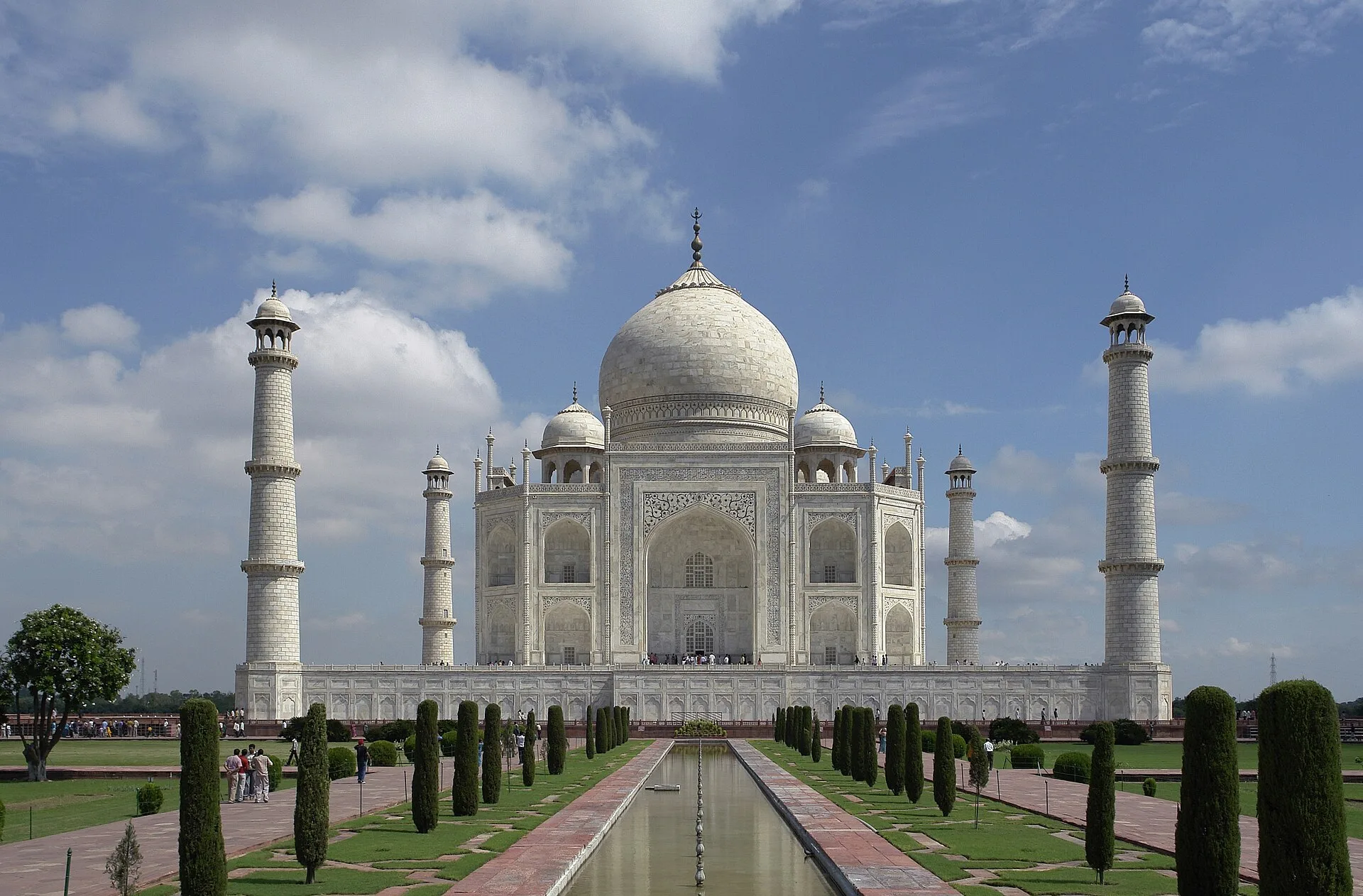
In 1992, a photograph of Diana, Princess of Wales, sitting alone on a marble bench in front of the Taj Mahal travelled around the world — and the bench is still there, halfway down the garden, beside the raised tank where the reflecting pool begins. What the photograph never showed is the queue: on a busy morning, visitors wait their turn for that same bench, and the marble changes colour while they wait. The Taj has no colour of its own. Its Makrana marble is slightly translucent, so it takes the colour of the sky — gold at dawn, white at noon, pink at dusk, silver under a full moon. That is why the hour you choose matters more than almost anything else about your visit, and why this guide starts with timings and tickets rather than history.
Taj Mahal at a Glance
| Where | Agra, Uttar Pradesh, on the south bank of the Yamuna River — about 230 km south-east of Delhi |
| Open | 30 minutes before sunrise to 30 minutes before sunset, Saturday to Thursday |
| Closed | Every Friday, for general viewing — the mosque inside is used for prayers |
| Entry (foreign) | ₹1,100, plus ₹200 extra to enter the main mausoleum |
| Entry (Indian / OCI) | ₹50, plus ₹200 extra for the main mausoleum; children under 15 free |
| Time needed | 2–3 hours inside; a full day with Agra Fort |
| Best months | October to March — cool, clear mornings; expect fog in December and January |
| Managed by | Archaeological Survey of India (ASI); official site tajmahal.gov.in |
1. Taj Mahal History in Brief: A Tomb Built for Love
The Taj Mahal is a tomb. The Mughal emperor Shah Jahan built it for his wife Mumtaz Mahal, who died in 1631 while giving birth to their fourteenth child. Work began on the banks of the Yamuna in 1632. The main mausoleum was complete by 1648, and the mosque, guest house, great gateway and gardens around it were finished by 1653 — a building project of about twenty years, carried out, by the usual account, by some 20,000 artisans under a board of architects led by the court architect Ustad Ahmad Lahori, whom UNESCO names as the main architect.
Shah Jahan himself is buried there too, beside his wife — his cenotaph sits off-centre in the chamber, the only asymmetrical note in a building otherwise obsessed with symmetry. He spent his last years imprisoned by his son Aurangzeb in Agra Fort, two kilometres upriver, in a tower with a view across the water to the tomb he had built. The Taj became a UNESCO World Heritage Site in 1983 — UNESCO calls it the jewel of Muslim art in India and one of the universally admired masterpieces of the world's heritage.
What you are walking through is a 17-hectare complex, not a single building: the white marble mausoleum at the far end, a charbagh garden of four quadrants with water channels, the red sandstone great gateway you enter through, a mosque on one side of the mausoleum and a mirror-image guest house on the other. The marble came from Makrana in Rajasthan; the inlay work — flowers and calligraphy in semi-precious stone set into the marble, known as pietra dura or parchin kari — is the detail to look for once the first gasp at the dome wears off.
2. Taj Mahal Timings: Opening Hours & the Friday Closure
The Taj Mahal has no fixed clock hours. The Archaeological Survey of India opens it 30 minutes before sunrise and closes it 30 minutes before sunset on normal operating days, so the times move through the year with the sun. In practice that means roughly 6:00–6:30 AM opening in winter and around 5:00 AM in summer, with closing around 5:00 PM in December and 6:30–6:45 PM in June. Check the sunrise time for your date before you set an alarm — the official site states the rule, not a timetable.
The ticket counters at the West and East Gates open earlier and close earlier than the monument itself: one hour before sunrise until 45 minutes before sunset. If you arrive at closing time without a ticket, you will not get in — buy online the day before, or arrive with time to spare.
Public holidays do not close the Taj — it is open on every day except Friday. Very occasionally the ASI closes it at short notice for a VIP visit; check the official site the evening before.
3. Taj Mahal Ticket Price 2026: What Entry Costs
Ticket prices are set by the ASI and the Agra Development Authority, and the figures below are taken from the official Taj Mahal website, tajmahal.gov.in, checked on 15 November 2026. They include both the ASI fee and the Agra Development Authority charge. Prices change from time to time, so re-check the official site before you travel rather than trusting any guide, including this one.
| Visitor | Complex entry | Main mausoleum (optional) | Total with mausoleum |
|---|---|---|---|
| Foreign tourists | ₹1,100 | + ₹200 | ₹1,300 |
| SAARC & BIMSTEC citizens | ₹540 | + ₹200 | ₹740 |
| Indian citizens & OCI cardholders | ₹50 | + ₹200 | ₹250 |
| Children under 15 (all nationalities) | Free | Free | Free |
Book online and you pay less: tickets bought online get a discount of ₹50 per foreign ticket and ₹5 per Indian ticket. Book through the official channels linked from tajmahal.gov.in — the ASI ticketing portals asiagracircle.in and asi.payumoney.com. Buying online also lets you skip the counter queue, the longest wait of the morning in peak season. Do not buy from touts or look-alike websites: the official site is a .gov.in address.
Is the ₹200 mausoleum ticket worth it? On a first visit, yes. The base ticket covers the gardens, the platform, the gateway and every outside view — but only the add-on gets you inside the chamber, where the cenotaphs of Mumtaz Mahal and Shah Jahan stand behind a pierced marble screen so finely carved it looks like lace. You cannot photograph inside, and you will spend perhaps ten minutes there, but the hush and the inlay work are worth it. The real graves lie in a sealed lower chamber closed to visitors — the cenotaphs upstairs are symbolic.
What the foreign ticket includes: shoe covers, a water bottle, a tourist map of Agra, and the battery bus and golf cart services are free with the foreign visitor's ticket, and shoe racks below the mausoleum are free. Carry government-issued photo ID — it is sometimes checked at the gate. Your ticket states how long you may stay inside — check the time printed on it when you buy, and plan on two to three hours.
4. Taj Mahal Gates: East, West & South — Which to Use
There are three gates, and only two of them let you in. The official site is plain about it: the South Gate is exit-only at present — no entry from it. Plan around the East and West Gates.
- West Gate — the main gate for most visitors, near the old city and the Agra Cantt side. Ticket counter near Saheli Burj. This is the busiest gate at sunrise, and the one most day-trippers from Delhi are dropped at. If your hotel is in Tajganj or near the old city, this is your gate.
- East Gate — the quieter choice, near Shilpgram and the main parking area, where tour buses and the battery buses run. If you are coming by car or with a driver, this is usually the easier gate: park, take the battery bus or walk, and join a shorter queue. Night viewing also enters from the East Gate side.
- South Gate — exit only. Do not plan to enter here; you will be turned away.
There are separate queues for foreign and domestic tourists, with signs directing you — follow them, because the foreign queue is usually much shorter. Security is airport-style: bags are scanned, and the prohibited list is enforced (see section 8). Cloakrooms are available at both gates.
The complex is a long walk from either gate to the mausoleum — roughly a kilometre from the West Gate. The free battery bus (included with the foreign ticket) runs from the gates to the platform area; use it when it is hot.
5. Sunrise vs Sunset at the Taj Mahal — and the Best Time of Year
Sunrise wins, and it is not close. The gates open 30 minutes before sunrise, and the first hour is the best of the day for three reasons: the light, the crowds and the heat. At dawn the marble turns gold, the water in the long channels is usually still before the breeze picks up, and the reflection is at its sharpest. The crowds that arrive by 9 AM are still in Agra or on the expressway. And in every month except deep winter, the air is cooler at 6 AM than at any other hour you could visit.
Sunset is the second-best light, but the monument closes 30 minutes before sunset, so you watch the light change while walking to the exit, and the afternoon crowds are at their thickest. For sunset, go across the river instead: Mehtab Bagh, the moonlight garden on the far bank of the Yamuna, looks straight at the Taj's river face. Entry is ₹25 for Indians and ₹300 for foreign visitors (official ASI table, November 2026).
Best time of year to visit the Taj Mahal
- October to March is the season: dry, clear and cool enough to enjoy a long morning outside. This is also peak season — book tickets and trains early, and expect the biggest crowds from late December into January.
- December and January bring dense fog on many mornings, which can hide the Taj entirely until 9 or 10 AM. Keep a second morning free if you can.
- April to June is brutally hot, with Agra regularly above 40°C. Only the first two hours after opening are comfortable — come at sunrise and leave by 10 AM.
- July to September is the monsoon: fewer visitors and green gardens, with the chance of a heavy shower.
6. Taj Mahal Night Viewing: the Full-Moon Rules
Five nights a month, the Taj opens after dark. Night viewing runs on the night of the full moon and the two nights before and after it — five nights in all — except on Fridays, and not at all during the month of Ramzan. The ASI fixes its own full-moon dates, and they do not always match a moon app: for December 2026 the apps say the 24th and the ASI says the 23rd, so go by the ASI's dates, which are published on the official Taj site.
Only 400 visitors a night are admitted, in eight batches of 50, each batch getting 30 minutes inside. The two official sources disagree about the clock: the official Taj Mahal site says 8:00 PM to midnight, while the ASI Agra Circle site says 8:30 PM to 12:30 AM. Your ticket shows your batch time, and that is the time that counts — report half an hour before it at Shilpgram, near the East Gate, for the security check, and enter through the East Gate.
Night viewing tickets cost ₹510 for Indian adults, ₹750 for foreign adults and ₹500 for children (3–15), per the ASI's prices as of October 2026 — confirm the current figure on the booking site before you plan around it. Booking opens seven days before each night on the ASI ticketing site, where night viewing is listed as a monument of its own; tickets were also sold a day in advance at the ASI office at 22 Mall Road, Agra. There are no walk-up night tickets, and there is no refund if fog, cloud or rain spoils the view — the ASI says so in writing, down to the "non-visibility of the moon".
What you see is different from a day visit: you view the monument from a raised platform at the great gateway end, and the mausoleum itself is not open at night. No cameras except mobile phones (no flash), no tripods, no food or drink. A quiet, silver-lit half hour — worth it if the moon cooperates, and a gamble if it does not.
7. Inside the Taj Mahal: the Walk from the Great Gate to the Tombs
The visit is designed as a sequence. You pass through the great gateway — the red sandstone Darwaza-i Rauza, about 30 metres high — and the Taj appears framed in its arch, at the far end of the reflecting pool. The gateway was built so that the mausoleum appears exactly the same height as the arch when you stand at the threshold. Take the photograph, then put the camera down and walk.
The garden is a charbagh, a four-quadrant Mughal garden with water channels along both axes and cypress trees at the quadrant boundaries. The long central channel runs to a raised marble tank halfway along — this is where the famous reflection photograph is taken, and where the Diana bench stands. Go early or late for the bench; in the middle of the morning there is a queue for it.
At the far end, the mausoleum sits on a raised marble platform with four minarets at its corners, leaning very slightly outwards — deliberately, so that if one ever fell it would fall away from the tomb. Climb the platform, leave your shoes at the free racks (or wear the shoe covers that come with the ticket), and go inside if you hold the mausoleum ticket. The chamber is dim and quiet: an octagonal hall, the two cenotaphs inside a pierced marble screen, Mumtaz Mahal's at the exact centre and Shah Jahan's beside it. No photographs inside, and keep your voice low — the dome answers a hum. Ten minutes is enough; linger on the platform instead, where the river side gives the view Shah Jahan had from his prison tower. Only the mosque on the west side is a working mosque; the guest house on the east is its mirror, built for symmetry.
8. Taj Mahal Photography Rules & What You Cannot Carry In
Photography is free across the gardens, the exterior and the platform with a still camera — the official rules are generous outside. Inside the main mausoleum, photography is prohibited, and it is enforced. Tripods and drones are banned throughout: drones are strictly prohibited inside and around the monument, and tripods sit on the ASI's prohibited list — treat a tripod as banned unless you have arranged written ASI permission in advance. Commercial filming needs a separate licence.
The ASI's prohibited list also covers arms and ammunition, fire and smoking items, tobacco, liquor, eatables and food, headphones, knives, wire, mobile chargers and electrical goods other than a camera, and large bags. A water bottle is explicitly allowed. Travel light: passport or ID, phone or small camera, a bottle of water, and a light shawl in winter. Everything else — food, chargers, big backpacks, selfie sticks with tripod legs — will cost you time at the security check, and there are cloakrooms at both gates for what you cannot carry in.
For photographs: the reflection is sharpest at dawn before the breeze; the Diana bench works best early or late; and the platform's river side gives the least-photographed angle. Do not climb on anything for a photograph, and ask before photographing people at prayer in the mosque.
9. How to Avoid the Crowds at the Taj Mahal
The Taj is India's most visited monument, and the crowds are the one thing every visitor complains about — and the one thing most in your control. The rules are simple, and they all point the same way:
- Enter at opening time. Be at the gate 30 minutes before sunrise, ticket already bought online. The first hour is a different monument from the third.
- Go on a weekday. Saturday and Sunday are the busiest days, and Indian public holidays and school-holiday weeks (late December, May–June) are the worst of all. Tuesday to Thursday mornings are the quietest.
- Use the East Gate. The West Gate takes the tour buses and the day-trippers; the East Gate queue is usually shorter.
- Book online. The counter queue is a separate wait from the security queue, and in peak season it is the longer of the two.
- Skip the middle of the day. Between 11 AM and 3 PM the light is flat, the marble glares, and the groups are at their largest. If you are staying overnight, see the Taj at dawn, rest through midday, and spend the afternoon at the fort.
- Travel in the shoulder months. October–November and February–March give you the season's weather with fewer visitors than the December–January peak.
10. How to Reach the Taj Mahal from Delhi — and from Agra
Agra is about 230 km south-east of Delhi by road, and almost every visitor arrives from the capital. There are two good ways to do it, and the choice depends on whether you want sunrise or a relaxed day.
By train: the fastest way
The Gatimaan Express is the classic day-trip train: it leaves Hazrat Nizamuddin station in Delhi at 08:10 and reaches Agra Cantt at 09:50 — 1 hour 40 minutes — with an evening return reaching Delhi around 19:30. It does not run on Fridays. Vande Bharat and Shatabdi services take roughly two hours, and the early Bhopal Shatabdi leaves New Delhi at 06:00, arriving Agra just after 08:00. Book on IRCTC (irctc.co.in) well ahead: the morning trains sell out in peak season. Note the station — Gatimaan leaves from Hazrat Nizamuddin, not New Delhi station — so allow 45–60 minutes to cross Delhi in morning traffic.
The catch with the train is the hour: no morning train from Delhi gets you to the Taj at sunrise. If sunrise is the point of your trip — and it should be — you need to be in Agra the night before. Stay in Tajganj or near the East Gate, and walk to the gate in the dark.
By car: the flexible way
By road, the Yamuna Expressway runs from Greater Noida to Agra — about 230 km from central Delhi, roughly 3 to 3.5 hours depending on Delhi traffic. A private car with a driver is the normal way to do it, and the only way to reach the Taj for sunrise from Delhi: leave at 2:30–3:00 AM. A car also lets you add Fatehpur Sikri on the way back, which the train timetable does not allow. Agree the price, tolls and waiting time before you leave, and use a hotel-arranged car rather than a tout at the station.
From Agra station to the Taj
Agra Cantt is about 6 km from the Taj. Auto-rickshaws and app cabs cover the run in 20–30 minutes; agree the fare first, and expect to be dropped at a parking area from where the battery bus or a short walk completes the journey — private vehicles are kept away from the gates. If you arrive by train in the morning, go straight to the Taj: the light and the crowds only get worse from here.
11. Near the Taj Mahal: Agra Fort, Fatehpur Sikri, Sikandra & More
The Taj is the reason to come to Agra, but it is not the whole of Agra. Three of India's great Mughal sites sit within an hour of it, and the ticket table below is from the same official ASI page as the Taj prices, checked 15 November 2026. Children under 15 enter free at all of them. Note the pattern in the table: the foreign fee drops slightly on Fridays and after a same-day Taj visit, because the Agra Development Authority toll bundled into your first ticket of the day covers the others.
| Monument | Indian | Foreign | Closed | Allow |
|---|---|---|---|---|
| Agra Fort | ₹50 (₹40 Fri) | ₹650 (₹600 Fri / after Taj) | Open daily | 2–3 hours |
| Fatehpur Sikri | ₹50 (₹40 Fri) | ₹610 (₹600 Fri / after Taj) | Open daily | Half a day |
| Akbar's Tomb, Sikandra | ₹30 (₹25 Fri) | ₹310 (₹300 Fri / after Taj) | Open daily | 1 hour |
| Itimad-ud-Daulah | ₹30 (₹25 Fri) | ₹310 (₹300 Fri / after Taj) | Open daily | 1 hour |
| Mehtab Bagh | ₹25 | ₹300 | Open daily | 1 hour, at sunset |
Agra Fort — the other half of the story
Two kilometres upriver, this red sandstone walled city of palaces, audience halls and gardens is where the Taj's story ends: Shah Jahan was held here by his son Aurangzeb for his last eight years, in the Musamman Burj tower with a view across the Yamuna to the tomb he built. Enter at the Amar Singh Gate and allow two to three hours. It is open daily, including Fridays — the right plan for a Friday in Agra. See our full Agra guide.
Fatehpur Sikri — the abandoned capital
About 40 km west of Agra, this is the city the emperor Akbar built entirely from red sandstone and then abandoned within a couple of decades, most likely over water supply. The Buland Darwaza, its victory gateway, is among the tallest of its kind anywhere, and the whole city is a UNESCO World Heritage Site (1986). It needs half a day with travel — go in the morning, and take the shuttle bus from the car park to the monuments.
Sikandra, Itimad-ud-Daulah & Mehtab Bagh
Akbar's Tomb at Sikandra, on Agra's north-west edge on the Delhi road, is the most underrated stop in the city: a sandstone-and-marble mausoleum blending Hindu, Islamic, Jain and Christian motifs, with deer in its gardens and a fraction of the Taj's crowds. Itimad-ud-Daulah, the jewel-box tomb Nur Jahan built for her father, is often called the Baby Taj — visibly the model for the Taj's pietra dura inlay, on a scale you can study up close. Mehtab Bagh, the moonlight garden across the Yamuna, is where to be at sunset.
12. What to Skip at the Taj Mahal
- A Friday visit. The Taj is closed; no ticket, guide or tour can get you in. Spend Friday at Agra Fort instead.
- Tickets from touts. Anyone at the station, the car park or the gate offering tickets, "VIP entry" or a shortcut is selling you something the official counters sell cheaper — or selling you nothing at all. Book on the ASI portals or buy at the gate counters.
- Marble-shop pressure. Agra's marble inlay workshops are a genuine craft, but the "free" tour that ends in a high-pressure sales room is a well-worn routine. If you want to buy, go to a shop you chose yourself, after the Taj, and bargain hard.
- An unlicensed guide. Licensed ASI guides wear identification; the self-appointed guide who attaches himself to you at the gate is not one. If you want a guide, book one through your hotel.
13. Practical Checklist: What to Carry & Know Before You Go
- Book tickets online the day before on the ASI portals linked from tajmahal.gov.in — cheaper, and no counter queue.
- Carry government photo ID and keep your ticket until you leave.
- Travel light: ID, phone or small camera, water bottle, light shawl in winter. No food, tripods, drones, chargers or large bags.
- Wear shoes you can slip off easily — you remove them (or wear shoe covers) on the mausoleum platform.
- Dress modestly. The Taj is a tomb and a working mosque; shoulders and knees covered is the respectful choice, and women may want a scarf for the mosque area.
- Emergency number: 112. The ASI Agra office can be reached on +91 562 2226431 (10 AM–5 PM, excluding Sundays and declared holidays).
Last verified 15 November 2026 — ticket prices, timings and night-viewing rules are set by the Archaeological Survey of India and change from time to time. Always re-check tajmahal.gov.in before you travel, and treat any price in an older guide as out of date until confirmed there.
Frequently Asked Questions
How much is the Taj Mahal ticket price?
Foreign tourists pay ₹1,100 for complex entry, plus ₹200 extra to enter the main mausoleum (₹1,300 in total). Citizens of SAARC and BIMSTEC countries pay ₹540 plus ₹200, and Indian citizens and OCI cardholders pay ₹50 plus ₹200. Children under 15 enter free, and booking online saves ₹50 per foreign ticket and ₹5 per Indian ticket. Prices from tajmahal.gov.in, checked 15 November 2026.
What are the Taj Mahal timings?
The Taj Mahal opens 30 minutes before sunrise and closes 30 minutes before sunset, every day except Friday — roughly 6:00–6:30 AM opening in winter and around 5:00 AM in summer. Ticket counters at the East and West Gates open one hour before sunrise and close 45 minutes before sunset.
Is the Taj Mahal closed on Friday?
Yes. The Taj Mahal is closed to general visitors every Friday, all day, because the mosque inside the complex is used for Friday prayers. There are no exceptions and no Friday tickets. Agra Fort, Fatehpur Sikri and the other Agra monuments stay open on Fridays.
Which gate should I enter the Taj Mahal from?
Use the East Gate or the West Gate. The West Gate, near the old city, is the busiest — most day-trippers arrive there. The East Gate, near Shilpgram and the main parking area, usually has a shorter queue and is the better choice if you come by car. The South Gate is exit-only and does not admit visitors. There are separate, signed queues for foreign and domestic tourists.
Can I see the Taj Mahal at night?
Yes, on five nights a month: the full-moon night and the two nights before and after it, except on Fridays and during Ramzan. Only 400 visitors a night are admitted, in eight batches of 50 for 30 minutes each. The official Taj site gives the hours as 8:00 PM to midnight and the ASI site as 8:30 PM to 12:30 AM — your ticket shows your batch time. Night tickets cost ₹510 for Indian adults, ₹750 for foreign adults and ₹500 for children (3–15), per ASI prices as of October 2026; book ahead, as there are no walk-up night tickets and no refund if cloud hides the moon.
Is sunrise or sunset better at the Taj Mahal?
Sunrise is better. The gates open 30 minutes before sunrise, the marble turns gold, the reflecting pool is at its stillest, and the crowds are thinnest. The monument closes 30 minutes before sunset, so sunset is watched while walking to the exit. For sunset light, go to Mehtab Bagh across the Yamuna instead — it looks straight at the Taj's river face.
Can I take photos inside the Taj Mahal?
Photography is allowed in the gardens, on the exterior and on the platform, but not inside the main mausoleum chamber. Tripods and drones are banned throughout the complex, and drones are strictly prohibited inside and around the monument. Food, tobacco, headphones, mobile chargers and large bags are also on the ASI's prohibited list; a water bottle is allowed.
How do I reach the Taj Mahal from Delhi?
By train, the Gatimaan Express leaves Hazrat Nizamuddin at 08:10 and reaches Agra Cantt in 1 hour 40 minutes, with an evening return — it does not run on Fridays. Vande Bharat and Shatabdi take roughly two hours. By car, the Yamuna Expressway is about 230 km and takes 3 to 3.5 hours. No morning train from Delhi arrives in time for sunrise, so stay in Agra the night before if sunrise is the point of your trip.
How much time do I need at the Taj Mahal?
Allow 2 to 3 hours inside the complex: the gateway and gardens, the platform, and the mausoleum chamber if you hold the ₹200 add-on ticket. With Agra Fort the same day, plan a full day; with Fatehpur Sikri as well, plan two days in Agra.
What is the best time of year to visit the Taj Mahal?
October to March is the season — dry, clear and cool. December and January bring dense fog on many mornings, which can hide the Taj until late morning. April to June is brutally hot, regularly above 40°C, and only the first two hours after opening are comfortable. July to September is the monsoon: fewer visitors and the chance of heavy rain.
Do I need to book Taj Mahal tickets online?
It is strongly recommended. Booking through the official ASI portals linked from tajmahal.gov.in (asiagracircle.in and asi.payumoney.com) saves ₹50 per foreign ticket and ₹5 per Indian ticket, and lets you skip the counter queue. Never buy from touts or look-alike websites — the official site is a .gov.in address.
Is the main mausoleum ticket worth the extra ₹200?
On a first visit, yes. The base ticket covers the gardens, the platform and every outside view, but only the ₹200 add-on gets you inside the chamber, where the cenotaphs of Mumtaz Mahal and Shah Jahan stand behind a pierced marble screen. You cannot photograph inside and you will spend about ten minutes there, but the inlay work and the hush are worth it. The real graves lie in a sealed lower chamber closed to visitors.
Every Place. Every Flavour.
The Taj is the beginning of the Golden Triangle, not the end of it — Delhi's tombs and bazaars behind you, Jaipur's forts ahead. Beauty of Bharat covers all 36 states and union territories: 550+ destinations, offbeat places and regional dishes, each with its own full guide.
Read the full Agra guide Read the blog