
West Bengal · Trek Guide
Sandakphu Trek Guide: West Bengal’s Highest Peak and the Sleeping Buddha

By Beauty of Bharat — India travel guide, every place, every flavour.
Guides covering all 36 States and UTs, researched from official sources and checked at publish time. Corrections welcome — see About Beauty of Bharat.
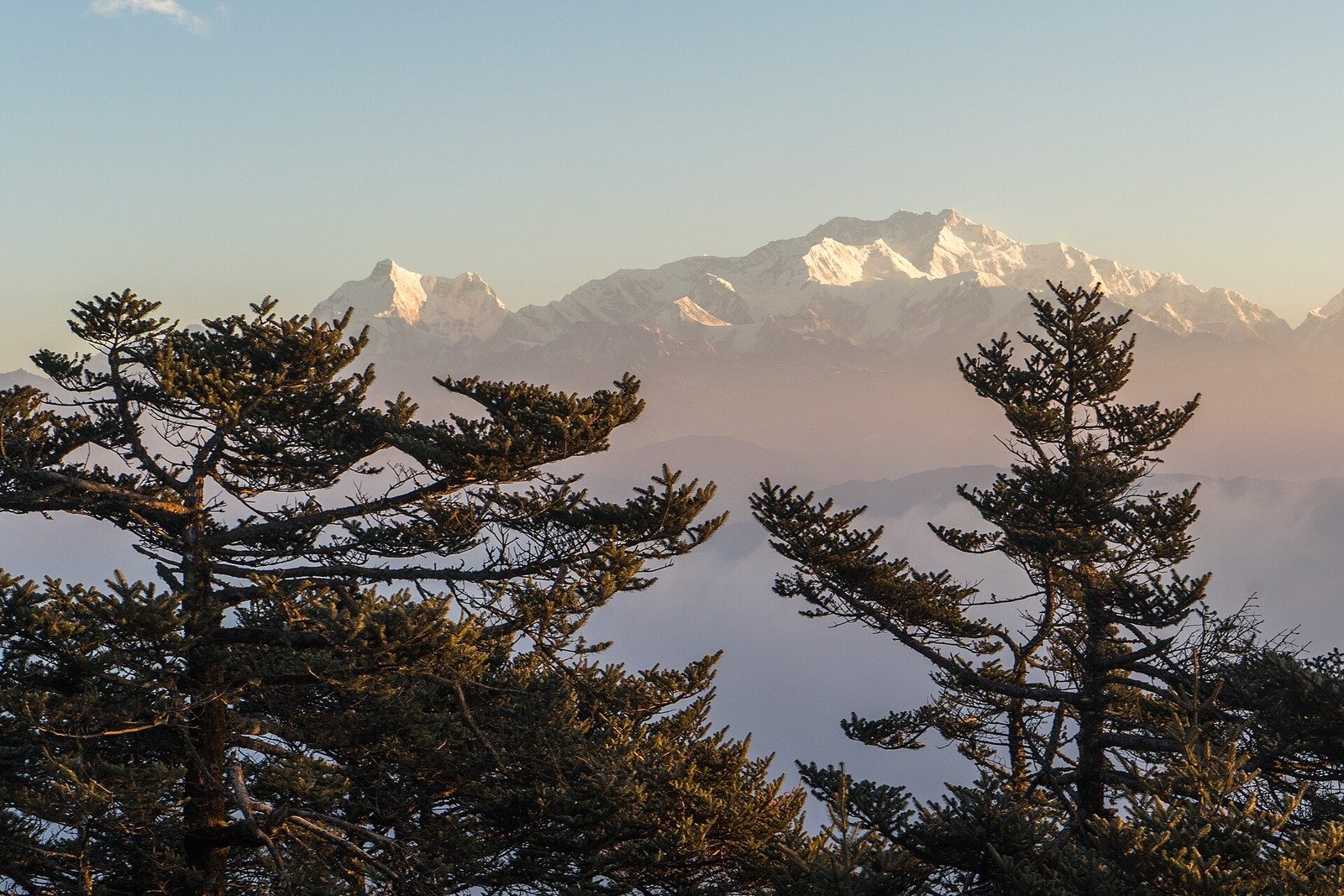
Stand on Sandakphu at dawn on a clear morning and four of the five highest mountains on Earth are in front of you at once — Everest, Kanchenjunga, Lhotse and Makalu. And the mountain that fills most of the sky is not Everest. It is Kanchenjunga, whose connected summits form the Sleeping Buddha, a reclining figure stretched across the horizon. That is the short answer to why people walk this ridge: Sandakphu, at 3,636 metres, is the highest point in West Bengal, on the Singalila Ridge along the India–Nepal border, and it is the one place in India where those four giants share a single skyline. The walk takes three days from Manebhanjan, via Tumling and Kalipokhri, or half a day in a vintage Land Rover; the clearest views come from October to December.
There is a second surprise waiting on the way up, and it gives the trek its strangest nickname. Sandakphu is also known as the land of poisonous flowers, and the last climb to the summit passes Bikheybhanjan, the poison col, named for the aconite — bikh — that grows there. The flowers are beautiful, and you should not pick them. It is a fitting final gate: a gentle, lodge-to-lodge trail through rhododendron forest that ends at the roof of West Bengal, in a national park where red pandas live and the border between two countries runs along the path under your feet.
| Fact | Detail | Note |
| Summit | Sandakphu, 3,636 m (11,929 ft) — highest point in West Bengal | On the Singalila Ridge |
| Route | Manebhanjan → Tumling → Kalipokhri → Sandakphu (about 32 km on foot) | Singalila Ridge, India–Nepal border |
| Days | 3 days up on foot; 6–7 days with Phalut and the Srikhola descent; 2–3 days by Land Rover | Inside Singalila National Park |
| Best months | October–November for the clearest views; March–May for rhododendrons | Park closed 16 June–15 September |
| Peaks in view | Everest, Kanchenjunga, Lhotse, Makalu — four of the world’s five highest | Sunrise is the moment to be up |
Fees, fares and guide rates change often and sources disagree on the exact figures — the ranges in this guide are as reported in 2026, and you should confirm them at the Manebhanjan desk before you travel. Snow is possible in winter, never guaranteed.
Sandakphu Trek Route: Manebhanjan to Sandakphu in Three Days
The classic Sandakphu trek route starts at Manebhanjan, a small town about 28 km from Darjeeling at 1,928 metres, and follows the Singalila Ridge north, crossing in and out of Nepal as the trail winds along the border. The route is a lodge trek: you sleep in tea houses and trekkers’ huts, eat dal-bhat at the end of each day, and carry only a day pack. A registered guide is compulsory inside Singalila National Park, beyond Tumling, so hire one at Manebhanjan or come with an operator.
Day 1: Manebhanjan to Tumling, about 11 km, 6–7 hours. The steepest day, climbing roughly 1,000 metres through forest past Chitre and Meghma. Tumling sits at about 2,900 metres, and on a clear evening Kanchenjunga is already in view. Some walkers stop a little earlier at Tonglu, at 3,070 metres. If you start instead from Dhotrey, at 2,591 metres, the first day is shorter.
Day 2: Tumling to Kalipokhri, about 14–15 km, 6–7 hours. The trail dips to Gairibas and climbs again through rhododendron and bamboo forest to Kalipokhri — the black lake — at about 3,171 metres. This is the long day, and the one where the ridge starts to feel high: the villages thin out, the forest closes in, and the park gate, about a kilometre past Tumling, is where your permit is checked.
Day 3: Kalipokhri to Sandakphu, about 6 km, 3–4 hours. The short, steep finish past Bikheybhanjan, the poison col, to the summit at 3,636 metres. Arrive by afternoon, rest, and be up before dawn: the panorama is at its best at sunrise, when the light turns the icefields from indigo to gold and the Sleeping Buddha — Kanchenjunga, Jannu and Pandim — stands out against the sky, with Everest, Lhotse and Makalu to the west.
The descent is your choice. Retrace the route to Manebhanjan in two days, or drop steeply from Sandakphu through Gurdum to Srikhola on the river, then drive out via Rimbick. Strong walkers finish the whole Manebhanjan–Srikhola crossing in five to six days. For the wider West Bengal picture, see our best places to visit in West Bengal and our Darjeeling guide.
How to Reach Sandakphu
Every Sandakphu journey funnels through Manebhanjan, and the question is how you get there — and whether you walk or ride the last 32 km. Fly into Bagdogra, the nearest airport, or take a train to New Jalpaiguri (NJP), the region’s railhead. From NJP a shared jeep or cab covers the roughly 85 km to Manebhanjan via Mirik in about three and a half to four hours. From Darjeeling it is a much shorter hop, about 28 km and one to one and a half hours by shared jeep. Your own car stops at Manebhanjan: beyond it, only four-wheel-drive Land Rovers are allowed on the rough ridge road.
The choice that shapes the trip is the Land Rover or your own feet. The vintage 1950s Land Rovers of the Singalila Land Rover Owners’ Association climb the same ridge in about four to five hours, and a round trip with one night at Sandakphu is reported at roughly ₹5,500–7,500 per vehicle, shared between up to six passengers — confirm the current fare at the Manebhanjan stand, as rates move. No Land Rover leaves after about 2 pm, so arrive early. Walking takes three days up and gives you the forest, the villages and the slow acclimatisation; riding gives you the summit in an afternoon but takes you from about 2,000 metres to 3,636 metres in a single day, so take the altitude seriously and talk to your doctor first if you have heart or lung trouble. Many travellers split the difference: walk up, ride down.
Whichever way you go, the paperwork happens at Manebhanjan. A Singalila National Park permit is issued at the Forest Department office there and at the park gate past Tumling — carry original photo ID, and a passport and visa if you are a foreign national. The entry fee is reported at roughly ₹120–200 per person per day for Indian nationals and ₹500 for foreign nationals, with the rate revised in 2026 after a suspension — confirm it at the desk, because sources disagree. A guide is compulsory inside the park; guide charges are reported at roughly ₹1,000–1,500 a day per group. Remember the park closes every year from 16 June to 15 September for the monsoon: nothing else in this guide matters if the park is shut.
Best Time to Visit Sandakphu
October and November are the months to aim for. The monsoon has washed the dust out of the air, the skies are at their clearest, and Everest, Kanchenjunga, Lhotse and Makalu stand out in a single frame. December to February is colder and often just as clear, with snow possible on the ridge — a white Sandakphu is a real sight, but it is never guaranteed, and winter nights drop well below freezing, so bring proper cold-weather gear and expect the Sandakphu–Phalut stretch to be hard in snow. March to May is rhododendron season, when the forests turn red in late April and May, though the peaks sit in more haze than in autumn. Mid-June to mid-September is closed: heavy rain, landslides and no views. If you are planning around the wider winter season, see our best places to visit in India in December and our best winter places in India for snow.
One timing note matters more than the month: the view is a morning event, and clouds build over the ridge through the day. Sleep at Sandakphu the night before, and keep a spare day in hand — a single cloudy dawn can hide the whole range, and a second morning doubles your odds.
Sandakphu Trek Cost: What to Budget
Sandakphu is one of the cheapest high Himalayan treks in India, because it is a lodge trek: you pay for a bed and a plate of dal-bhat, not for tents, cooks or mules. As a rough guide from 2026 operator and trekker reports, a self-organised walker sharing a guide with a friend spends about ₹2,000–2,500 a day, and a full Manebhanjan-to-Srikhola trek of six to seven days usually comes to roughly ₹12,000–17,000 per person from Darjeeling — less in a bigger group, more travelling solo, since the guide fee is charged per group, not per person. Organised packages are advertised from around ₹9,000–12,000 per person for the standard trek, excluding travel to NJP or Bagdogra. These are indicative figures for 2025–26, not prices: fees, fares and lodge rates are revised often, so treat every number here as a range to confirm before you book.
The Land Rover is the biggest single cost. Six friends splitting a vehicle pay roughly ₹1,100–1,500 each for the ride; two people hiring the same vehicle pay more than twice that each. Sleep in dorms or shared rooms, eat what the lodge cooks, and share the compulsory guide. Book lodges ahead in October and around the Puja holidays — the small tea houses fill up — and carry cash, because there are no ATMs or card machines on the ridge.
Sandakphu or Phalut: Should You Keep Walking?
Phalut, at 3,600 metres, is the ridge’s second summit and the northernmost point of West Bengal, about 21 km beyond Sandakphu along an empty ridge with no villages in between. The walk takes seven to ten hours via Sabarkum, and it is the finest stretch of the whole trek for walkers who want the ridge to themselves — but it is also the hardest day, and in winter snow it can be genuinely difficult. You can split it with a night at Moley. From Phalut the trail drops through forest to Gorkhey and down to Srikhola, a five-to-six-day walk all told from Manebhanjan.
Our advice: if you have the days, keep walking. Sandakphu gives you the panorama; Phalut gives you the ridge walk itself. If you are short on time or travelling with children, stop at Sandakphu and ride back — you will have seen the four peaks, and that is the point of the trip.
Watch & Feel the Place: Sandakphu on Film
Videos are by their respective creators.
Sandakphu FAQs
How many days does the Sandakphu trek take?
Three days on foot from Manebhanjan to Sandakphu, via Tumling and Kalipokhri. Allow five to six days for the full crossing to Srikhola, and six to seven days if you add Phalut. A Land Rover trip can be done in two to three days, with one night at Sandakphu.
What is the best time to visit Sandakphu?
October and November, for the clearest skies and the sharpest views of Everest, Kanchenjunga, Lhotse and Makalu. March to May brings rhododendron blooms but more haze. December to February is cold with snow possible on the ridge. The park is closed from 16 June to 15 September.
How much does the Sandakphu trek cost?
As a rough 2026 guide, about ₹2,000–2,500 a day for a self-organised walker sharing a guide, or roughly ₹12,000–17,000 per person for a six-to-seven-day trek from Darjeeling. Organised packages are advertised from around ₹9,000–12,000 per person. Confirm all rates before you book — they change often.
How do I reach Sandakphu from Darjeeling?
Take a shared jeep about 28 km from Darjeeling to Manebhanjan, in one to one and a half hours. From Manebhanjan, either trek three days up the Singalila Ridge with a registered guide, or hire a vintage Land Rover for the 32 km ridge road, about four to five hours. Pay the Singalila National Park fee at the checkpost.
Is the Sandakphu trek difficult?
It is rated easy to moderate — one of the gentler Himalayan viewpoint treks, with lodge stays every night and tea houses along the way. The hard parts are the first day’s roughly 1,000-metre climb out of Manebhanjan and the long 21 km Sandakphu–Phalut day. The altitude is the real challenge: you sleep at 3,636 metres, so walk up rather than driving up in a day if you can.
Sandakphu asks very little of you — three days of walking, a guide, a permit — and gives back the one view in India where four of the world’s five highest mountains stand in a single skyline. Go in October or November, sleep on the summit, and be awake before the sun. Next, read our Darjeeling guide, our best places to visit in West Bengal and our best places to visit in Sikkim.
Plan your Sandakphu trek
West Bengal’s highest peak, four of the world’s five highest mountains, and a ridge walk along the Nepal border.
West Bengal state guide →