
Rajasthan · Pushkar Camel Fair 2026
Pushkar Animal Fair: Camels, Horses & Cattle at Pushkar Camel Fair 2026
By Beauty of Bharat — India travel guide, every place, every flavour.
Guides covering all 36 States and UTs, researched from official sources and checked at publish time. Corrections welcome — see About Beauty of Bharat.

At the world’s most famous camel fair, the horses now outnumber the camels. At the 2025 fair, 3,028 horses were registered against 1,306 camels, according to The Tribune, quoted in a photo guide to the mela. It tells you what the Pushkar animal fair really is: a working livestock market that happens to be spectacular to watch.
The animal mela is the fair’s working heart. Long before the cultural programme opens, herders walk their animals in from across the desert and pitch camp on the dunes outside Pushkar town. They groom, decorate, bargain and sell — and by the time the tourist crowds peak, many have already sold their animals and set off home. Come on the wrong days and you will see the festival but miss the market.
This guide is about the livestock side of Pushkar Camel Fair 2026: the camels, the horses, the cattle, how a deal is done, and when to be there. For the full week, see our Pushkar Fair visitor guide and the Pushkar Camel Fair festival page.
| Official fair | 17–24 November 2026 (Tuesday to Tuesday), closing on Kartik Purnima, 24 November |
| Trading window | Herders arrive from about 10 November; trading peaks 17–20 November, in the early mornings |
| Animals traded | Camels, Marwari and Sindhi horses, cattle, buffalo, sheep and goats |
| Where | Pushkar Mela Ground, on the dunes outside Pushkar town, toward the Savitri Mata temple |
| Entry | Free — there is no ticket for the fairgrounds |
| Best days for the animals | 17–20 November, before sunrise; the herds thin out in the final days |
Pushkar Camel Fair 2026 Dates: When the Animals Arrive
Rajasthan Tourism’s official fairs and festivals calendar lists the Pushkar Fair for 17–24 November 2026, closing on Kartik Purnima, the full moon of the Hindu month of Kartik, on 24 November. Those are the dates of the official programme — not the dates of the market.
The market starts earlier. The gathering begins unofficially around 10 November, when herders and horse breeders start pitching camp across the dunes, according to CNBC-TV18’s report on the 2026 fair. The fair is really three events in one: first the market, then the arena festival, then the pilgrimage to the lake on the full-moon night. The first days — roughly 17 to 20 November — belong to the traders; the later days belong to the competitions and the pilgrims. If the animals are the reason you are coming, plan for the first half of the week, and plan your mornings early: the serious negotiating happens at dawn.
The Mela Ground: Where the Trading Happens
The trading does not happen in the town. It happens on the mela ground — the open dunes just outside Pushkar, stretching toward the desert at the foot of the Savitri Mata temple hill. Walk out of town in the morning and the fair assembles itself in front of you: canvas tents, woodsmoke, sacks of feed, tethered animals in loose groups, and traders in bright turbans moving between them.
The ground has its own geography. The camels hold one stretch of the dunes; the horses have their own section, set up right where the dunes begin, apart from the camels. The Mela Ground arena — the fenced showground where the competitions happen — is a different place again: that is the stage, not the market. The market is the sand itself, and it is busiest where the animals are tethered, not where the crowds gather.

Pushkar itself is a small, sacred town — about 14 km from Ajmer — and a strict vegetarian and alcohol-free town all year round, so the fair’s food stalls follow the same rule. The lake at its centre has 52 bathing ghats, and the fair grew up around the Kartik Purnima pilgrimage to that lake: pilgrims came to bathe, and traders came to meet them.
Camels: The Decorated Stars of the Mela
The camel is the fair’s emblem, and the animals on sale are dressed for it. Before a sale, traders groom their camels, shave patterns into their coats, and dress them in beads, mirrors, pom-poms, brass bells and handwoven saddles. A decorated camel is not dressed up for the tourists — the decoration is part of the sale.

How many camels are there? The honest answer is that nobody publishes an exact count. Guides commonly describe around 50,000 camels, horses and cattle at the fair — treat that as the fair’s traditional figure, not a census. The documented counts tell a more careful story. In 2014, the fair brought in 9,934 animals, including 4,472 camels and 4,279 horses, with livestock trade worth about ₹9.38 crore, according to Business Standard. In 2025, registrations counted 3,028 horses against 1,306 camels. Behind those numbers sits a real decline: India’s camel population stood at 2,51,799 (ministry data cited by PIB, August 2025), and Rajasthan’s 2015 Camel Act now regulates how camels move and are sold.
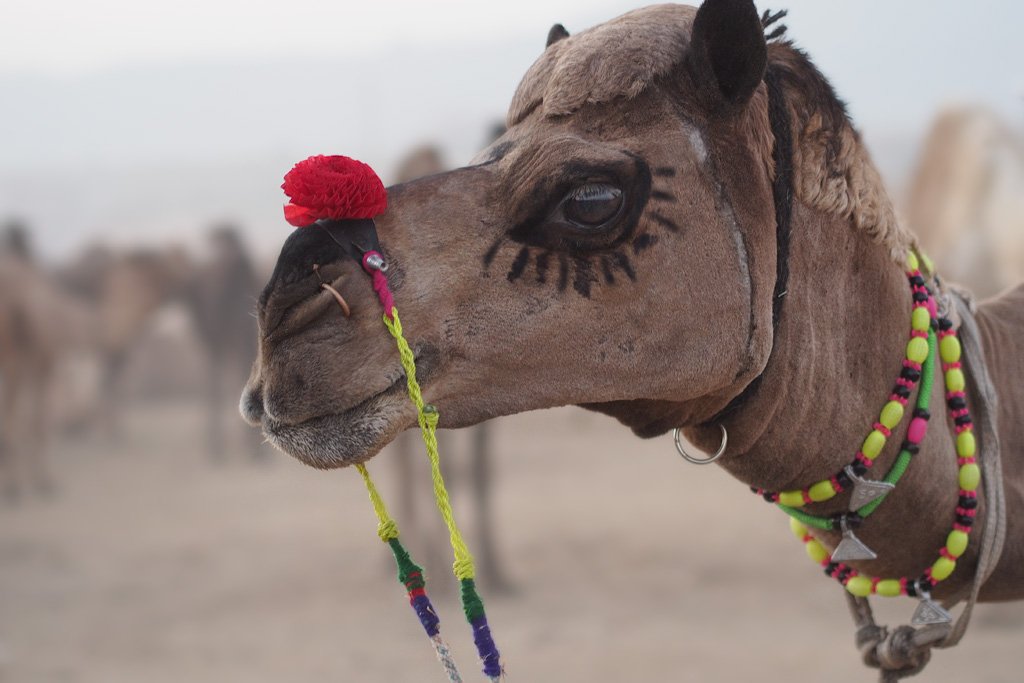
The herders who bring the camels are mostly Rabari, Raika, Gujjar and Rajput pastoralists, and many have walked for weeks to get here with their animals.
Horses: Marwari Stars and the Fair’s Biggest Market
If the camels are the emblem, the horses are the surprise. Pushkar is one of Rajasthan’s most important horse markets, and for many Indian buyers the horses matter as much as the camels. The breed you will see most is the Marwari, recognisable by its ears, which curve inward until the tips almost touch. Sindhi horses are traded here too.
Horse breeders travel further than the camel herders — from Punjab, Haryana and Gujarat, as well as across Rajasthan — and trading begins as soon as they arrive. In the 2026 fair’s early days, vloggers filming the horse market found owners discussing bloodlines and asking prices on camera, from working animals to, in one 13 November 2026 vlog, an owner who said he would not sell his Ablak colt for less than ₹1 crore. That is one owner’s asking price, not a market rate. The horses also have their moment in the arena, where Marwari horses dance to the drums and run in the horse races.
Cattle, Buffalo and the Rest of the Market
The fair began as a cattle fair — the camels came later, as the draw — and cattle are still a large part of the market. Cows, buffalo, sheep and goats are traded alongside the camels and horses, and the buffalo in particular can command extraordinary prices. At the 2025 fair, a buffalo named Anmol was reported to carry an asking price of ₹23 crore — a reported asking price for a famous animal, not a typical sale.
There is no official tally of what is sold. Most sales are negotiated one-on-one between buyer and seller, and no official data is published on the number of animals sold at Pushkar. The counts in this guide are the documented ones; the rest is the fair’s own folklore.
How a Deal Is Done at Pushkar
Watch a deal happen and you will see a ritual that has barely changed. The buyer inspects the animal first: pulling the lips back over the teeth, lifting the legs to check the hooves, running hands over the back to feel for problems with the ride. Then the bargaining begins — and the most famous part of it is the secret bargain, negotiated under a cloth, with buyer and seller clasping hands out of sight and signalling the price with their fingers, so no onlooker can read the figure.

The fair’s rhythm follows the deals. A trader arrives, camps, sells, and leaves. By the final days, many of the animals are already gone, sold and walked home, which is why the first days are the days for the market and the last days are the days for the festival. If you are a visitor, not a buyer, the rule is simple: watch, ask, and do not start a negotiation you do not mean. In a livestock market, a price agreed is a deal.
The Animals on Show: Races, Dances and the Arena
The arena is where the animals stop being merchandise and become performers. The competitions run through the fair week: camel races, camel decoration contests, camel dancing, horse races and horse dancing, the longest-moustache contest, turban-tying challenges, matka phod, and the parade of water buffaloes for the title of the most magnificent animal at the fair.
The exact day-by-day programme is published by the district administration closer to the fair, and it changes from year to year. The 2026 programme opens with the inaugural puja on 17 November and includes a Mandana folk art competition and the ‘Chak De Rajasthan’ football match on the first day. But the arena is the showground. If you want the market, go to the dunes in the morning; if you want the spectacle, go to the arena in the afternoon.
Photographing the Animal Mela
Pushkar is one of the most photographed fairs in India, and the animal mela is the reason: decorated camels against the dunes at sunrise. The best light is the first hour after sunrise, when the herds are moving and the dust hangs in the air — the same hour the trading is at its busiest.
A few courtesies matter. Ask before you photograph people or their animals — the traders are at work, not on display. Do not step between a buyer and an animal mid-inspection, and keep your distance from skittish horses. The fair’s most famous images were made by photographers who spent days in the dunes, not by visitors who rushed through in an hour.
Practical Tips for the Livestock Side
There is no ticket for the fairgrounds — the mela is free to enter, and you pay only for rides, safaris and separately ticketed events. Wear closed shoes: the ground is sand, dust and dung, and you will be walking it for hours. Carry water and sun protection; November days in the desert are warm even when the mornings are cool. The lake and its ghats are sacred, and the Kartik Purnima dip on the night of 24 November is the fair’s religious peak.
For where to stay, how to reach Pushkar, and the full week’s programme, see our Pushkar Fair visitor guide — rooms sell out around the fair, so settle the stay first and the mornings second. The official fair website is pushkarcattlefair.com, and the district administration publishes the day-by-day programme closer to the event.

And beyond the animals, the fair is a bazaar: stalls of bracelets, textiles, saddlery and sweets line the streets between the mela ground and the lake. Walk both, but start with the dunes.
Watch & Feel the Place: The Trading on Film
Videos are by their respective creators.
Pushkar Animal Fair FAQs
When is Pushkar Camel Fair 2026?
17–24 November 2026, according to Rajasthan Tourism’s official fairs and festivals calendar, closing on Kartik Purnima, the full moon, on 24 November. The livestock trading starts earlier — herders begin arriving around 10 November — and trading peaks in the first days, roughly 17–20 November.
What is the Pushkar animal fair?
The livestock market at the heart of the Pushkar Fair, also called the Pushkar Pashu Mela or Pushkar cattle fair. Camels, Marwari and Sindhi horses, cattle, buffalo, sheep and goats are bought and sold on the mela ground outside Pushkar town, while the cultural programme and the Kartik Purnima pilgrimage run alongside it.
Where is Pushkar fair held?
On the Pushkar Mela Ground, the dunes outside Pushkar town in Rajasthan, about 14 km from Ajmer, stretching toward the desert at the foot of the Savitri Mata temple hill. The town itself holds the lake, the ghats and the bazaar; the animals are out on the sand.
How many camels come to Pushkar fair?
No official count is published for 2026. Guides commonly describe around 50,000 camels, horses and cattle at the fair — treat that as the fair’s traditional figure, not a census. The documented counts: 9,934 animals, including 4,472 camels, in 2014; and 1,306 camels registered against 3,028 horses in 2025.
Can visitors buy a camel at Pushkar fair?
In principle, yes — it is a working market, and deals are struck one-on-one between buyer and seller. In practice, a camel needs transport, feed and paperwork, and Rajasthan’s 2015 Camel Act regulates the movement of camels, so it is not a souvenir purchase. Most visitors come to watch the trading, not to take part in it.
What is the best time to see the animals at Pushkar?
Early morning, in the first days of the fair — 17–20 November 2026. The serious negotiating happens at dawn, and many herders sell their animals and leave before the final days, when the fair shifts to competitions and the Kartik Purnima pilgrimage.
The animal mela is only one of the fair’s three faces. The other two are the cultural programme in the arena and the Kartik Purnima pilgrimage at the lake — and the full week, with where to stay and how to get there, is in our Pushkar Fair visitor guide. Next, our best places to visit in Rajasthan guide covers the rest of the state.
Plan your Rajasthan November
The animal mela at dawn, the arena in the afternoon, and the lake at full moon.
Best places to visit in Rajasthan →