
Offbeat Spotlight · Meghalaya
Mawlynnong: Asia's Cleanest Village — Complete Guide

By Beauty of Bharat — India travel guide, every place, every flavour.
Guides covering all 36 States and UTs, researched from official sources and checked at publish time. Corrections welcome — see About Beauty of Bharat.
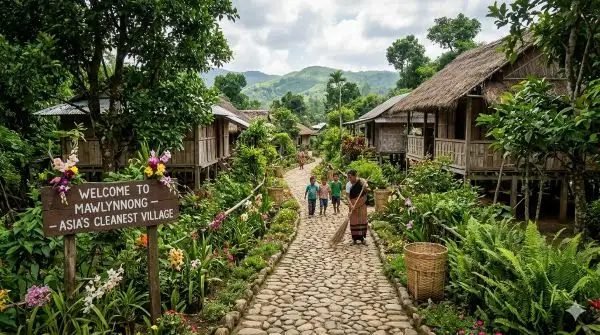
Mawlynnong, a small Khasi village in Meghalaya's East Khasi Hills, is Asia's cleanest village — a place where spotless lanes, bamboo dustbins and flower-filled gardens are not a campaign but a way of life. Come for the village itself, climb the bamboo Sky View platform for a panorama across the Bangladesh plains, walk to the living root bridge nearby, and pair it all with Dawki's clear Umngot River. Best time: October to April. Time needed: one day, or an overnight stay for the village at dawn.
One honest note first: Mawlynnong is a real, working village of around a hundred households, not a theme park. Its charm is quiet — swept paths, tidy gardens, the smell of rain on leaves — and the village asks visitors to match it: no littering, no plastic, no loud behaviour. Slow down, walk, and the place does the rest.
Why Mawlynnong is called Asia's cleanest village
The title dates to 2003, when travel magazine Discover India declared Mawlynnong the cleanest village in Asia; it was named the cleanest village in India in 2005. What makes the title stick is that it was earned, not awarded and forgotten: cleanliness here is a community rule, kept up by every household, year after year.
The system is simple and visible. Woven bamboo dustbins stand along every lane, and villagers sweep the paths daily — fallen leaves included. Waste is collected in pits and composted into manure for the gardens. Smoking and the use of polythene are banned in the village, and rainwater harvesting is encouraged. Children grow up with the habit, and visitors are politely expected to follow it. The result is a village that smells of flowers and wet earth rather than drains and dust, and that is the whole attraction.
Mawlynnong is also known as "God's Own Garden": orchids, ferns and flowering shrubs edge nearly every home, and the Khasi village council keeps the rules — and the welcome — in place.
What to see in Mawlynnong village
The village lanes. The walk itself is the experience. Start at the entrance and wander the swept lanes between tidy Khasi homes, each with its own garden, bamboo fencing and dustbin. There is no set route and no rush; an hour of unhurried walking covers the village, and the details — a carved gate, a basket of flowers, a child sweeping a path — are the sights.
Sky View. A tall bamboo viewing platform, built and maintained by the village, rises above the treetops near the village edge. Climb it (the steps are steep and narrow, so take your time) for a wide panorama over the surrounding hills and, on a clear day, the plains of Bangladesh beyond. It is the best single photograph in Mawlynnong — and the best place to grasp how green and far this corner of Meghalaya really is.
The balancing rock. Near the village stands a large natural boulder, balanced improbably on a smaller rock — a short, easy stop on the village walk and a favourite with children. Mawlynnong's church and community spaces anchor village life; visit respectfully, as this is a place where people live and worship.
The living root bridge near Mawlynnong
A short walk from the village — roughly a kilometre, along a path that descends through forest — stands a living root bridge, woven over generations from the aerial roots of rubber fig trees. Unlike a built bridge, it grows stronger with age as roots thicken and are guided across the stream, and it is still a working footbridge for villagers.
Cross gently and in small numbers, and do not climb on the handrails for photographs: the bridge is alive, and the village maintains it by hand. The walk down is the harder part — stone steps, damp in the monsoon — so wear shoes with grip and allow time for the climb back. The more famous double-decker root bridge is at Nongriat, a separate and much longer trek from Tyrna near Cherrapunji (Sohra); see our Nongriat destination guide before attempting it. No photograph of this bridge is used here: we publish only verified photos of the actual subject, and our library holds no confirmed photo of it.
Best time to visit Mawlynnong
Come between October and April, when the weather is dry and comfortable, the lanes are at their greenest after the monsoon, and the Umngot River at nearby Dawki is at its clearest — the pairing most visitors plan, as our Dawki destination guide explains. November to February brings the coolest, clearest days; March and April are warmer but still pleasant.
The monsoon, roughly May to September, turns the hills a deep, dripping green and fills every stream — beautiful, but paths are slippery, the root-bridge walk is muddy, and road disruption is possible. If you come in the rains, allow slack in your plans and check conditions from Shillong before setting out.
How to reach Mawlynnong from Shillong
Mawlynnong lies about 90 kilometres from Shillong, and the drive takes roughly two and a half to three hours. The usual route runs from Shillong towards Dawki, turning off for the village; the last stretch is a narrower hill road through forest and small settlements, so drive slowly and do not plan a tight onward connection the same evening.
Most visitors hire a taxi from Shillong for the day, combining Mawlynnong with Dawki — the standard circuit, and the easiest way to cover both without worrying about return transport. Shared taxis and local buses run on the Shillong–Dawki corridor but are less predictable, so confirm timings locally the day before. The nearest airport is Shillong (Umroi), with Guwahati the larger gateway and railhead.
Once in the village, everything is on foot: no vehicles move through the lanes, which is part of why they stay so clean. Wear comfortable walking shoes for the root-bridge path.
Where to stay near Mawlynnong
Village homestays in Mawlynnong itself are the most rewarding option: staying with a local family puts you in the village at dawn, before the day-trippers arrive, and after they leave — when the lanes are quietest. Guest houses and small stays around Mawlynnong and on the Dawki road suit travellers who want a little more separation from village life while staying close. Shillong offers the widest choice of stays and services, at the cost of an early start and a long day on the road.
We give no prices, ratings or availability here: Mawlynnong's small stays change rates and seasons often, and a printed figure would date fast. Book ahead for October to February, confirm what is included — meals in the village are home-style and simple — and carry cash as well as cards, since card acceptance in the village is limited.
Nearby: Dawki and the Umngot River

Dawki, a short drive from Mawlynnong, is where the Umngot River runs so clear in the dry season that boats appear to float on air — one of Meghalaya's most photographed sights, and the natural second half of a Mawlynnong day. Arrive in the morning for the clearest water, take a boat ride, and then continue to the village for the afternoon, or reverse the order to suit the light. Our Dawki guide covers the river, the border viewpoint and the practicalities.
With a second day, add Shillong itself — the "Scotland of the East", with its lakes, viewpoints and markets — or head to Cherrapunji (Sohra) for waterfalls and the longer root-bridge treks. For the wider state picture, see our Meghalaya state guide and best places in North East India.
A one-day Mawlynnong plan
Leave Shillong early, reach Dawki by mid-morning for the Umngot River at its clearest, then drive on to Mawlynnong for lunch in the village. Spend the afternoon walking the lanes, climbing Sky View and visiting the balancing rock, then walk down to the living root bridge in the cooler late afternoon before driving back. Overnight visitors should reverse the emphasis: arrive in the village by evening, sleep in a homestay, and walk the lanes at dawn — the village at its quietest and cleanest — before the day's visitors arrive.
Practical tips for Mawlynnong
Leave no trace, and bring no plastic. The village bans polythene; carry a reusable bottle and bag, and use the bamboo dustbins. Matching the village's standard is the price of admission, and it is a small one.
Wear shoes with grip. The root-bridge path is stone steps, damp even in the dry season. Sandals are a poor choice for that walk.
Carry cash. Card acceptance in the village is limited, and small stays and eateries run on cash. Carry enough for entry contributions, food and the return taxi.
Check locally, every time. Entry contributions, Sky View access and road conditions change with season and village decisions. Confirm on the day in Shillong or at the village rather than relying on any single page for operational details.
Photography. The lanes photograph best in soft morning or late-afternoon light; Sky View at midday is harsh. Ask before photographing people at home — a smile and a word go a long way.
Watch & feel the place
Before you plan the drive, watch Mawlynnong itself: the lanes, the bamboo dustbins, the root bridge and the Sky View panorama.
Why Mawlynnong belongs on an offbeat India list
Mawlynnong is the offbeat formula at its purest: no spectacle, no crowds, just a village that decided to be clean and stayed clean — and in doing so became a lesson the rest of the country quotes. It asks little — a day from Shillong, walking shoes, respect for the rules — and gives back one of India's most hopeful sights: proof that a community can keep its home beautiful. For more quiet corners, see our offbeat places in India guide, the flagship best places to visit in India, and the Beauty of Bharat blog.
Frequently asked questions
Why is Mawlynnong called Asia's cleanest village?
Mawlynnong earned the title after travel magazine Discover India declared it Asia's cleanest village in 2003, and it was named the cleanest village in India in 2005. The title reflects a community-wide practice: every household keeps its surroundings clean, bamboo dustbins line the lanes, plastic is banned, and waste is composted into manure.
Where is Mawlynnong and how far is it from Shillong?
Mawlynnong is a Khasi village in the East Khasi Hills district of Meghalaya, close to the Bangladesh border, about 90 kilometres from Shillong. The drive takes roughly two and a half to three hours, and most visitors combine it with Dawki on the same day trip.
What is the best time to visit Mawlynnong?
October to April is the best time to visit Mawlynnong, when the weather is dry, the lanes are at their greenest after the monsoon, and the nearby Umngot River at Dawki is at its clearest. Monsoon months are lush but wet, with slippery paths and occasional road disruption.
What is the living root bridge near Mawlynnong?
A short walk from Mawlynnong stands a living root bridge, woven over generations from the aerial roots of rubber fig trees and strengthened as it grows. It is a working footbridge used by villagers, not a monument, and visitors are asked to cross gently and in small numbers.
How many days do I need for Mawlynnong?
One day is enough for Mawlynnong itself — the village lanes, Sky View, the living root bridge and the balancing rock — and most visitors pair it with Dawki the same day. Staying overnight in a village homestay lets you see the village at dawn, before day-trippers arrive.
Is Mawlynnong suitable for families?
Yes — Mawlynnong is very family-friendly: flat, walkable lanes, no traffic inside the village, and sights close together. Keep children close on the bamboo Sky View platform and on the root-bridge walk, wear shoes with grip, and carry water.
Plan your Meghalaya trip
Start with the state's offbeat corners and headline destinations, then build your own Shillong–Dawki–Mawlynnong circuit.
Meghalaya state guide →