
Maharashtra · Offbeat Guide
Lonar Crater Lake, Maharashtra: The Complete Guide to India’s Meteorite Lake

By Beauty of Bharat — India travel guide, every place, every flavour.
Guides covering all 36 States and UTs, researched from official sources and checked at publish time. Corrections welcome — see About Beauty of Bharat.
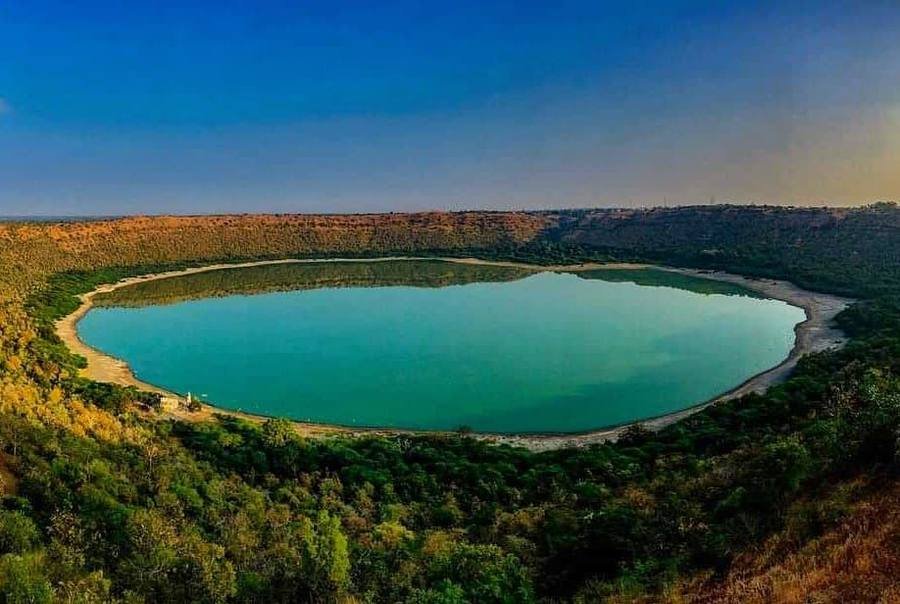
Lonar Crater Lake is a lake that should not exist — a near-perfect circle of green, salty water inside a hole punched into solid rock by a meteorite, in the middle of Maharashtra’s cotton country. The crater is about 1.8 km across and roughly 150 m deep, the lake inside it is both saline and alkaline, and it is the only crater lake of meteoritic origin in India. It is also, as of this week, officially one of the most important geological sites on Earth: on 13 November 2026 Lonar was named to the International Union of Geological Sciences’ list of the Third 100 Geological Heritage Sites, only the second Indian site on the list. This guide covers the science, the temples on the rim, how to reach Lonar, and the honest answers to the questions people actually search for — including why the lake once turned pink.
| Where | Lonar town, Buldhana district, Maharashtra |
| Crater | About 1.8 km across, roughly 150 m deep; lake surface about 137 m below the rim |
| Age | Disputed: about 52,000 years (early dating) vs about 570,000 years (later, contested) |
| Water | Saline and alkaline (soda lake), pH about 10–11; no swimming |
| Status | National Geo-Heritage Monument; Ramsar wetland since 2020; IUGS Geological Heritage Site (2026) |
| Best time | October to March |
| Time needed | Half a day at the crater; overnight stay recommended |
| Nearest rail / air | Jalna, about 85–90 km; Chhatrapati Sambhajinagar airport, about 140–160 km |
Lonar Crater Lake History: How a Meteorite Made This Lake
Tens of thousands of years ago — the exact number is still argued over, as we explain below — a meteorite estimated at around two million tonnes slammed into the Deccan Plateau at something like 90,000 km/h. The impact vaporised rock, threw up a raised rim 20–25 m above the plain, and left a bowl so circular that early visitors assumed it must be volcanic. It was not: the crater walls hold maskelynite, a rare glass formed only when minerals are shocked by a high-velocity impact, along with coarse breccia and tiny glassy spherules. Rainwater and perennial springs then filled the bowl, and because the crater has no outlet, the water stayed and turned salty.
What makes Lonar extraordinary even among impact craters is the rock it hit. The Deccan Traps are vast basalt lava flows from about 66 million years ago, and Lonar is the only known impact crater on Earth formed entirely in basaltic rock. That is why NASA and the Geological Survey of India have studied it for decades: its craters resemble the Moon’s and Mars’ more closely than any other site on Earth. The crater was first studied scientifically in 1823 by British geologist C. J. E. Alexander. The Geological Survey of India has declared it a National Geo-Heritage Monument, and in 2020 it was added to the Ramsar list of wetlands of international importance.
One honest caveat: the crater’s age is genuinely disputed. Early thermoluminescence dating put the impact at 52,000 years ago, give or take 6,000. A later argon-argon study suggested about 570,000 years — but that figure has been challenged, because inherited argon in the samples may have inflated it. Most travel writing still says “about 50,000 years old”; the careful answer is tens of thousands of years, and scientists are still arguing.
Why Did Lonar Lake Turn Pink?
In June 2020, Lonar Lake did something that made headlines around the world: it turned pink. The water, normally deep green, flushed a startling rose colour within days. The cause was a bloom of haloarchaea — salt-loving microbes that produce pink pigments — triggered by a hot, dry summer with very little rain, which raised the lake’s salinity. As the monsoon diluted the water, the pink faded and the lake returned to green.
The pink episode shows how unusual this water is. Lonar is a saline soda lake: both salty and highly alkaline, with a pH of about 10 to 11, among the most alkaline natural waters on Earth. That chemistry supports a strange ecosystem — spirulina algae thrive here, and the lake hosts microbes found almost nowhere else. It also means one firm rule for visitors: do not swim, and do not drink the water. The alkaline water irritates skin and eyes, and the lake is a protected scientific site, not a bathing spot. Local guides sometimes demonstrate the alkalinity with a turmeric test — the water turns the yellow spice red — which is the closest you should get to touching it.
The Temples of Lonar Crater Lake
Science is only half of Lonar. The other half is older: a ring of temples, most of them in ruins, that has drawn pilgrims here for centuries. Local legend says the demon Lonasura lived here until Lord Vishnu, as Daityasudan, slew him — and Lonar takes its name from that story. The lake is mentioned in the Skanda Purana and the Padma Purana, and even in the Ain-i-Akbari, Akbar’s 16th-century chronicle.
The finest temple is the Daitya Sudan Temple in Lonar town, dedicated to Vishnu and built in the Hemadpanthi style during the Chalukya period, roughly the 6th to 12th centuries. Its carved stonework has drawn comparisons with Khajuraho, and it is the one temple around the crater that stands in good repair. Down inside the crater, the walk passes the Gomukh Temple, where a perennial stream flows from a cow-shaped rock, and the Kamalja Devi Temple among the trees on the crater floor. Other shrines — Vishnumandir, Wagh Mahadev, Mora Mahadev and Munglyacha Mandir — stand in various states of ruin around the rim and the lake, a thousand years of temples slowly returning to the jungle inside a meteor crater.
One practical note before you plan the temple walk: since 2021 the lake’s water level has been rising after heavy monsoons, and some lakeside temples have been partly submerged, with paths under water at times. Check the current situation locally — at the MTDC resort or with a local guide — before setting out.
Lonar Crater Lake Depth, Size & What to See on the Rim Walk
The numbers are the reason to come. The crater measures about 1.8 km from rim to rim and roughly 150 m deep, with the lake itself about 1.2 km across and its surface about 137 m below the rim. The full walk around the rim is about 6–8 km depending on the route, and the descent to the lake shore takes roughly 30–40 minutes on uneven stone steps — wear proper walking shoes, carry water, and go early, because the climb back up in the midday sun is the hard part.
The best way to see Lonar is in two parts. First, the rim: start at the MTDC resort viewpoint for the classic full-crater panorama, then walk the rim as the lake shifts from green to steel-blue with the light and the temples appear among the trees. Second, the descent: down to the lake edge, past Gomukh Temple to Kamalja Devi Temple, where the scale finally makes sense — you are standing at the bottom of a hole a meteorite dug. The crater is protected as the Lonar Wildlife Sanctuary, created in 2000, and the forest is alive: langurs and peafowl are common, and about 160 bird species have been recorded here, including the Indian roller, little grebe, shelduck and black-winged stilt. Winter mornings are best for birdwatching, and the crater is a fine place for stargazing once the town lights are behind you.
Where Is Lonar Crater Lake Situated? Location & How to Reach Lonar
Lonar is in Buldhana district in Maharashtra’s Vidarbha region, about 80–100 km from the district town of Buldhana and about 140 km south-east of the Ajanta Caves. There is no railway station or airport at Lonar itself, so every trip runs through a nearby hub — and the distances quoted online disagree, because different routes are being measured. The figures below are the ranges the sources agree on.
By air: the nearest airport is Chhatrapati Sambhajinagar (Aurangabad), about 140–160 km away, roughly a 3-hour drive. Nagpur airport is about 360 km away and Pune about 350 km — both are long drives, so fly into Aurangabad if you can. By train: the nearest railway station is Jalna, about 85–90 km away, with Shegaon and Malkapur on the Howrah–Nagpur–Mumbai line about 100 km away. From any of them, take a state transport bus or a taxi on to Lonar. By road: the usual route is from Chhatrapati Sambhajinagar via Jalna and Deulgaon Raja on NH 753A, about 140–160 km and roughly 3 hours. From Mumbai it is about 500–550 km, and from Nagpur about 360 km — both are full-day drives, so break the journey. MSRTC buses run to Lonar from Aurangabad, Jalna, Akola, Buldhana and Nagpur, and a daily Lonar Darshan bus covers the main sights once you are there. If you are coming from Nagpur, note that our best weekend trips from Nagpur guide treats Lonar as an overnight trip — and it is right.
The most rewarding way to use Lonar is as part of a longer Maharashtra circuit. Chhatrapati Sambhajinagar gives you the Ajanta and Ellora caves, and the road east from there runs through the Marathwada countryside to Lonar and on to Shegaon, a major pilgrimage town. For the wider state, see our best places to visit in Maharashtra guide and the Maharashtra state guide.
Lonar Crater Lake Timings & Best Time to Visit
The best time to visit Lonar Crater Lake is October to March, when the weather is cool and dry, the descent is comfortable and the birdlife is at its best. Summer is harsh on the exposed crater rim, and the monsoon makes the steep paths slippery. As for timings, the crater area is generally open through daylight hours, but there is no single published timetable to rely on — entry arrangements and guide availability change, and the rising water level has altered access to some lakeside temples in recent years. Check with the MTDC resort or a local guide on arrival. Plan on half a day at the crater: an hour on the rim, two to three hours for the descent and the temples, and time to sit at the viewpoint and take in the scale of it.
Can You Do Lonar Crater Lake in a Day?
Yes — from Chhatrapati Sambhajinagar, if you leave early. It is about 3 hours each way, which leaves 3–4 hours at the crater for the rim viewpoints, the descent and the temples, and you can be back by nightfall. From anywhere further away, no: Nagpur is about 360 km, Mumbai 500–550 km, and both need an overnight stay. The better plan, even from Aurangabad, is to stay the night. The MTDC resort sits right on the crater rim, and staying over buys you the two best hours at Lonar: sunrise on the rim, when the light drops into the crater and the birds are loudest, and the quiet evening after the day-trippers have left. Book ahead in the October-to-March season, when the resort fills up. For food on the road, Lonar town has simple local eateries — for the state’s table, see our famous food of Maharashtra guide.
Watch & Feel the Place: Lonar Crater Lake on Film
Videos are by their respective creators.
Lonar Crater Lake FAQs
Where is Lonar Crater Lake situated?
Lonar Crater Lake is in Lonar town, Buldhana district, Maharashtra, in the Vidarbha region. It sits about 140–160 km from Chhatrapati Sambhajinagar (Aurangabad), about 85–90 km from the nearest railway station at Jalna, and about 360 km from Nagpur. The crater is a near-perfect circle about 1.8 km across, holding a saline, alkaline lake.
How old is Lonar Crater Lake?
Scientists do not agree on one number. Early thermoluminescence dating put the impact at about 52,000 years ago, while later argon-argon dating suggested about 570,000 years — but that older figure is disputed, because inherited argon in the samples may have inflated it. Most travel guides still quote around 50,000 years; the honest answer is that the crater is tens of thousands of years old, and the exact age is still debated.
Why did Lonar Lake turn pink?
In June 2020 the lake turned a startling pink. The cause was a bloom of haloarchaea — salt-loving microbes that produce pink pigments — helped by high salinity, low rainfall and warm water that summer. The colour faded as the monsoon diluted the lake. It is a rare, temporary phenomenon, not the lake's normal colour, which is usually green.
How to reach Lonar Lake from Aurangabad?
Lonar is about 140–160 km from Chhatrapati Sambhajinagar (Aurangabad), roughly a 3-hour drive via Jalna and Deulgaon Raja on NH 753A. Take a state transport bus or hire a taxi from Aurangabad; the nearest railway station is Jalna, about 85–90 km away, and the nearest airport is Chhatrapati Sambhajinagar, about 140–160 km away.
Can you do Lonar Crater Lake in a day?
Yes, from Chhatrapati Sambhajinagar it works as a long day trip if you leave early — about 3 hours each way, plus 3–4 hours at the crater for the rim viewpoints, the descent to the lake and the temples. But an overnight stay at the MTDC resort on the crater rim is the better plan: it lets you walk the rim at sunrise, when the light and the birdlife are at their best.
What is the best time to visit Lonar Crater Lake?
October to March, when the weather is cool and dry and the descent to the lake is comfortable. Avoid the summer heat and the monsoon, when the steep crater paths turn slippery. Winter mornings are also the best time for birdwatching — about 160 bird species have been recorded around the crater.
A meteorite fell on Maharashtra and left a lake that is salty, alkaline, ringed with temples and still arguing with science about its own age — and this week the world officially ranked it among its hundred most important geological sites. Go for the crater, stay for the sunrise on the rim, and give it the overnight it deserves. Next, read our best places to visit in India guide, or plan the wider state with our state-by-state guide to India.
Plan your Lonar trip
A meteor crater, a pink lake, a thousand years of temples — one overnight in Buldhana district.
Maharashtra state guide →