
State Food Guide · Karnataka
What to Eat in Karnataka

By Beauty of Bharat — India travel guide, every place, every flavour.
Guides covering all 36 States and UTs, researched from official sources and checked at publish time. Corrections welcome — see About Beauty of Bharat.

Order breakfast in Karnataka and you may be handed a plate-sized idli, a crepe so thin you can almost see through it, or a smooth millet ball you are told never to chew — and all three are correct. That is why the famous food of Karnataka is so hard to pin down: this is not one cuisine but several, shaped by coast, hills, palace city and farmland. The coast cooks with coconut, tamarind and fresh seafood; the hills of Kodagu (Coorg) cook pork with pepper and a souring vinegar found nowhere else; Mysuru gives the state its most famous dosa and its most famous sweet; and the farming south eats ragi mudde with hot saaru. This guide works through them region by region, so you know what each dish is, where it comes from, and what to eat it with.
Start with the map in your head. Karnataka's state guide names bisi bele bath, Mysore pak and neer dosa as the plates the state is known for — a fair trio, but only a start. Add Mysuru's masala dosa, Coorg's pandi curry, the coast's ghee roast, Bidadi's thatte idli and Dharwad's pedha, and you have the full shelf. Every dish below is either covered in the site's own Karnataka food pages or grounded in reputable sources checked for this post; no prices or restaurant names are claimed.
Mysuru and Bengaluru: dosa, plate idli and a palace sweet
Mysore masala dosa
If Karnataka has one dish the whole country recognises, it is this: a crisp dosa with a soft, spongy inside, spread inside with a fiery red chilli-garlic chutney before the spiced potato filling — potato palya, with mustard, turmeric and curry leaves — is added and the dosa folded. That red chutney is the whole difference from an ordinary masala dosa. Stories link the style to Mysuru's palace kitchens; the reliable part is the construction. Eat it in Mysuru, where it belongs, and in Bengaluru, where it is an everyday breakfast.
Thatte idli: the idli the size of a plate
Thatte means plate in Kannada, and that is exactly what this idli is: a thick, spongy steamed rice cake cooked in a flat circular plate instead of a small mould, so one idli is roughly the size of two or three ordinary ones. It comes from Bidadi, between Bengaluru and Mysuru, and travellers on that road still stop for it, served with coconut chutney and sambar, often with vegetable saagu. No verified photograph of thatte idli is held in the site's photo library, so this dish is described in words only rather than illustrated with a substitute.
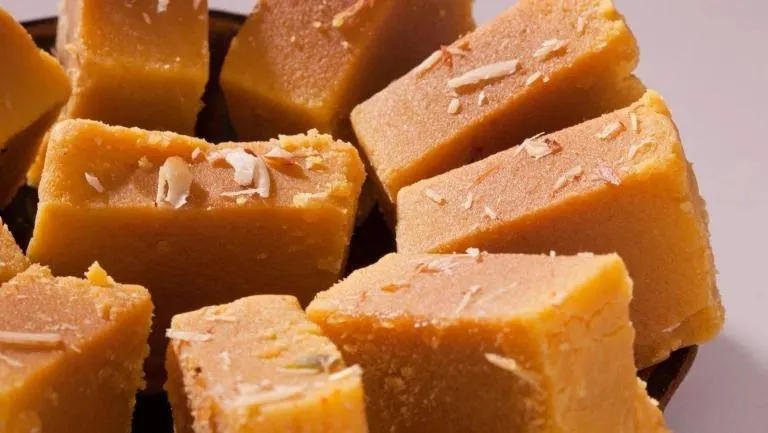
Mysore pak
Mysore pak is the sweet that closes a Mysuru meal, and it is disarmingly simple: gram flour (besan), sugar and generous ghee, cooked until the mixture thickens and leaves the pan, then set and cut into rectangles. The site's own guide describes it as a ghee-drenched gram-flour fudge made in porous and melt-in-mouth styles, named after Mysuru, with tradition placing its birth in a palace kitchen. Expect intensely sweet and buttery, with the roasted, nutty depth of besan cooked in ghee.
One pot and one ball: bisi bele bath and ragi mudde
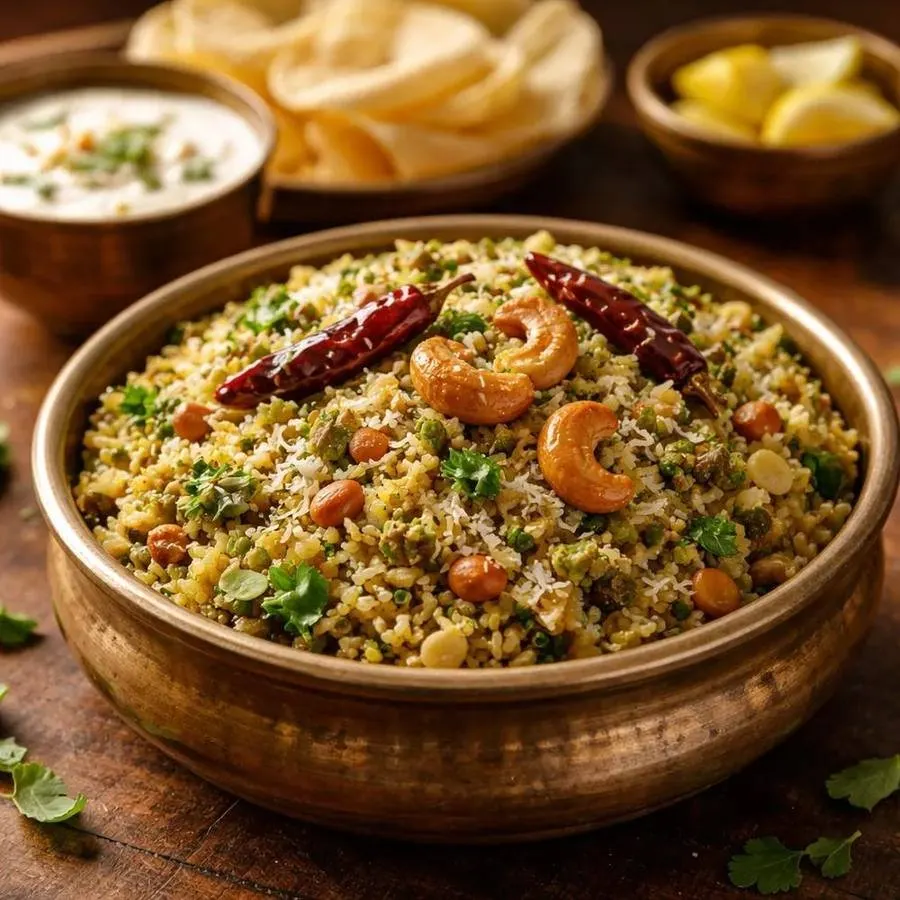
Bisi bele bath
The name says it plainly in Kannada — bisi (hot), bele (lentils), bath (rice) — and the dish delivers exactly that, all in one pot. Rice and toor dal cook together with vegetables and a freshly ground spice blend built around Byadgi chillies and cinnamon, finished with tamarind for sourness and a ghee tempering with mustard, cashews and curry leaves. The site's guide puts it well: warm, tangy and deeply spiced, more aromatic and complex than sambar rice, with gentle heat. It is the state's great home and lunchbox dish.
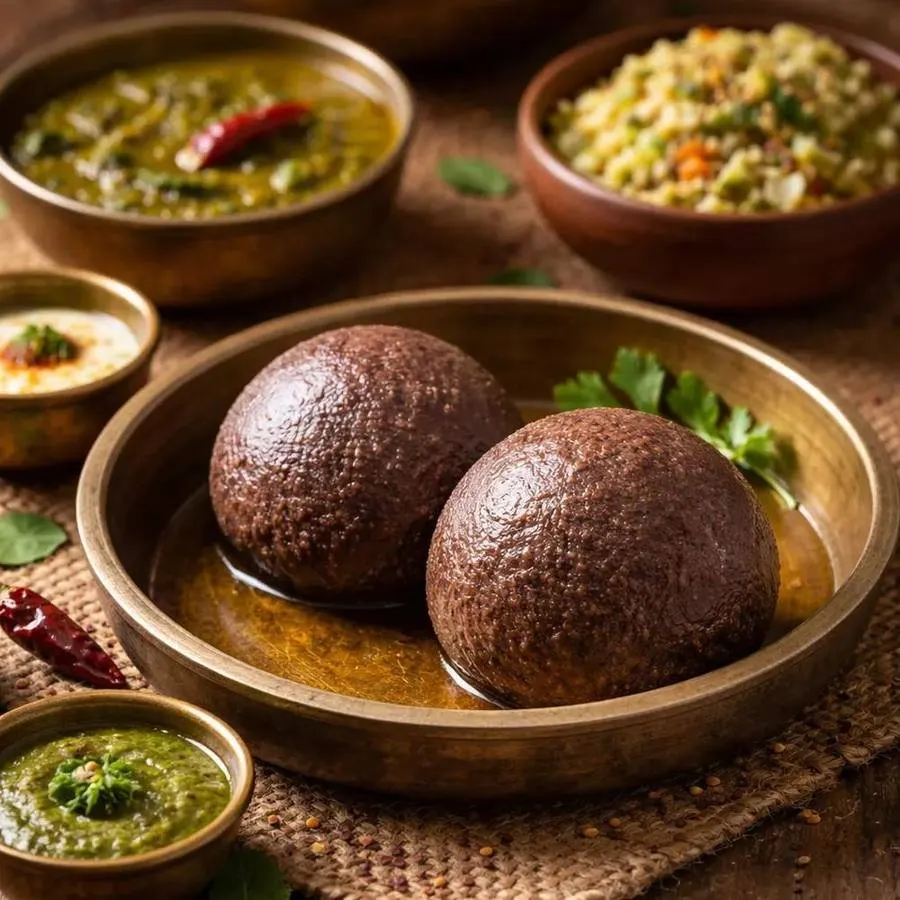
Ragi mudde
Ragi mudde is the opposite of a showpiece, and that is why it matters: a smooth ball of ragi (finger millet) flour stirred into boiling salted water until it comes together, shaped with wet hands and served steaming. The site's guide calls it the staple centrepiece of meals in southern Karnataka's farming districts, deliberately plain and earthy — the flavour comes from the saaru or curry served with it. Tradition is to take small pieces with the accompaniment and swallow them rather than chew the ball itself. Read the full guides to ragi mudde and bisi bele bath.
The coast: neer dosa, ghee roast and banana buns
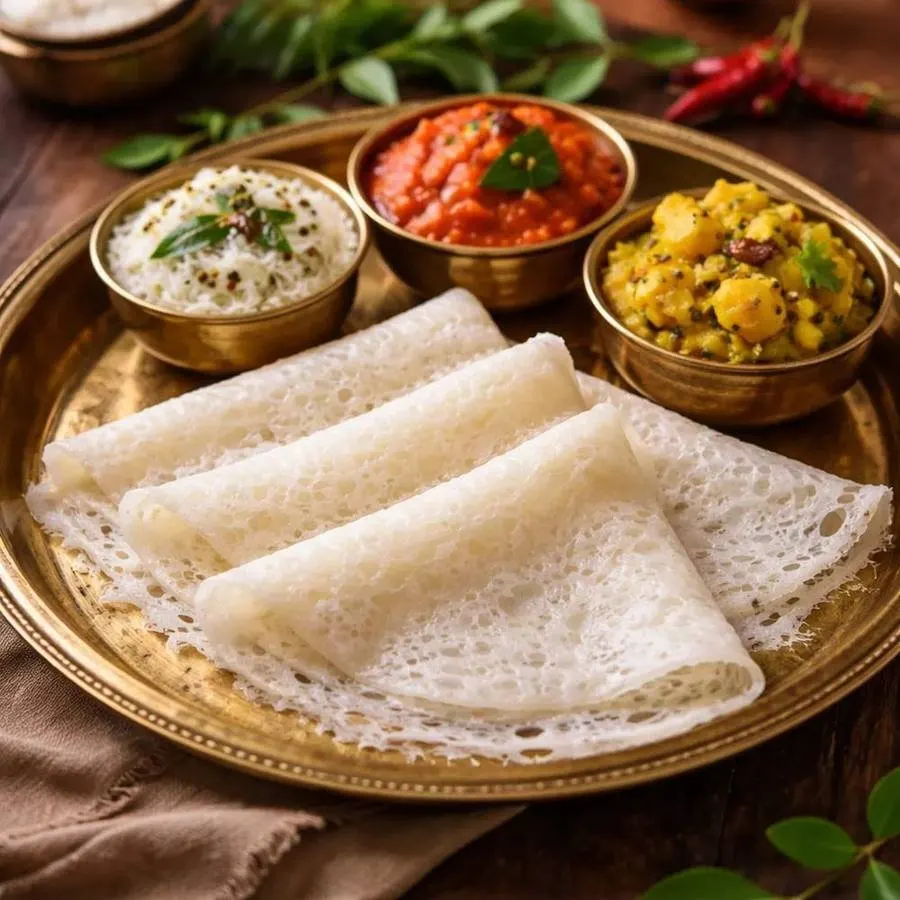
Neer dosa
On the Tulu coast, the dosa changes character completely. Neer means water in Tulu, and neer dosa is made from a watery, unfermented rice batter — as thin as milk, in the site's guide's phrase — ladled onto a hot tawa, swirled into a lacy sheet and removed soft, without browning or crisping. It is very mild and delicate, and that mildness is deliberate: it exists to soak up spicy curries, meat or vegetable. That is also why neer dosa and ghee roast are so often served together.
Mangalorean ghee roast and seafood
The coast's most famous export after neer dosa is ghee roast: chicken — and, by extension, prawns and other seafood — cooked in a fiery masala of Byadgi chillies, coriander and other roasted spices, finished in generous ghee with tamarind tang and a touch of sweetness. Published accounts trace the chicken version to Kundapur, near Mangaluru, where local histories credit a 1950s family eatery with the ghee-slicked red roast; from there it spread across India. The same coast's fish and prawn curries, built on coconut, tamarind and curry leaves, are served with rice or neer dosa. No verified photograph of ghee roast itself is held in the site's photo library, so this section is text-only.
Mangaluru buns
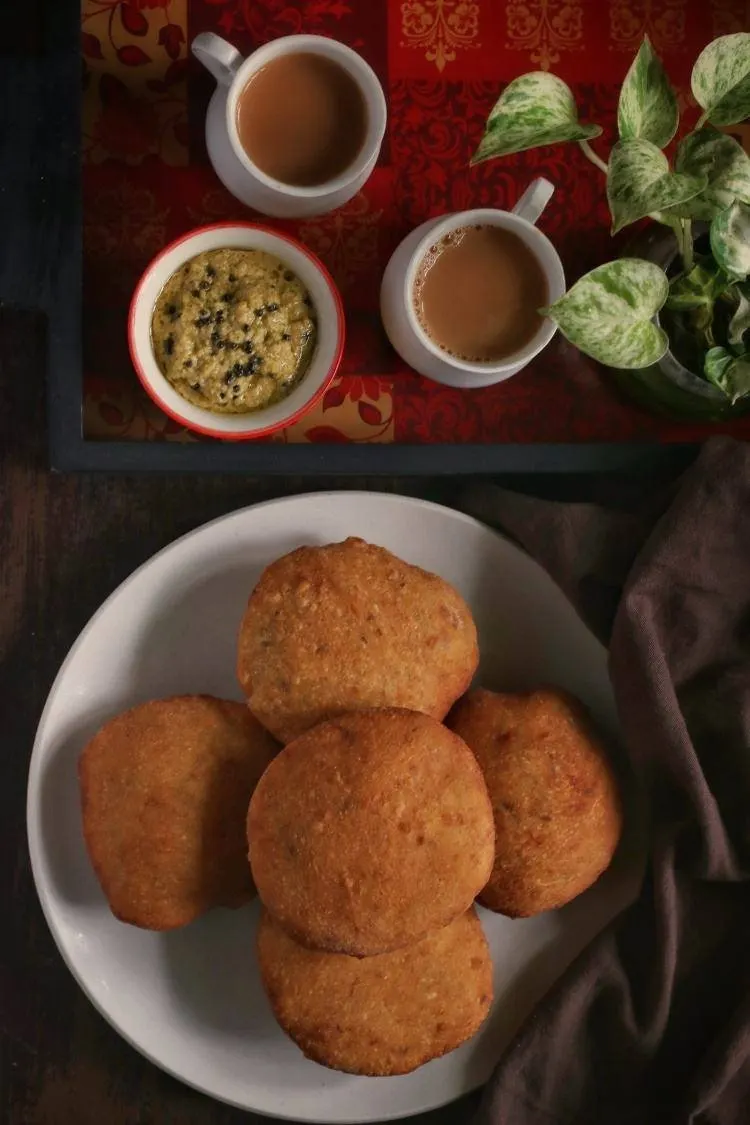
For something gentler, look for Mangaluru buns: soft, puffed, deep-fried breads made from flour kneaded with ripe banana and a little sugar or jaggery, with cumin and curd in the dough, rested for hours and fried into golden rounds. The site's guide describes them as gently sweet with a clear banana aroma, mildly spiced with cumin, and savoury enough to pair with chutney or curry. See the full guides to Mangaluru buns and neer dosa.
The hills: Coorg pandi curry
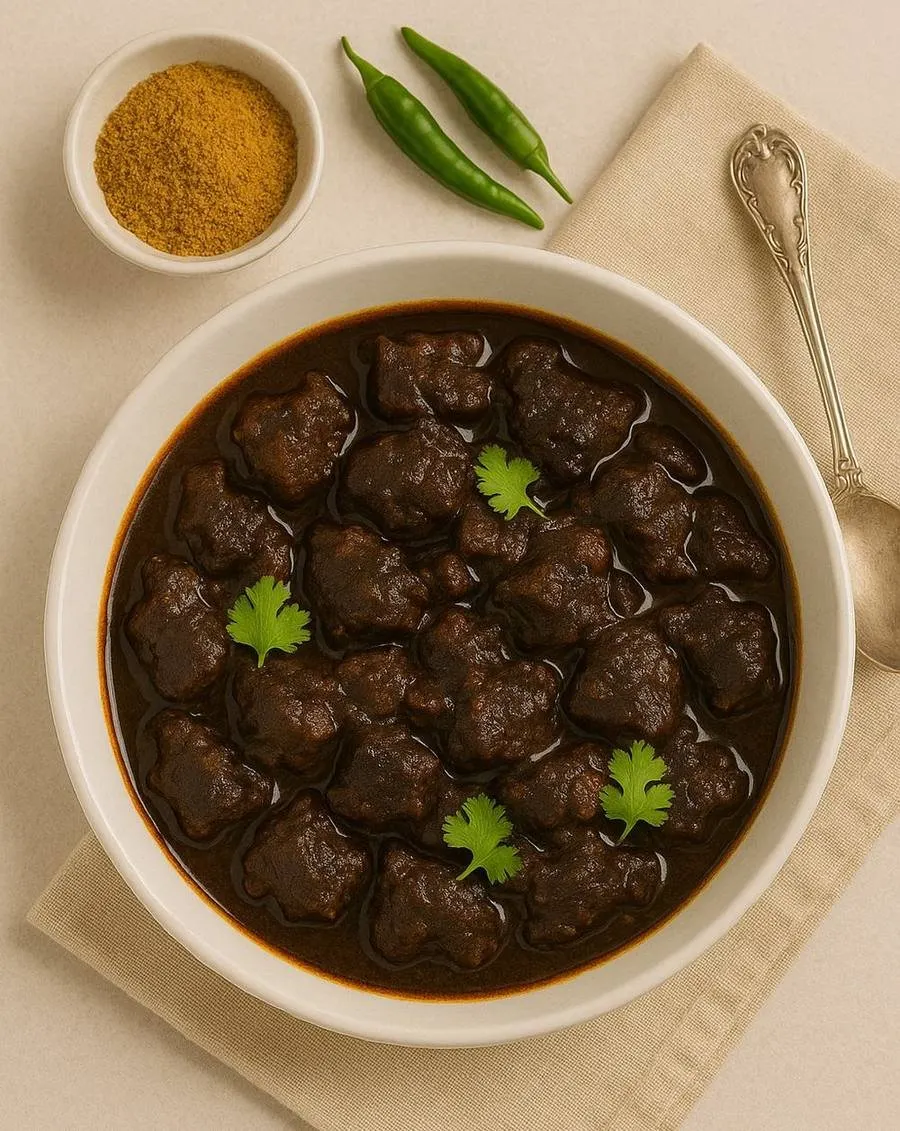
Head inland to Kodagu, known as Coorg, and the cooking turns darker and sharper. Pandi curry is a pork curry made with coarsely ground spices and kachampuli, the region's own souring vinegar made from Garcinia, which gives it a deep colour and distinctly sour edge. The site's guide describes it as deep, peppery and distinctly sour, with rich pork fat balanced by sharp, fruity acidity, and notes that resting and reheating deepens it further. It is traditionally eaten with kadambuttu (steamed rice dumplings) or akki rotti. This is the one dish here that non-pork eaters should skip. Pair it with the Coorg destination guide and the full guide to Coorg pandi curry.
North Karnataka: Dharwad pedha
Finish in the north, in Dharwad, with the state's other great sweet: a dark, caramelised milk sweet, browned by slow cooking rather than coloured, dusted with fine sugar, and softer and less sweet than many north Indian pedhas. Published accounts trace it back some 175 years to the Thakur family, confectioners who migrated from Unnao in Uttar Pradesh to Dharwad, where it is still called Line Bazaar pedha after their shop. It carries a Geographical Indication tag. No verified photograph of Dharwad pedha is held in the site's photo library, so it is described in words only.
How to eat your way across Karnataka
For a first trip, follow the food in this order: Bengaluru and Mysuru for dosas, thatte idli on the road between them, and Mysore pak; Coorg for pandi curry; then the coast for neer dosa, ghee roast, seafood and Mangaluru buns. Bisi bele bath and ragi mudde will find you anywhere in the interior, and Dharwad pedha rewards the detour north. The state's own guide gives October to February as the best window for many circuits, with coastal and hill weather varying. The series continues with famous food of Kerala, famous food of Goa, famous food of Tamil Nadu and famous food of Maharashtra, plus the wider best food in India guide.
Watch the food of Karnataka
Two videos show these dishes better than words can: a tour of Karnataka cooking, and a step-by-step thatte idli:
What to Eat in Karnataka FAQs
What is the most famous food of Karnataka?
There is no single official answer, but three dishes come up first: bisi bele bath, the hot lentil-rice one-pot dish; Mysore masala dosa, the crisp dosa smeared with red chutney and filled with potato palya; and Mysore pak, the ghee-rich gram-flour sweet named after Mysuru.
What makes a Mysore masala dosa different from an ordinary masala dosa?
The red chutney: a Mysore masala dosa is smeared inside with a fiery red chilli-garlic chutney before the spiced potato filling goes in, giving it a heat and colour an ordinary masala dosa does not have. Stories link the style to Mysuru.
What is ragi mudde, and how is it eaten?
Ragi mudde is a smooth, steamed ball of ragi (finger millet) flour, the staple centrepiece of meals in southern Karnataka's farming districts. It is deliberately plain and earthy — the flavour comes from the saaru or curry served with it — and tradition is to swallow small pieces with the accompaniment rather than chew the ball itself.
What should vegetarians — and travellers who do not eat pork — know before ordering?
Most signatures here are vegetarian: bisi bele bath, ragi mudde, neer dosa, thatte idli, Mangaluru buns, Dharwad pedha and Mysore pak. Two famous exceptions are meat dishes: Coorg pandi curry is pork, and Mangalorean ghee roast is most famously chicken, with seafood versions also common.
Karnataka rewards the traveller who eats region by region instead of ordering the same dosa everywhere: the red chutney of Mysuru, the one-pot warmth of bisi bele bath, the plain honesty of ragi mudde, the lacy coast, the dark sourness of Coorg and the two great sweets at either end of the state. Start with the Karnataka state guide, let the map follow the menu.
Plan your Karnataka trip
Start in Bengaluru and Mysuru, add Coorg and the coast, and eat your way across the state.
Karnataka state guide →