
Food Atlas · Karnataka
Ragi mudde: A smooth finger-millet ball, swallowed — never chewed — with hot saaru

By Beauty of Bharat — India travel guide, every place, every flavour.
Guides covering all 36 States and UTs, researched from official sources and checked at publish time. Corrections welcome — see About Beauty of Bharat.
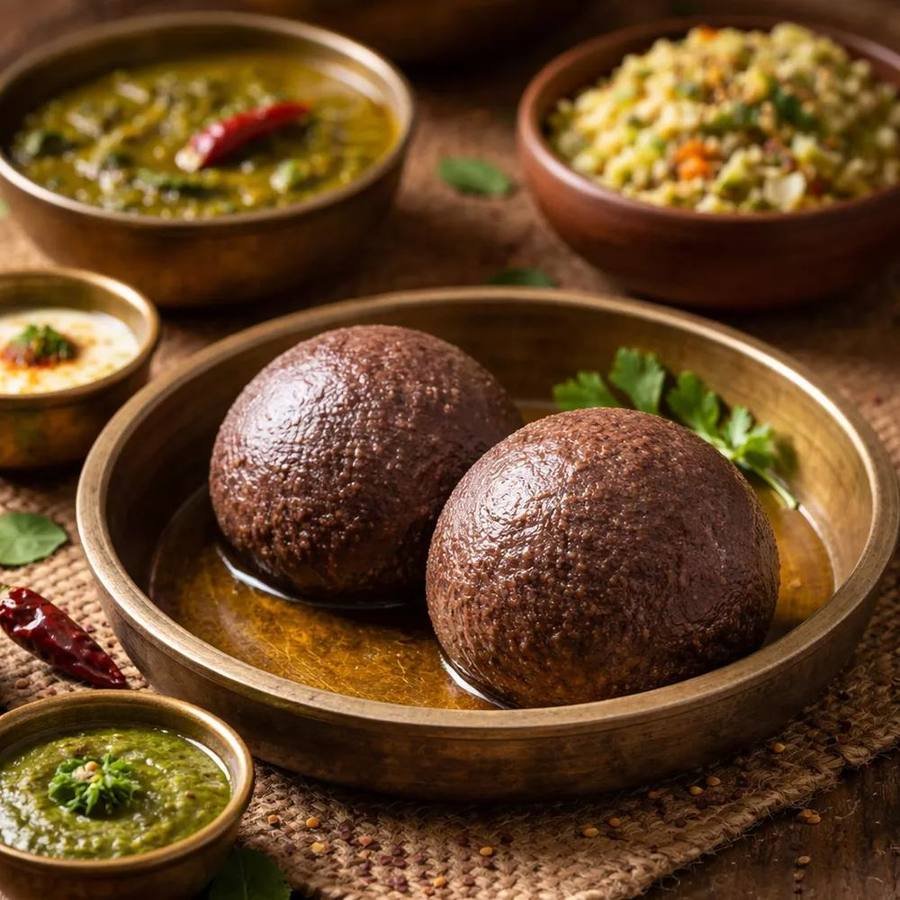
Ragi mudde gives travellers one of the clearest tastes of Karnataka — specific in flavour, rooted in place and still part of living food culture. A steamed ball of ragi (finger millet) flour cooked in water, the staple centrepiece of meals in southern Karnataka's farming districts.
A detail worth knowing before the first bite: tradition says mudde pieces should be swallowed, not chewed, dipped well in saaru. Keep that in mind as you read on, because Ragi mudde rewards eaters who notice how Karnataka seasons, serves and shares its food.
Ragi mudde at a Glance
| State / UT | Karnataka |
| Capital / base | Bengaluru |
| What it is | A steamed ball of ragi (finger millet) flour cooked in water, the staple centrepiece of meals in southern Karnataka's farming districts |
| Main ingredients | ragi (finger millet) flour, water and salt |
| Taste | Very mild and earthy, deliberately plain — the flavour comes from the saaru or curry served with it |
| Texture | Smooth, dense and springy outside, soft inside; pieces are meant to be swallowed without chewing |
| Usually eaten | Eaten by pinching off small pieces, dipping in saaru (lentil, greens or mutton curry) and swallowing, often with a side of soppu (greens) and chutney powder |
| Occasion | An everyday lunch staple in farming households of southern Karnataka |
The Story on Karnataka’s Table
Ragi mudde is the defining staple of rural south Karnataka — the Bengaluru, Mandya, Hassan and Tumakuru belt — where ragi has been farmed for centuries on dry land. It is food of physical work: filling, slow to digest and traditionally eaten by hand with hot lentil or meat saaru. In recent years it has been embraced in cities as a nutritious traditional food. That context is essential in Karnataka, where a plate can signal a harvest, a religious calendar, a market habit or the meeting of communities. Ragi mudde belongs in this atlas under Karnataka because this is the setting in which its ingredients, accompaniments and meaning come together.
The state guide places Ragi mudde alongside Bisi bele bath, Mysore pak and Neer dosa. Start with the Karnataka travel and food guide if you are planning where this tasting fits into a route.
Taste, Texture and Ingredients
Expect very mild and earthy, deliberately plain — the flavour comes from the saaru or curry served with it. Think smooth, dense and springy outside, soft inside; pieces are meant to be swallowed without chewing.
The ingredient list is best read as a structure rather than a shopping list: ragi (finger millet) flour, water and salt.
How Ragi mudde Is Made
Ragi flour is stirred into boiling salted water and cooked, stirring hard to avoid lumps, until it comes together as a smooth mass. Portions are shaped with wet hands into round balls and served immediately, steaming. The cooking rewards attention to sequence and balance rather than a long list of additions.
When Ragi mudde is made for a gathering, that timing also becomes social — food reaches the table as part of a shared rhythm, not as an isolated plate.
When and How It Is Eaten
Eaten by pinching off small pieces, dipping in saaru (lentil, greens or mutton curry) and swallowing, often with a side of soppu (greens) and chutney powder. Its natural moment is an everyday lunch staple in farming households of southern Karnataka.
Karnataka’s broader food culture helps explain the serving style. The state is known for heritage, coffee and beaches, and its calendar includes Mysuru Dasara and Hampi Utsav.
Where to Try It in Karnataka
Try it at military hotels and traditional eateries in Bengaluru and Mandya, served with mutton saaru or bassaru. For a traveller, setting matters almost as much as seasoning.
Ragi mudde pairs naturally with time in Bengaluru and Mysuru, and can sit just as comfortably beside a quieter excursion to Badami or Aihole.
More Dishes of Karnataka
Continue through Karnataka’s other signature plates and drinks below — each has its own page, photograph and story.



Frequently Asked Questions
What is Ragi mudde?
A steamed ball of ragi (finger millet) flour cooked in water, the staple centrepiece of meals in southern Karnataka's farming districts. Expect very mild and earthy, deliberately plain — the flavour comes from the saaru or curry served with it.
What are the main ingredients in Ragi mudde?
The defining ingredients or components are ragi (finger millet) flour, water and salt. Ragi flour is stirred into boiling salted water and cooked, stirring hard to avoid lumps, until it comes together as a smooth mass. Portions are shaped with wet hands into round balls and served immediately, steaming.
What does Ragi mudde taste like?
Expect very mild and earthy, deliberately plain — the flavour comes from the saaru or curry served with it. Think smooth, dense and springy outside, soft inside; pieces are meant to be swallowed without chewing. Serving pattern: Eaten by pinching off small pieces, dipping in saaru (lentil, greens or mutton curry) and swallowing, often with a side of soppu (greens) and chutney powder.
When is Ragi mudde eaten in Karnataka?
An everyday lunch staple in farming households of southern Karnataka. The accompanying lentil soup made from the dal's cooking water is called bassaru.
Where can I try Ragi mudde in Karnataka?
Try it at military hotels and traditional eateries in Bengaluru and Mandya, served with mutton saaru or bassaru. Pair a first tasting with Bisi bele bath and Mysore pak to see how Ragi mudde sits within the wider Karnataka table.
Every Place. Every Flavour.
Ragi mudde is one of 6 dishes and drinks profiled from Karnataka — and one of 213 regional dishes across all 36 states and union territories in this atlas.
Open the Karnataka guide Read the blog