
Jammu & Kashmir · Food and Culture
Famous Food of Jammu and Kashmir: 12 Dishes to Try

By Beauty of Bharat — India travel guide, every place, every flavour.
Guides covering all 36 States and UTs, researched from official sources and checked at publish time. Corrections welcome — see About Beauty of Bharat.

The famous food of Jammu and Kashmir is not a single dish but a feast: the wazwan, a ceremonial meal of up to 36 courses, cooked overnight by hereditary chefs and served on one large copper platter, the trami, shared by four people sitting together. The meal runs in a fixed order, from crisp fried ribs to slow-cooked curries, and ends with one dish nobody is allowed to leave before — the gushtaba, pounded mutton balls in a pale yoghurt gravy. The second surprise is that the reddest curry in India is also one of the mildest: rogan josh gets its deep red from Kashmiri chillies and the cockscomb flower, which give colour, not heat. Below are the 12 dishes that carry this food culture.
What Is the Wazwan?
Wazwan is the ceremonial feast of Kashmir, served at weddings and big family occasions. The word comes from waz, cook, and wan, shop — the art of setting up a feast. The cooking begins the night before, in heavy copper cauldrons over wood fires, under a master chef called the vasta waza, whose craft passes from father to son. Guests sit in fours and share a trami heaped with rice; first, attendants carry round the tash-t-nari, a copper basin and ewer, to wash everyone’s hands at the table. The dishes arrive in a set order — dry dishes first, then the curry sequence, then gushtaba to close the savoury courses, and finally phirni, a cool rice pudding. Seven dishes are a must at a proper wazwan: tabak maaz, rista, rogan josh, daniwal korma, aab gosh, marchhwangan korma and gushtaba. In Srinagar, restaurants serve a shortened wazwan all year round, so no wedding invitation is needed to taste it. See our Srinagar guide for where the Valley’s food sits in the city.
What to Eat in Kashmir: 12 Dishes to Try
1. Rogan Josh

Rogan josh is Kashmir’s most famous dish, and the one most visitors already know by name. Tender mutton is slow-cooked in a deep red gravy of fennel, dry ginger and Kashmiri chillies, coloured with mawal, the dried cockscomb flower, or ratan jot, the root of dyer’s alkanet. The name is Persian — roghan, ghee or oil, and josh, to stew or braise — and the Mughals brought the dish to the Valley centuries ago. The authentic version has no tomato; the Pandit version has no onion either, and uses yoghurt and asafoetida for body. Eat it with plain steamed rice, and expect fragrance and warmth rather than fire: the chillies here are chosen for colour.
2. Yakhni

Yakhni is the quiet dish of the wazwan, and the one that shows what Kashmiri cooking does best. Mutton is simmered in a yoghurt gravy with fennel, cardamom, bay leaves, cloves and mint — and no chilli at all. The result is pale, creamy and fragrant, a deliberate contrast to the red curries around it. The same gravy is used for lotus stem in nadru yakhni, below.
3. Gushtaba
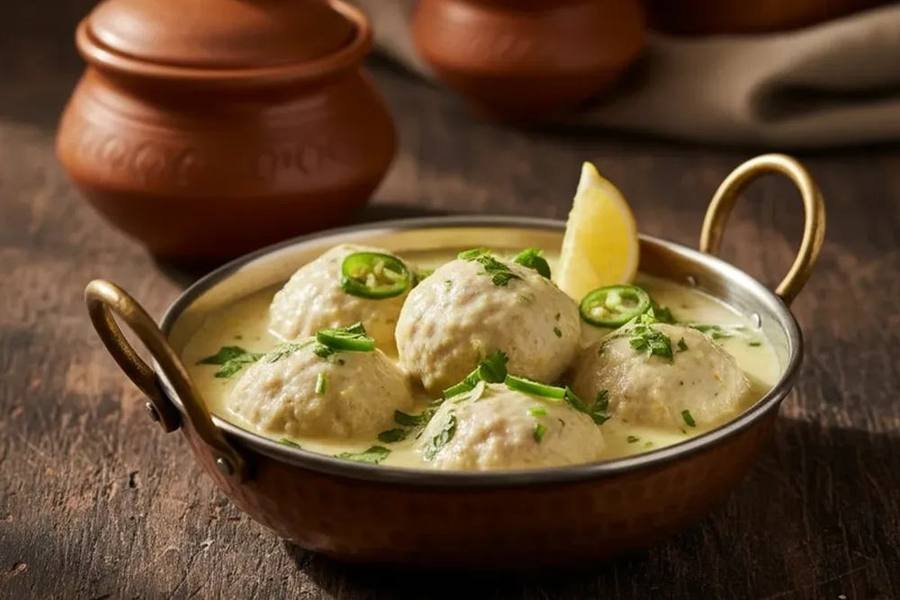
Gushtaba is the king of the wazwan and the last savoury course served — leaving before it arrives is poor form. Lean mutton from the leg is pounded for hours with a wooden mallet until it is smooth and velvety, then shaped into large, delicate meatballs and poached in a yoghurt gravy flavoured with cardamom, cloves and mint. It is the ultimate test of a waza’s skill: the meatballs must melt, yet hold their shape. After the richer courses, the pale gushtaba calms the palate, and then the phirni follows.
4. Rista
Rista is gushtaba’s fiery sibling, made from the same hand-pounded mutton but served in a red, saffron-tinted gravy instead of a white one. The meatballs are smaller than gushtaba’s, in a gravy of Kashmiri chilli, fennel and mawal, and the dish sits in the middle of the wazwan’s curry sequence. Together they are the feast’s two great meatballs: one red, one white, one spiced, one soothing.
5. Tabak Maaz
Tabak maaz opens the wazwan. Lamb ribs are braised for hours in milk, water and spices until soft, then simmered in yoghurt until dry and finished by frying in ghee until the outside crisps. The result is rich, glossy and crackling at the edges — a dish rarely found outside Kashmir, because the double cooking takes so long. Two pieces arrive on the trami with the first rice, eaten with the hands while the curries are still on their way.
6. Dum Aloo (Dum Olav)

Dum aloo, or dum olav, is the signature dish of the Kashmiri Pandit kitchen — the Valley’s other great food tradition. Small potatoes are slow-cooked in a spiced yoghurt gravy with fennel and dry ginger, and, as in all Pandit cooking, without onion or garlic; asafoetida, fennel and yoghurt carry the flavour instead. It is as well known outside Kashmir as rogan josh, yet in the Valley it is an everyday dish as much as a feast one.
7. Nadru Yakhni
Nadru is the lotus stem pulled from Dal Lake, and it is one of the Valley’s signature vegetables. In nadru yakhni it is cooked in the same yoghurt-and-fennel gravy as the mutton yakhni, so the dish is pale, fragrant and gentle, with the stem’s crunch holding up in the sauce. The same lotus stem is also fried crisp in a spiced batter as nadru monji, sold at stalls outside Srinagar’s shrines. It tastes of the lake it comes from.
8. Haak Saag
Haak, the collard greens grown in the Valley, is the everyday vegetable of Kashmir, cooked simply in mustard oil with a little chilli. Incredible India calls it indispensable to the wazwan itself — without it, the feast feels incomplete. Earthy and slightly bitter, the greens are the palate’s rest between the rich meat courses — the plain, seasonal side of Kashmiri cooking.
9. Modur Pulao
Modur pulao is Kashmir’s sweet rice: basmati cooked in milk and ghee with saffron and sugar, and finished with separately roasted dry fruits and raisins. It is served at festivals and celebrations, and at wazwan feasts as a fragrant, golden counterpoint to the meat curries. The saffron gives the rice its colour and perfume; Kashmir grows some of the world’s finest, around Pampore south of Srinagar.
10. Kahwa

Kahwa is the tea of guests and afternoons: green tea brewed with saffron, cardamom and cinnamon, and served in small brass cups with slivered almonds. It arrives after the meal, on houseboats and in homes, and closes a wazwan along with the phirni. Its everyday companion is noon chai, the pink salted tea made from green tea leaves with a little baking soda and milk, drunk at breakfast with bread from the local baker.
11. Kashmiri Breads

No Kashmiri morning is complete without a trip to the kandur, the neighbourhood baker who fires a clay tandoor before dawn. The breads are a tradition at least six centuries old: girda, also called tsot, the round daily loaf with fingertip dents; lavasa, the thin flatbread used to wrap kebabs and chickpeas; kulcha, the sweet milk bread; sheermal, the saffron-laced festive bread; and bakarkhani, the flaky layered bread of Eid and shrine fairs. Buy the bread warm, eat it with butter or jam, and drink noon chai with it — that is breakfast in Srinagar.
12. Harissa
Harissa is Kashmir’s winter breakfast, and it is worth setting an alarm for. Mutton and rice are cooked overnight — six to eight hours or more in a sealed earthen pot — then pounded into a thick, warming paste and finished with a ladle of smoking mustard oil. The shops are in Srinagar’s old city, around Aali Kadal and Saraf Kadal, and they start serving in the early morning, from about 4am, during the cold months, roughly October to March; by mid-morning it is usually gone. It is eaten with torn pieces of girda, which scoop up the paste, and it is at its best in the harshest weeks of winter, the forty days of chillai kalan from 20 December. Do not confuse it with the Tunisian chilli paste of the same name: this is a porridge, not a sauce.
Jammu’s Dogra Table: Kalari, Rajma and Khatta Meat
Cross the Pir Panjal into Jammu and the food changes character completely. Dogra cooking is tangy, mustard-led and largely vegetarian. Start with kalari kulcha: kalari, also called kaladi, is a dense, mozzarella-like cheese from Udhampur, pan-fried and stuffed into a soft kulcha — Jammu’s best-known street snack. Then rajma chawal, made with the small, sweet kidney beans of Bhaderwah, which locals consider the best in India. Khatta meat is mutton soured with dried pomegranate seed or lemon, and ambal is sweet-sour pumpkin soured with tamarind. See our Jammu guide for the city behind the food.
How to Eat Like a Local in Srinagar
Eat the wazwan at lunch, when the restaurants are at their best, and order a shared trami rather than single dishes — the feast is meant to be eaten together. The long-running wazwan restaurants on Residency Road, Ahdoos and Mughal Darbar, are the names every guide agrees on, and the old city holds the harissa shops and the kandur bakeries. Eat with your right hand at a traditional wazwan, pace yourself through the opening dry dishes, and wait for the gushtaba. Vegetarians eat well here — dum aloo, haak and nadru are everyday food, and hotels and houseboats cook vegetarian meals on request. If you are visiting in winter, read our Kashmir in winter guide before you plan the food around the cold.
Watch & Feel the Place
Videos are by their respective creators.
Famous Food of Jammu and Kashmir FAQs
What is the famous food of Jammu and Kashmir?
Rogan josh, yakhni, rista and gushtaba, served together in the wazwan feast, are the famous food of the Kashmir Valley, along with kahwa and noon chai. In the Jammu region, the famous dishes are kalari kulcha, rajma chawal made with Bhaderwah beans, khatta meat and ambal. For vegetarians, dum aloo, nadru yakhni and haak are the best-known Kashmiri dishes.
What is the most famous food of Kashmir?
The wazwan, the multi-course feast of slow-cooked mutton dishes such as rista, rogan josh, tabak maaz and gushtaba, is Kashmir’s most famous food as a whole. Rogan josh is the best-known single dish, and the one most visitors already know by name.
What is wazwan?
Wazwan is a ceremonial multi-course Kashmiri feast, traditionally of up to 36 courses, cooked overnight by hereditary chefs called wazas under a master chef, the vasta waza. Guests sit in fours and share one large copper platter, the trami, and the meal traditionally ends with gushtaba, pounded mutton balls in a yoghurt gravy.
What is harissa, and when can I eat it?
Harissa is a slow-cooked mutton and rice breakfast, pounded into a thick, warming paste and finished with smoking mustard oil. It is eaten in the cold months, roughly October to March, in Srinagar’s old city, where shops start serving in the early morning and often sell out by mid-morning, so go early.
What time do kandur shops open in Srinagar?
Kandur bakeries start baking between about 3:30am and 4:30am and open their shutters by around 5am, so the freshest girda and lavasa are gone early. Go soon after dawn for bread still warm from the clay tandoor, and pair it with noon chai or kahwa.
Twelve dishes, three kitchens — the wazwan’s meat courses, the Pandit kitchen’s vegetables and the Dogra table of Jammu — and one rule that runs through all of them: food in Kashmir is cooked slowly, shared from one plate, and finished with tea. Next, read our best places to visit in Jammu and Kashmir and our Jammu and Kashmir state guide.
Plan your Jammu and Kashmir food trip
A 36-course feast on one copper plate, bread warm from a clay tandoor at dawn, and saffron tea in a brass cup — that is the Valley on a plate.
Jammu and Kashmir state guide →