
Jammu & Kashmir · State Guide
Best Places to Visit in Jammu and Kashmir: Srinagar, Gulmarg, Pahalgam & More

By Beauty of Bharat — India travel guide, every place, every flavour.
Guides covering all 36 States and UTs, researched from official sources and checked at publish time. Corrections welcome — see About Beauty of Bharat.

There is a city in India where the grandest houses float. When the Dogra Maharaja of Kashmir barred outsiders from owning land in the valley, British visitors got around the rule by building lavish houseboats on Dal Lake instead — carved cedar palaces with walnut panelling that never touch the shore. Around a thousand of those houseboats are still moored on the lake today, and sleeping on one remains the most romantic night in Srinagar. The short answer to where to go: base yourself in Srinagar for Dal Lake and the Mughal gardens, add Gulmarg for snow and the gondola, Pahalgam for the valleys, and Jammu for Vaishno Devi. Five to six days covers the valley properly; eight to ten adds Jammu and the quieter meadows. For the winter version of this trip, see our Kashmir in winter guide.
The Best Places in Jammu and Kashmir at a Glance
| Place | Why go | Best time |
| Srinagar | Dal Lake, houseboats, Mughal gardens | March–October; December–February for snow |
| Gulmarg | Gondola to Apharwat, skiing, meadows | December–March for snow; April–June for flowers |
| Pahalgam | Lidder River, Betaab and Aru valleys | April–October |
| Sonmarg | Thajiwas Glacier, Sindh River, Zoji La road | May–September |
| Jammu & Katra | Vaishno Devi, Raghunath Temple, Bahu Fort | March–April, September–October |
| Patnitop | Pine forests, meadows, paragliding at Nathatop | April–June; December–February for snow |
| Doodhpathri | Quiet high meadow, river and pine forest | April–October |
| Yusmarg | Slow valley walks and pony rides | March–September |
Altitudes and distances as reported at publish time; check road, gondola and temple timings locally before you travel.
Srinagar: Dal Lake, Houseboats and the Mughal Gardens
Srinagar is the summer capital and the base for almost every Kashmir trip, and Dal Lake is the reason. The lake sits at 1,583 metres and covers about 18 square kilometres; it is so shallow in places — an average depth of just 1.42 metres — that it can freeze over in a severe winter. The best way to see it is from the water: a shikara, the flat canopied boat that works as taxi, grocery van and sightseeing ride. Go at dawn, when the floating vegetable market trades from boats between about 5:30 and 7 am. See our Srinagar guide.

On shore, the Mughal gardens are the other half of Srinagar. Shalimar Bagh was laid out in 1619 for Emperor Jahangir, and Nishat Bagh followed in 1633, built by Asaf Khan, brother of Empress Nur Jahan — terraced Persian-style gardens stepping down to the lake, with chinar trees that turn gold in autumn. Between them, the old city holds the craft workshops — papier-mâché, walnut wood, pashmina — and the Hazratbal Shrine on the lake’s northern shore. Stay at least one night on a houseboat: the carved cedar interiors descend directly from that old workaround against the land-ownership ban. In spring, the Indira Gandhi Memorial Tulip Garden blooms for a few weeks, usually late March into April, on the lake’s eastern edge.
Gulmarg: the Gondola, the Snow and the Meadow of Flowers
Gulmarg, about 50 km from Srinagar, is a winter ski resort and a summer meadow whose name means “meadow of flowers”. The Gulmarg Gondola is the reason most people come. Run by the Jammu and Kashmir Cable Car Corporation, it climbs in two phases: Phase 1 from Gulmarg to Kongdoori, about ten minutes to roughly 3,050–3,100 metres, and Phase 2 from Kongdoori up to Apharwat, about twelve minutes to 3,980 metres — one of the highest cable-car rides in the world. The system uses 36 six-seat cabins, rises through 1,330 metres of height and covers nearly 5 km. Book only through the Corporation’s own online portal, and book early: it sells out in peak months. At 3,980 metres the air is thin, so move slowly and do not rush up from Srinagar the same morning. See our Gulmarg guide.
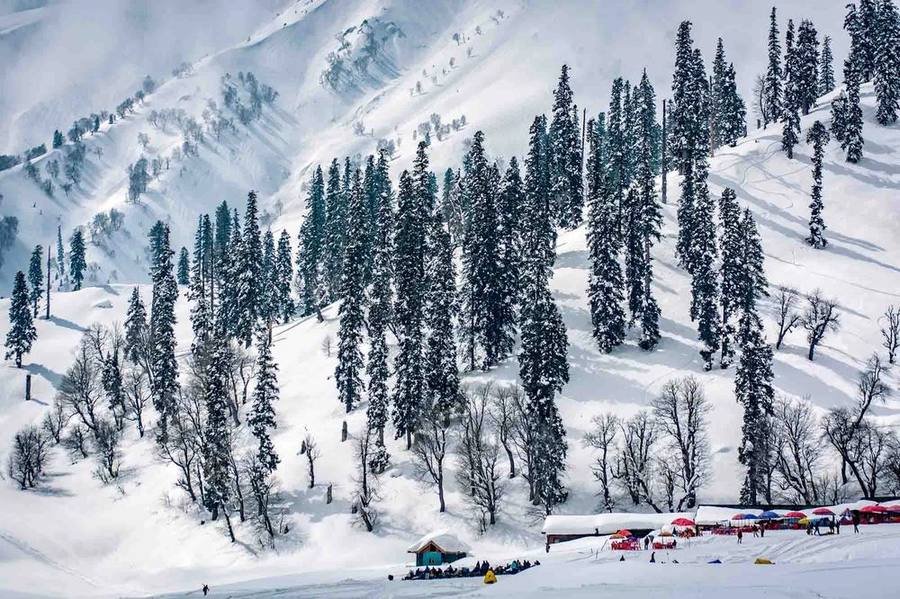
Winter is when Gulmarg earns its reputation. JKTDC puts the best skiing season from November to February, on slopes between about 8,700 and 10,500 feet, with powder that draws skiers from around the world; learner slopes and instructors sit near the resort. In summer the same bowl is a flower meadow, with an 18-hole golf course at 2,650 metres — one of the highest in the world — at its centre. Stay a night if you can: the meadow at dawn, before the day-trippers arrive from Srinagar, is the quietest hour in Kashmir.
Pahalgam: the Valley of Shepherds on the Lidder
Pahalgam sits about 90–96 km from Srinagar, at roughly 2,130 metres, where the Lidder River runs through pine forest — and the drive there is half the pleasure, passing the saffron fields of Pampore. The town itself is the base for three valleys, each a short drive away. Betaab Valley, about 15 km towards Chandanwari, is the film-famous meadow named after the 1983 film Betaab, shot here. Aru Valley, about 12 km up the Lidder, is a meadow village and the trailhead for treks towards the Kolahoi Glacier. Baisaran, often called the mini Switzerland of Kashmir, is a pine-ringed meadow reached by pony ride from the town. Chandanwari, about 16 km away, is where the Amarnath Yatra begins each summer. See our Pahalgam guide.
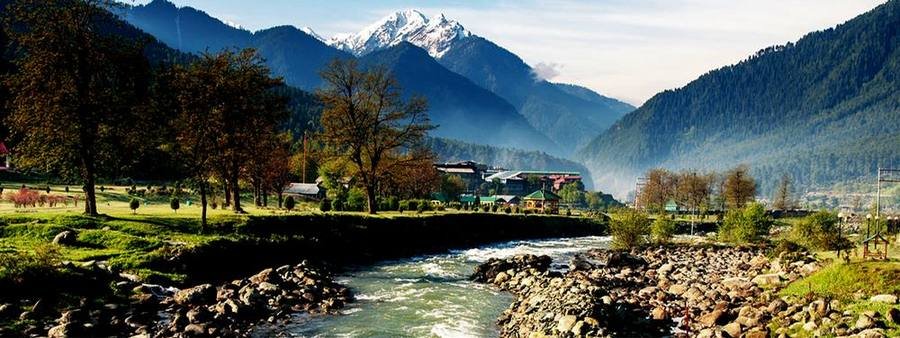
Pahalgam rewards two nights rather than a day trip: the first day for Betaab and Aru, the second for a slow walk along the Lidder, trout fishing or a pony ride to Baisaran. Note that the valley sightseeing — Betaab, Aru, Chandanwari — runs on local taxis hired at Pahalgam itself, not on outside cars. In winter Pahalgam turns quiet and snowy, and the same valleys that are green in June are white by January.
Sonmarg: the Meadow of Gold Below Thajiwas Glacier
Sonmarg, about 80 km from Srinagar on the road to Ladakh, sits at roughly 2,740–2,800 metres on the banks of the Sindh River, and its name means “meadow of gold”. The draw is the Thajiwas Glacier, reached by pony ride from the town, where snow lingers through the summer. Beyond Sonmarg the road climbs towards Zoji La, the pass into Ladakh, which is why most people visit as a day trip from Srinagar, leaving by about 8 am. Go between May and September, when the road is fully open and the meadow is green; in deep winter the higher road can close. If you are continuing to Ladakh, read our how to reach Leh Ladakh guide before you set out. See our Sonmarg guide.
Jammu and Katra: Vaishno Devi and the City of Temples
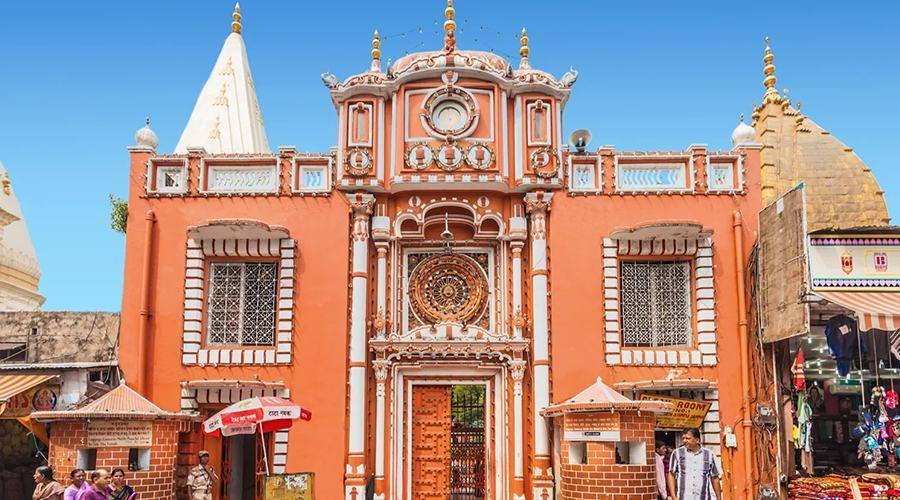
Jammu, the winter capital, is a different trip from the valley — warmer, flatter, and built around temples, which is why it is called the City of Temples. Most visitors come for Vaishno Devi: from Katra, about 48 km from Jammu, the climb to the shrine is roughly 12 km uphill on a paved track, with ponies, palkis and a helicopter service for those who need them. Plan the yatra for March–April or September–October, when the weather is kindest and the crowds are thinner than festival weeks. In the city, the Raghunath and Ranbireshwar temples sit near Jammu Tawi station, and Bahu Fort, above the Tawi River, holds the Bagh-e-Bahu garden. The new railway link through the Chenab Rail Bridge is steadily changing how travellers reach the region; check current services before you plan around it. See our Jammu guide.
Patnitop: Pine Forest Above the Jammu Hills
Patnitop, about 110 km from Jammu on the Srinagar highway at roughly 2,024 metres, is the hill station the Jammu region keeps for itself: deodar pine forest, rolling meadows and a much cooler summer than the plains below. Nathatop, about 10 km further up, is the viewpoint and adventure spot above it, known for paragliding and for winter snow when the meadows whiten. Come between April and June for walking and views, or in December to February for snow. It works well as an overnight stop on the Jammu–Srinagar road, breaking the long drive into two easy days.
Doodhpathri: the Valley of Milk
Doodhpathri, a day trip from Srinagar, is the meadow for travellers who found Gulmarg too busy: a wide grass valley with a river running through it, pine forest on the slopes, and almost no crowds. Its name means “valley of milk”, after the milky colour of the river water. There is little here by way of shops or sights, and that is the point — come for a picnic and a slow afternoon, and be back in Srinagar by evening.

Yusmarg: the Slow Valley
Yusmarg is the other quiet meadow, south-west of Srinagar, reached through pine forest and apple orchards. The Doodhganga River runs through it, and the day’s work is a pony ride, a walk to the small lakes above the valley, or nothing at all. Put it on a seven- or eight-day itinerary, when the main circuit is done and you want one unhurried day before flying home.

What Is the Best Time to Visit Jammu and Kashmir?
There is no single best month — there are four different trips. March to April brings spring: tulips in Srinagar and blossom in the orchards. May to August is the classic summer season, when every road is open. September to November is autumn, when the chinar trees turn gold. December to February is deep winter: snow everywhere and skiing in Gulmarg. Want snow? Go from late December to early March. Want every road open? Go from May to October.
How Many Days Do You Need in Jammu and Kashmir?
Count nights, not days. Three to four days suits a quick Srinagar escape with one of Gulmarg or Pahalgam. Five to six days is the sweet spot: two nights in Srinagar, one on a houseboat, one night in Gulmarg and two in Pahalgam, with Sonmarg as a day trip. Seven to eight days adds the quieter meadows — Doodhpathri or Yusmarg — and time that is not spent entirely in a vehicle. Nine to ten days covers the valley plus Jammu and Vaishno Devi at a relaxed pace. Whatever the length, keep one buffer day: winter weather can close roads and delay flights out of Srinagar.
How to Reach Jammu and Kashmir
Fly into Srinagar’s Sheikh ul-Alam International Airport for the valley, or into Jammu for the south. Jammu Tawi is the main railhead, with trains from Delhi and across the north; the railway is being extended towards Srinagar. By road, the Jammu–Srinagar highway (NH44) links the two capitals, and it is the stretch most affected by winter weather, so check its status on the day. Inside the valley, hire a car with a local driver for the circuit — Srinagar to Gulmarg, Pahalgam and Sonmarg — and use local taxis for the valley sightseeing at Pahalgam and Sonmarg, where outside cars are not allowed.
Is Jammu and Kashmir Safe for Tourists?
The valley welcomes large numbers of visitors every year, and the main tourist circuit — Srinagar, Gulmarg, Pahalgam, Sonmarg — runs normally. Conditions in the region can change, though, and travel advisories and road access do vary, so check your government’s current advisory and the local situation for your dates before you book, keep a buffer day in the plan, and follow local advice once you are there.
Watch & Feel the Place
Videos are by their respective creators.
Best Places to Visit in Jammu and Kashmir FAQs
What is the best time to visit Jammu and Kashmir?
It depends on what you want. March to April brings tulips and spring blossom; May to October opens every road and is best for a first trip; September to November brings golden chinars and clear skies; December to February is for snow and skiing in Gulmarg. There is no bad month, only different trips.
How many days are enough for Jammu and Kashmir?
Five to six days covers Srinagar, Gulmarg and Pahalgam at a comfortable pace, with Sonmarg as a day trip. Three to four days works for Srinagar plus one of Gulmarg or Pahalgam. Add Jammu and Vaishno Devi with nine to ten days, and keep a buffer day for winter weather.
Is Jammu and Kashmir safe for tourists?
The main tourist circuit — Srinagar, Gulmarg, Pahalgam and Sonmarg — welcomes large numbers of visitors every year and runs normally. Conditions can change, so check your government’s current travel advisory and local conditions for your dates before booking, and follow local advice while travelling.
How do I reach Kashmir?
Fly into Srinagar’s Sheikh ul-Alam International Airport, or take a train to Jammu Tawi and drive up the Jammu–Srinagar highway (NH44). Inside the valley, hire a car with a local driver for the circuit, and use local taxis for sightseeing at Pahalgam and Sonmarg.
What is the famous food of Jammu and Kashmir?
Kashmiri cuisine centres on the wazwan feast — rogan josh, yakhni, gushtaba and rista — with kahwa, the saffron almond tea, and Kashmiri breads alongside. Jammu’s side of the table brings kaladi kulcha and dum aloo. Our famous food of Jammu and Kashmir guide covers the full table.
Nine places, one valley and a winter capital: a lake that freezes, a gondola that climbs to nearly 4,000 metres, and valleys named for shepherds and gold. Start in Srinagar, sleep one night on the lake, and let the season choose the rest. Next, read our famous food of Jammu and Kashmir guide — and our Kashmir in winter guide if you are travelling between December and February.
Plan your Jammu and Kashmir trip
Dal Lake at dawn, the Gulmarg gondola, Pahalgam’s valleys and Vaishno Devi — five to six days covers the valley, and winter is the season to see it at its whitest.
Jammu and Kashmir state guide →