
Festival Guide · October 2027
For five nights every autumn, Kolkata stops being a city and becomes a gallery. More than 3,000 neighbourhood pandals open their doors at once, the metro runs past midnight, and millions of people walk the streets until dawn — all of it built around clay, bamboo and light, and all of it gone within days. Durga Puja 2027 runs from Maha Shashthi on Tuesday 5 October to Bijoya Dashami on Sunday 10 October, and this is the guide to seeing it properly.
Durga Puja 2026 concluded on 21 October 2026. This guide covers the 2027 edition — the dates, the pandals worth your time, the routes that actually work, and the practical details that make the difference between a magical night and a miserable one. If you are reading this before October 2027, the dates below come from the Bengali almanac (panchang) and match the dates on our Durga Puja 2027 in Kolkata festival page; confirm them nearer the time, since almanac traditions can differ by a day for some rites.

The main days run from Maha Shashthi on Tuesday 5 October to Bijoya Dashami on Sunday 10 October 2027. Mahalaya falls on Wednesday 29 September 2027, and pandals generally open to visitors from Shashthi. The five main days are Shashthi (5 October), Saptami (6 October), Ashtami (7 October), Navami (9 October) and Dashami (10 October). The festival is centred on Kolkata, where it was inscribed on UNESCO's Representative List of the Intangible Cultural Heritage of Humanity on 15 December 2021.
The best nights for pandal-hopping are Saptami, Ashtami and Navami, when the big pandals are fully open, the lighting is at its best and the city stays out latest. Shashthi is quieter and a good night for a first, unhurried walk. Dashami is for the immersion processions, when the goddess is carried to the river.
You do not need a ticket or a pass to see the pandals. The great majority are free and open to everyone, all night. There is no paid VIP pass for ordinary public viewing — anyone selling you one for a neighbourhood pandal is selling you something that does not exist.
Durga Puja marks the goddess Durga's victory over the buffalo-demon Mahishasura, and her annual return to her parents' home. In Bengal it is far more than a religious festival: it is the year's biggest public art event. Each neighbourhood — each para — commissions a pandal, a temporary pavilion that is also a work of installation art, and a clay idol of the goddess made by hand in the potters' quarter of Kumartuli.
Kolkata alone has more than 3,000 community pandals, and the festival draws millions of visitors over its five days. On 15 December 2021 UNESCO inscribed "Durga Puja in Kolkata" on its Representative List of the Intangible Cultural Heritage of Humanity — the first festival in Asia to receive that recognition. The inscription covers the whole practice: the idol-making, the pandal art, the rituals, the music, the food and the crowds.
What makes it different from other Indian festivals is that the art is the point. A pandal is not a backdrop; it is the work. Themes change every year — a pandal might be built entirely from recycled materials, or shaped like a temple from another state, or dedicated to a social cause. The idol, too, is remade every year from river clay, worshipped for five days, and then immersed. Nothing is kept.
The dates below follow the Bengali almanac (panchang) for 2027 and match the dates on our festival page. They are the dates Kolkata observes; almanac traditions can differ by a day for some rites, so check again as October approaches.
Mahalaya — Wednesday 29 September 2027. The goddess is invoked and the festival season begins. In Kolkata, Mahalaya morning is famous for the radio broadcast of Birendra Krishna Bhadra's "Mahishasura Mardini", a tradition since the 1930s.
Maha Shashthi — Tuesday 5 October 2027. The goddess is formally welcomed and the pandals open. Bodhon, the awakening of the goddess, takes place in the evening.
Maha Saptami — Wednesday 6 October 2027. The first full day of worship. The ritual bathing of a banana plant (Kola Bou), dressed as a bride, is the day's distinctive rite.
Maha Ashtami — Thursday 7 October 2027. The most important day of the Puja. Devotees fast until the Pushpanjali (flower offering) and the evening Sandhi Puja, the climactic rite at the junction of Ashtami and Navami. In 2027 the Ashtami tithi runs long, into the morning of 8 October, so Sandhi Puja falls late — check the exact time nearer the day.
Maha Navami — Saturday 9 October 2027. The last full day of worship, and the biggest night for pandal-hopping. Kumari Puja — the worship of a young girl as the living goddess — is performed in the morning at several famous pandals, including Belur Math.
Bijoya Dashami — Sunday 10 October 2027. The farewell. Married women smear each other with vermilion (Sindoor Khela), the goddess is carried in procession to the river, and the idols are immersed. It is the most emotional day of the festival — and the most crowded at the ghats.
Kolkata's pandals fall into two rough halves — north and central, and south — and a good plan covers one half per night. The famous names change in reputation from year to year, but these are the pandals that consistently draw the biggest crowds and the most ambitious art.
North and Central Kolkata. Sreebhumi Sporting Club, in Lake Town, is famous for its scale — it has recreated everything from the Vatican to the Burj Khalifa. Santosh Mitra Square, near Sealdah, is known for its gold and silver work. Kumartuli Park sits in the potters' quarter itself. College Square, with its lake and illuminated water, is one of the most photographed pandals in the city. Bagbazar Sarbojanin, founded in 1919, is one of the oldest community pujas. Tala Prattoy, Jagat Mukherjee Park and Mohammad Ali Park are all within a short walk of each other, and the Shobhabazar Rajbari — the 1757 palace where the festival began in its modern form under Raja Nabakrishna Deb — still holds its own traditional puja.

South Kolkata. Chetla Agrani and Suruchi Sangha, in the Alipore–New Alipore area, are famous for themed pandals that change completely every year. Ekdalia Evergreen, in Gariahat, has been running since 1943. Deshapriya Park, Mudiali, Tridhara, Jodhpur Park, Singhi Park and Hazra Park form a walkable cluster in the south, and Rajdanga Naba Uday Sangha and Dum Dum Park Bharat Chakra are worth the trip for their ambition.
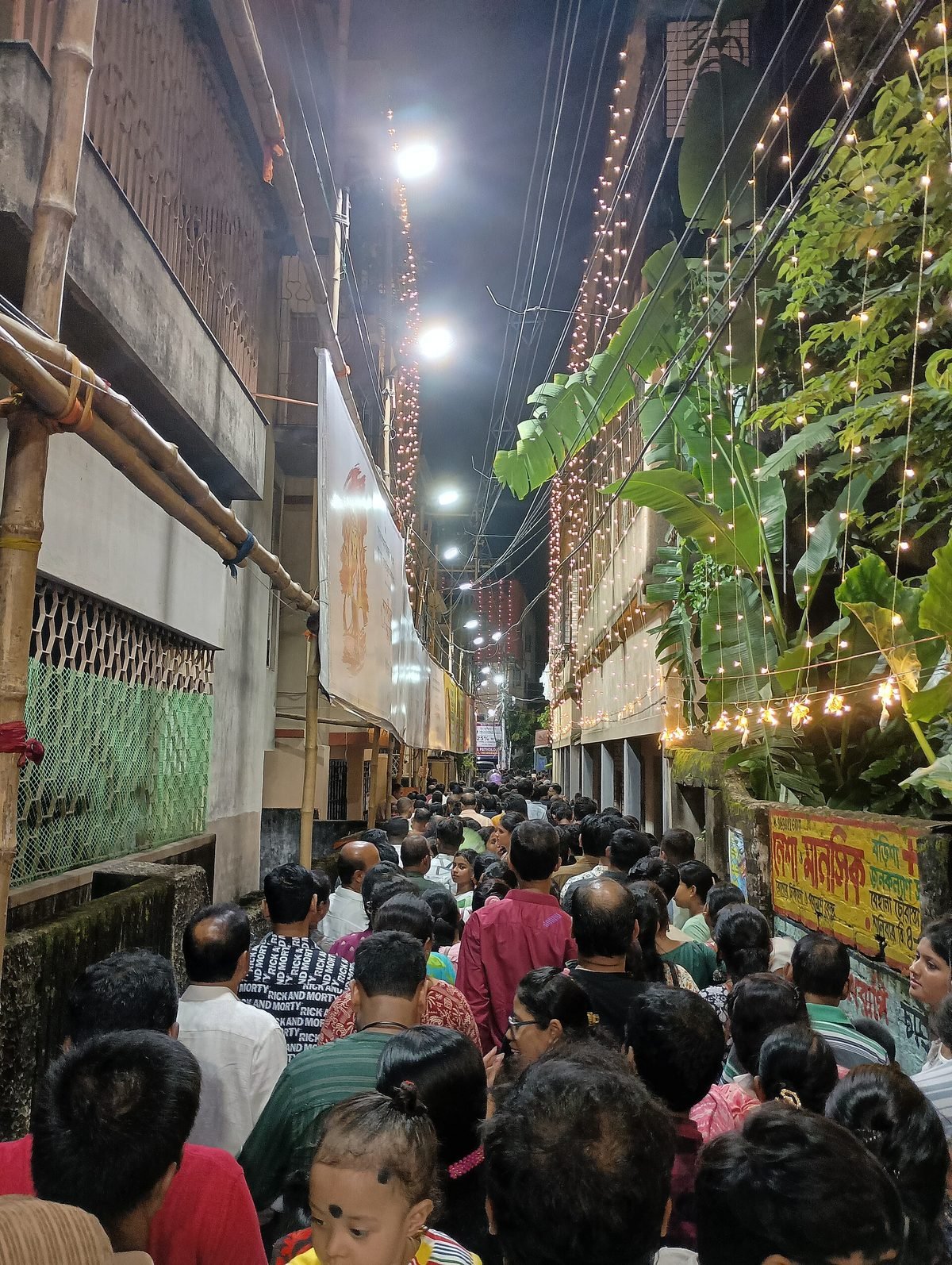
The single biggest mistake first-timers make is trying to see everything in one night. The queues at the famous pandals can run to an hour or more on Ashtami and Navami. Pick one area per night and walk it.
Night one — North Kolkata. Start at Sovabazar, walk through Kumartuli and Bagbazar, then take the metro or a taxi to College Square and Mohammad Ali Park. This is the old city: narrow lanes, old houses, and the most traditional pandals.
Night two — South Kolkata. Start at Gariahat (Ekdalia Evergreen, Deshapriya Park), walk south through Jodhpur Park and Singhi Park, and finish at Suruchi Sangha or Chetla Agrani. The south has the biggest theme pandals and the widest roads, so it is easier walking.
Night three — the big names. Sreebhumi and Santosh Mitra Square are the two most crowded pandals in the city. Go early in the evening, before the queues peak, or go very late — after 2 AM the crowds thin and the pandals are still open.
Kolkata Police publishes an annual Durga Puja guide map with the major pandals marked, and it is the most reliable way to plan a route. Pick one up at a police assistance booth or check the Kolkata Police website before you go.
The metro is the best way to move around during the Puja, and the city extends its hours for the festival. In 2026 the Blue and Green lines ran from around 1 PM to 4 AM on Saptami, Ashtami and Navami. Expect a similar pattern in 2027, but confirm the exact timings on the Kolkata Metro website before you travel — they are announced a few days before the festival.
Useful stations. Sovabazar Sutanuti (Blue Line) for Kumartuli and Bagbazar. Girish Park for College Square and Mohammad Ali Park. Esplanade for the central pandals. Kalighat and Jatin Das Park for the south Kolkata cluster. Rabindra Sarobar for the Lake-area pandals.
Roads in the pandal areas are closed to private cars during the Puja, and app cabs surge heavily. Walk where you can, use the metro for longer jumps, and allow far more time than Google Maps suggests. A 20-minute walk can take an hour in the crowds on Ashtami night — and that is part of the experience.
The rituals give the festival its shape. Bodhon, on Shashthi evening, is the awakening of the goddess. The Pushpanjali on Ashtami morning — when thousands of devotees offer flowers together — is the most moving moment of the Puja, and anyone can join in. Sandhi Puja, at the junction of Ashtami and Navami, is the climactic rite, when 108 lamps are lit. Sindoor Khela on Dashami, when married women smear each other with vermilion before the immersion, is the festival's emotional farewell.

The idol itself is worth looking at closely. Durga stands on her lion, ten-armed, with her four children beside her — Lakshmi and Saraswati, Ganesha and Kartikeya — and the buffalo-demon Mahishasura at her feet. Every part of the idol is made by hand in Kumartuli, from straw and bamboo armatures to river clay, and the eyes are painted last, in a rite called Chokkhu Daan, around Mahalaya. Read more about the makers and the story of Mahishasura in our Kumartuli guide.
Book early. Hotels in central and south Kolkata fill up weeks before the Puja, and prices rise sharply — book by August at the latest. Staying near a metro station matters more than staying near any one pandal.
Eat on the street. The Puja is also a food festival. The pandal areas fill with stalls selling everything from phuchka and kathi rolls to full Bengali thalis. Eat where the queues are longest.
Wear comfortable shoes and light clothes, and go late. You will walk for hours, mostly at night, in crowds, and October in Kolkata is warm and humid. The pandals are open all night and the crowds peak between 8 PM and midnight; after 1 AM the queues shorten and the light is better for photographs. Carry water, and keep your phone and wallet in a front pocket or a cross-body bag.
One last note: the Red Road Carnival, the grand immersion procession that used to close the festival, was scrapped in 2026 and is not part of the current festival. Do not plan your trip around it. The immersion processions at the ghats — Babughat, Prinsep Ghat, Bagbazar Ghat — are where Dashami happens now.
Durga Puja is not a festival you watch. It is a festival you walk through, eat through, and stay up all night for. Plan one area per night, go late, eat on the street, and let the crowds carry you. That is how Kolkata does it.
For the wider trip, see our Kolkata guide and the West Bengal state page.
The main days run from Maha Shashthi on Tuesday 5 October to Bijoya Dashami on Sunday 10 October 2027. Mahalaya falls on 29 September 2027. The dates follow the Bengali almanac (panchang); almanac traditions can differ by a day for some rites, so confirm them nearer the time.
No. The great majority of Kolkata's pandals are free and open to everyone, all night. There is no paid VIP pass for ordinary public viewing at a neighbourhood pandal.
In the north and centre: Sreebhumi, Santosh Mitra Square, Kumartuli Park, College Square, Bagbazar Sarbojanin and Shobhabazar Rajbari. In the south: Chetla Agrani, Suruchi Sangha, Ekdalia Evergreen, Deshapriya Park and Dum Dum Park Bharat Chakra. Plan one area per night — the famous pandals are rebuilt from scratch every year, so follow the queues.
The metro extends its hours for the festival. In 2026 the Blue and Green lines ran from around 1 PM to 4 AM on Saptami, Ashtami and Navami. Expect a similar pattern in 2027, but confirm the exact timings on the Kolkata Metro website a few days before the festival.
Yes. UNESCO inscribed “Durga Puja in Kolkata” on its Representative List of the Intangible Cultural Heritage of Humanity on 15 December 2021 — the first festival in Asia to receive that recognition.
Kolkata Police publishes an annual Durga Puja guide map with the major pandals marked. Pick one up at a police assistance booth during the festival or check the Kolkata Police website before you go.
Go late. The pandals are open all night and the crowds peak between 8 PM and midnight. After 1 AM the queues shorten, the light is better for photographs, and the city is at its most magical.