
Delhi · 3-Day Itinerary
Delhi in 3 Days: The Complete Itinerary

By Beauty of Bharat — India travel guide, every place, every flavour.
Guides covering all 36 States and UTs, researched from official sources and checked at publish time. Corrections welcome — see About Beauty of Bharat.

Delhi is not one city but eight. That is the count India’s own tourism board gives: eight historic cities built, destroyed and rebuilt on the same ground, from the 12th-century Qutub Minar to the colonial avenues of New Delhi, inaugurated as the capital in 1931. Three days is exactly enough to walk through three of them. Day 1 takes Shahjahanabad, the walled Mughal city of the 1600s: the Red Fort, Jama Masjid and Chandni Chowk. Day 2 takes Lutyens’ New Delhi: India Gate, the Rashtrapati Bhavan quarter, Humayun’s Tomb, the Lotus Temple and the Qutub Minar. Day 3 takes modern Delhi: Akshardham, Dilli Haat, Hauz Khas and Lodhi Gardens. One city per day, the metro doing the long hauls, and every evening ending somewhere you can eat well. See our Delhi guide for the city at a glance.
Delhi in 3 Days at a Glance
| Day | Where you go | Not to miss |
| Day 1 — Old Delhi | Red Fort, Jama Masjid, Chandni Chowk, Raj Ghat | Sunrise at the Red Fort, parathas in Chandni Chowk |
| Day 2 — New Delhi | India Gate, Rashtrapati Bhavan area, Humayun’s Tomb, Lotus Temple, Qutub Minar | Humayun’s Tomb in the morning light, Qutub Minar at dusk |
| Day 3 — Modern Delhi | Akshardham, Dilli Haat, Hauz Khas, Lodhi Gardens, National Museum | The Akshardham water show, sunset at Lodhi Gardens |
Timings, fares and entry fees as reported at publish time; confirm them locally before you travel — all costs below are rough estimates.
How Many Days Are Enough for Delhi?
Three days is the honest answer for a first trip. One day gives you the Red Fort and India Gate — a postcard. Two days adds Humayun’s Tomb and Chandni Chowk, but forces a choice between the Qutub Minar and Akshardham. Three days is where the trip stops feeling rushed: the three UNESCO sites, the bazaars, one museum and one unhurried evening in Hauz Khas. Four or five days adds a day trip — see our weekend trips from Delhi guide.
Day 1 in Delhi: Old Delhi — Red Fort, Jama Masjid and Chandni Chowk
Morning — the Red Fort. Start at the Red Fort itself, early, before the tour groups arrive. Shah Jahan built the palace fort of Shahjahanabad between 1639 and 1648, and UNESCO calls it the zenith of Mughal creativity — red sandstone walls and marble pavilions joined by the Nahr-i-Behisht, the Stream of Paradise. The complex is open from sunrise to about 9 pm, and an Archaeological Survey of India order of February 2026 ended the old Monday closure, so it is now open daily — though older guides still list Mondays as closed, so confirm on the day. Entry is about ₹35–50 for Indian visitors and ₹550–600 for foreign visitors, a rough estimate, and children under 15 enter free. Allow two to three hours, and take the metro to Lal Qila station on the Violet Line. Our Red Fort guide has the full story.
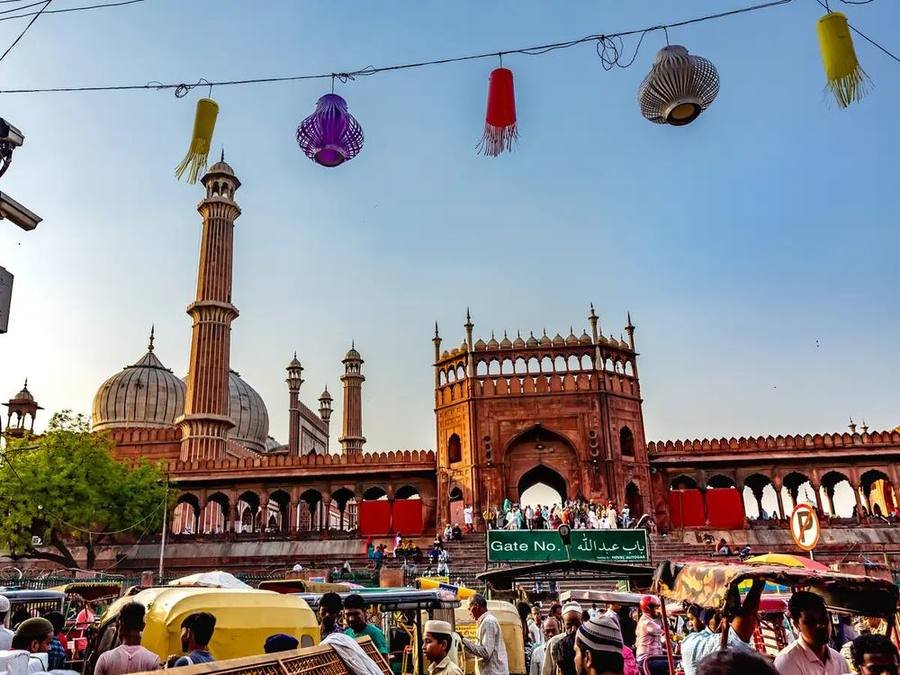
Midday — Jama Masjid and Chandni Chowk. From the fort, cross to Jama Masjid, completed in 1656 and one of India’s largest mosques, its sandstone courtyard holding some 25,000 worshippers. It is open to visitors from about 8 am to sunset, closed during prayer hours — plan around Friday midday — and Indian visitors enter free while foreign visitors pay a small fee of about ₹400, a rough estimate. Climb the southern minaret if it is open: the view across the fort and the bazaar roofs is the best in Old Delhi. Then walk into Chandni Chowk, the market street Shah Jahan built with the fort in the 17th century, and eat your way down it: stuffed parathas in Paranthe Wali Gali, jalebis fried in front of you, and the spice sacks of Khari Baoli, one of Asia’s largest spice markets. Our best street food in Delhi guide lists what to order and where.
Evening — Raj Ghat. End Day 1 quietly at Raj Ghat, the black marble memorial to Mahatma Gandhi on the banks of the Yamuna, a short auto ride from the fort. The eternal flame burns beside the spot where Gandhi was cremated in 1948, and the gardens are one of the few places in Old Delhi where the noise stops. Entry is free and it is open daily. Come at dusk, when the crowds thin and the flame is the brightest thing in the garden.
Day 2 in Delhi: New Delhi — India Gate, Humayun’s Tomb and Qutub Minar
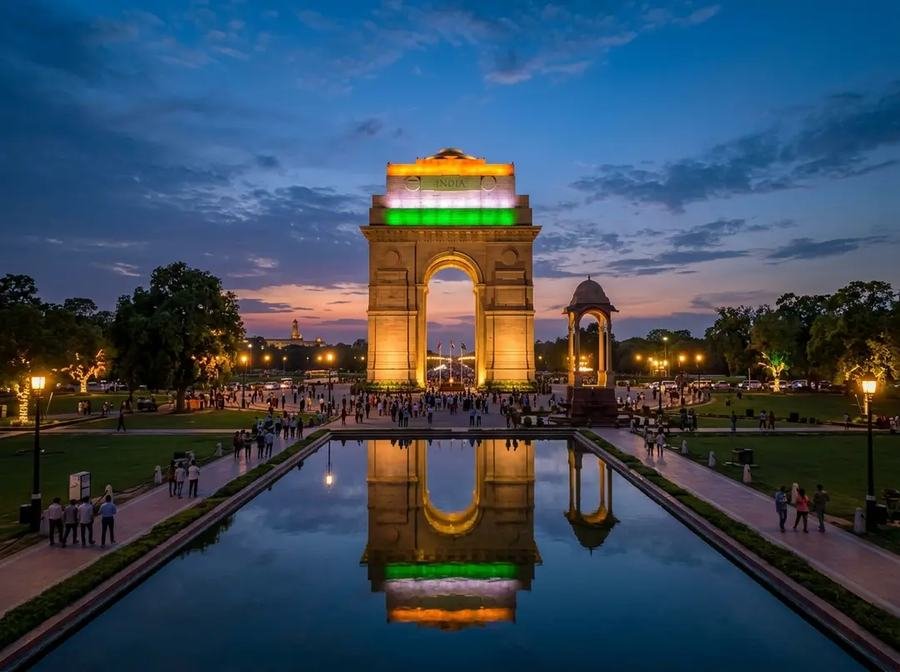
Morning — India Gate and the Rashtrapati Bhavan quarter. Day 2 starts on the wide avenues the British laid out in the 1910s and 1920s. Take the metro to Central Secretariat and walk Kartavya Path — the ceremonial boulevard once called Rajpath — to India Gate, the 42-metre war memorial arch completed in 1931. It is free, open all hours, and best in the morning, when families picnic on the lawns and the sandstone glows. From there, look up the hill to Rashtrapati Bhavan, the President’s residence, and the Secretariat buildings flanking the avenue. Our India Gate guide covers the memorial and the National War Memorial beside it.
Midday — Humayun’s Tomb. Ride the Violet Line one stop to Jangpura for Humayun’s Tomb, the first grand Mughal garden tomb, built between 1565 and 1572 — the red sandstone and white marble mausoleum in a Persian char bagh garden that became the model for the Taj Mahal. It is open from sunrise to about 9 pm, and entry follows the same ASI table as the Red Fort: about ₹35–50 for Indian visitors and ₹550–600 for foreign visitors, a rough estimate, with children under 15 free. Come before midday, when the light is on the dome, and allow two hours for the main tomb and the garden. Our Humayun’s Tomb guide has the full history.

Afternoon — Lotus Temple. From Jangpura, the metro takes you to Kalkaji Mandir for the Lotus Temple, the Bahá’í House of Worship completed in 1986 and shaped like an unfolding lotus in white marble. Entry is free; the hall inside is silent, no photography, no sermons — sit for ten minutes and the city falls away. It is closed on Mondays, so if Day 2 falls on a Monday, swap it with the National Museum on Day 3. Our Lotus Temple guide covers visiting hours and the gardens.

Evening — Qutub Minar. End Day 2 in Mehrauli, at the Qutub Minar: the 72.5-metre tower begun in 1199 by Qutb-ud-din Aibak, the oldest of Delhi’s eight cities, ringed by the Quwwat-ul-Islam mosque, the Iron Pillar and the Ala’i Darwaza. The complex is open from sunrise to about 8 pm, entry about ₹35–50 for Indian visitors and ₹550–600 for foreign visitors, a rough estimate, and the tower has been closed to climbers since 1981. Come at dusk: the sandstone turns gold and the ruins empty out. Take the Yellow Line to Qutub Minar station. Our Qutub Minar guide has the full story.

Day 3 in Delhi: Akshardham, Dilli Haat, Hauz Khas and Lodhi Gardens
Morning — Akshardham. Day 3 starts at Swaminarayan Akshardham, the temple complex opened in 2005 on the banks of the Yamuna — carved pink stone and white marble, gardens and exhibitions. The temple itself is free to enter; the exhibitions and the evening water show are ticketed, so check prices on the day. It is closed on Mondays, and photography is not allowed inside the temple. Take the Blue Line to Akshardham station and allow three to four hours. Our Akshardham guide covers timings and the water show.

Afternoon — Dilli Haat and Hauz Khas. From Akshardham, cross the city to Dilli Haat at INA — the open-air crafts bazaar where artisans from every state sell textiles, pottery and jewellery from their own stalls, with food from a different state at every counter. Entry is a small fee, and it is the best single place in Delhi to buy something made by the person selling it. Then ride to Hauz Khas on the Yellow Line: a 14th-century reservoir, the ruins of Firoz Shah Tughlaq’s madrasa and tomb on its edge, and the lanes of Hauz Khas Village behind it.
Evening — Lodhi Gardens and the National Museum. End the trip at Lodhi Gardens, the park of 15th- and 16th-century Lodhi tombs between Khan Market and the India Gate quarter — free, open from sunrise, and at its best in the hour before sunset, when joggers, families and the old domes share the lawns. If you still have an hour, the National Museum on Janpath, near India Gate, holds the country’s oldest collection, from Harappan artefacts to Mughal miniatures; it is ticketed, and like most Delhi museums it is typically closed on Mondays, so check before you go. Our best shopping markets in Delhi guide covers Dilli Haat, Khan Market and Sarojini Nagar.
Where to Stay in Delhi for 3 Days
Stay in one area and let the metro do the work. Connaught Place and the streets around it are the most convenient base for first-timers: the Yellow and Blue Lines cross at Rajiv Chowk, India Gate is a short ride away, and the restaurants and markets stay open late. Paharganj, near New Delhi station, is the budget end of the same centre, with the same metro access. If you would rather wake up somewhere quieter, the lanes around Hauz Khas and Greater Kailash put you near Day 3’s sights and the Yellow Line. Stay near a station either way — Rajiv Chowk, Mandi House or Hauz Khas cover all three days. No hotel names or prices here — rates swing by season, so check live prices for your dates.
What Does a 3-Day Delhi Trip Cost?
All figures below are rough estimates, per person per day, excluding stay — confirm before booking, because fares and entry fees change. Foreign visitors should budget more: the three ASI monuments alone cost about ₹550–600 each at the online rate.
| Style | Food & transport | Entries & extras | Daily total |
| Budget | Street food & metro, about ₹500–800 | One paid sight a day, about ₹100–200 | About ₹1,000–2,000 |
| Comfortable | Cafés, cabs & metro, about ₹1,000–1,500 | Museums & Akshardham shows, about ₹400–800 | About ₹2,500–4,000 |
Stay is the big variable: it can cost less than a day’s food or more than the whole trip, depending on season and area.
What Is the Best Time to Visit Delhi?
October to March, when the air is dry and cool enough to walk all day — the season this itinerary is written for, and the reason December is one of Delhi’s busiest months. But December has a catch: the mornings can be foggy and cold, with flights and trains running late, and the air quality can turn poor, so check the day’s reading before planning long hours outdoors. Start late on foggy mornings and let the sun burn through before the big outdoor sites. March is the other sweet spot, mild and clear. April to June is brutally hot, with daytime temperatures routinely above 40°C; July to September is the monsoon, humid with sudden heavy rain.
Getting Around Delhi
Let the metro do the long hauls. The Yellow Line runs Chandni Chowk and Chawri Bazaar in Old Delhi through Rajiv Chowk and INA to Qutub Minar and Hauz Khas; the Violet Line runs Lal Qila and Jama Masjid through Jangpura to Kalkaji Mandir; the Blue Line reaches Akshardham; the Magenta Line meets the Yellow Line at Hauz Khas. A one-day tourist card costs roughly ₹200 and a three-day card roughly ₹500, a rough estimate — either pays for itself quickly on this plan. Inside Old Delhi, walk or take a cycle rickshaw for the short hops; auto-rickshaws and app cabs cover the rest.
Watch & Feel the Place
Videos are by their respective creators.
Delhi in 3 Days FAQs
Is 3 days enough to see Delhi?
Yes — three days covers the major highlights comfortably: the Red Fort, Jama Masjid and Chandni Chowk on Day 1, India Gate, Humayun’s Tomb and the Qutub Minar on Day 2, and Akshardham, Dilli Haat and Lodhi Gardens on Day 3. For a day trip to Agra, or for the museums in depth, add a fourth day.
How many days do you need in Delhi?
Three full days is the right amount for a first visit: one day for Old Delhi, one for New Delhi and one for modern Delhi, at a comfortable pace. Two days works for the highlights only, and five days lets you add Agra and a slower museum day.
What is the best time to visit Delhi?
October to March is the best time: dry, relatively cool and clear-skied, with December one of the busiest months. March is mild and clear; April to June is very hot, and July to September is the monsoon. In December, watch for morning fog and check the air quality before long days outdoors. For the wider month, see our best places to visit in India in December guide.
How much money should I budget for 3 days in Delhi?
Excluding stay, a budget traveller spends roughly ₹1,000–2,000 a day on food, metro and entries, and a comfortable traveller roughly ₹2,500–4,000 a day. Foreign visitors pay more at the ASI monuments — about ₹550–600 per site — so add roughly ₹1,500–1,800 for the three of them.
Can I add the Taj Mahal to a 3-day Delhi trip?
Yes, but add a fourth day rather than squeezing it into the three. Agra is about two hours each way by express train, and the Taj Mahal deserves a full morning — an early train out, the fort and the Taj, and an evening train back. Our Golden Triangle itinerary shows how Delhi, Agra and Jaipur fit together.
Three days, three cities, one metro card: Delhi rewards the traveller who gives each layer its own day. Start at the Red Fort at dawn, end at Lodhi Gardens at dusk, and let the fog, the food and the 800-year-old towers set the pace. Next, stretch the trip with our best weekend trips from Delhi guide — Agra’s Taj Mahal, Jaipur’s forts and the hills beyond are all a morning away.
Plan your Delhi trip
Red Fort at dawn, Humayun’s Tomb in the morning light, Qutub Minar at dusk and Akshardham on Day 3 — three days covers Delhi’s best, and October to March is the season to do it.
Delhi travel guide →