
Meghalaya · Tourist Attraction Guide
Dawki, Meghalaya: The Umngot River Guide — Boating, Best Time & How to Reach

By Beauty of Bharat — India travel guide, every place, every flavour.
Guides covering all 36 States and UTs, researched from official sources and checked at publish time. Corrections welcome — see About Beauty of Bharat.

Look at the photograph above. The boat seems to float on air, its shadow sharp on the pebbles far below. It is real — but it is also a seasonal trick, and that is the first thing this Dawki, Meghalaya guide has to tell you honestly. The Umngot River only looks like this in the dry months, roughly November to April, once the monsoon silt has settled and the water runs low and clear. Turn up in July and you will find a brown river, beautiful in its own way but nothing like the photographs. Timed right, Dawki delivers one of India’s most startling sights: a river so transparent you cannot tell where air ends and water begins. This guide covers when to go, what the boat ride costs, the old bridge, the quieter stretch at Shnongpdeng, and how to reach Dawki from Shillong.
| Where | Dawki, West Jaintia Hills, Meghalaya, on the India–Bangladesh border |
| Known for | The Umngot River — glass-clear water in the dry season, with boats that seem to float on air |
| Best time | November to April for clear water; clearest December to March; go early in the morning |
| How long | A full day trip from Shillong, or two days with an overnight stay at Shnongpdeng |
| Getting there | By road from Shillong, about 82–95 km, roughly 2.5–3.5 hours; from Guwahati about 170–195 km |
| Permit | No permit needed for Dawki; carry a photo ID near the border |
Why Is the Umngot River So Clear?
In the dry season the Umngot carries almost no silt. The river drains the southern slopes of the Khasi and Jaintia Hills over a bed of rock, sand and pebbles, and once the monsoon rain stops in October, the soil settles, the flow drops, and sunlight reaches the bottom. The limestone-rich hills act as a natural filter, and the forested, sparsely settled catchment upstream sends very little runoff or pollution into the river. On a still morning a boat casts a sharp shadow on the stones several metres down — the famous floating-boat effect, strongest before about 9 AM, before wind and midday boats break the surface.
Two things spoil it: rain, which washes soil back in, and wind, which breaks the glassy surface. There is also an honest caveat for this season. Since late 2025 the river has turned murky at times because of silt from the Shillong–Dawki road-widening works upstream, and local operators have reported bookings falling when the water clouds over. Boats have kept running, but the famous clarity cannot be taken for granted on any given day — check recent reports or ask a local operator about the water that week.
Best Time to Visit Dawki
November to April is the window, and December to March is when the water is at its clearest. Meghalaya Tourism lists October to May as the pleasant season, and October is a fair shoulder month: the rains have gone, the hills are at their greenest, and the water is clearing week by week, though peak transparency usually arrives by November. January and February give the coldest, calmest water; March and April stay clear in the mornings, with pre-monsoon storms possible in the afternoons, and an annual boat race is held on the Umngot at Umsyiem in March–April. From June to September the monsoon turns the river high, fast and brown, and boating is often suspended — skip those months if clear water is your reason for going.
The time of day matters almost as much as the month. Be on the water by 8 or 9 AM, when the surface is mirror-flat, the light is soft and the queues are short. By late morning the ghat fills with day-trippers and ripples from dozens of boats break the glass effect; weekdays beat weekends for the same reason. November has a bonus this year: it is cherry-blossom season in Shillong, and the Shillong Cherry Blossom Festival runs on 20–21 November 2026, with the wild Himalayan cherry blooming pink around the city — Dawki and a pink Shillong pair naturally into one trip.
Dawki River Boating: Price, Timings & What to Expect
Boating is the reason most people come to Dawki, and it is a simple, low-key affair. The main ghat sits beside the Dawki suspension bridge, where local boatmen paddle small wooden boats along the calm stretches. A ride lasts about 30 to 60 minutes, and a boat seats about four people. Recent reports put the price at roughly Rs. 500 to Rs. 1,000 per boat — per boat, not per person — with the rate set locally by the boatmen and varying with the season and the crowds, so confirm the price and duration before you board. Boating generally runs from around 8 or 9 AM to 4 or 5 PM daily, weather and river conditions permitting, and boats can stop early in rain or high water.
On the ride itself, expect a slow paddle rather than a thrill: the pleasure is the water. Look down and you will see pebbles, fish and the boat’s own shadow on the riverbed; look up and the green Jaintia Hills close in on both banks. The boatmen usually pause at the clearest stretches for photographs. Wear wet-proof sandals, carry sunglasses and a light jacket, and keep your phone in a dry pouch. Ask for life jackets, especially if children are aboard, and if the water is running high after rain, take the boatman’s word on whether to go out at all.
The Dawki Suspension Bridge & the Bangladesh Border
Just above the boating ghat stands the Dawki suspension bridge, built by the British in 1932 and still carrying traffic across the Umngot. Walk it slowly for the view: from the middle you look straight down the river, with the boats below and the hills rising on either side. Photograph it from the riverbank in the early morning. Dawki town itself is small and busy — a border trading town rather than a resort — and the bridge is the landmark that tells you that you have arrived.
Dawki sits on the India–Bangladesh border, facing the Tamabil land port, and the Umngot forms part of the border here. Casual tourists cannot cross into Bangladesh — crossing needs a valid Bangladesh visa and the right paperwork, and the land port is a working trade crossing, not a sightseeing stop. You can walk to the border area and the Indo-Bangladesh Friendship Gate with a photo ID and look across at the same river, known in Bangladesh as the Piyain. Follow instructions from border personnel, and ask before photographing checkpoints.
Shnongpdeng: The Quieter Umngot
About 8 km upstream from Dawki, the village of Shnongpdeng sits on the same river — and for many travellers it is the better half of the trip. The water here is calmer and often clearer than at the crowded Dawki ghat, and the village has grown into the riverside-camping base for the Umngot: tents on the bank, kayaking, snorkelling and cliff jumping in season, and the option of staying the night beside the river instead of rushing back to Shillong. Meghalaya Tourism lists kayaking, cliff jumping, zip-lining and even scuba diving here, though what runs depends on the season — confirm for your dates.
Come to Shnongpdeng for time on the river rather than a single boat ride: an afternoon of kayaking, a swim, and a night in a riverside camp, with the morning boat ride while the water is still glass. Simply put, Dawki is the photograph and Shnongpdeng is the stay. There is no verified photograph of Shnongpdeng in this guide, so the village is described here from the sources rather than shown with a picture of another place. Carry cash: there are no ATMs in Dawki or Shnongpdeng, and mobile signal near the border is patchy and can flip to Bangladeshi networks, which can interrupt UPI payments.
Krang Suri Falls: A Nearby Add-On
With a second day, add Krang Suri Falls. It lies near Amlarem in the West Jaintia Hills, about 30 km from Dawki on the Jowai–Dawki road, roughly an hour’s drive, and is known for a deep turquoise pool at its base. The walk down from the parking area takes about 15 to 20 minutes, with steps. It pairs well with a Shnongpdeng overnight: falls in the morning, river in the afternoon. Swimming is not allowed, so treat it as a viewpoint stop. Krang Suri is described here from the sources, as no verified photograph of the falls was available for this guide.
Mawlynnong & the Living Root Bridge
Dawki is about an hour from Mawlynnong, the village often called Asia’s cleanest village, and the two are the classic single-day pairing from Shillong. Mawlynnong’s swept lanes, bamboo dustbins and flower-lined paths are worth an unhurried hour, and nearby at Riwai is the living root bridge — a bridge grown, not built, from the roots of rubber trees over generations. Read our full Mawlynnong cleanest village guide before you go, and see our Mawlynnong destination page for the practical details.
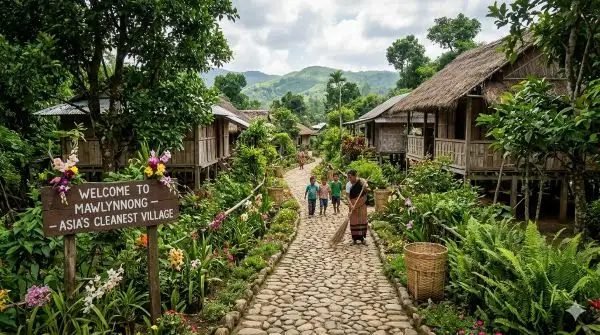
As a loop: Shillong to Dawki for the early boat ride, then Mawlynnong and the Riwai root bridge, and back by evening — long, but doable with a private cab and an early start. With two days, stay at Shnongpdeng and give Mawlynnong a slow morning.
How to Reach Dawki from Shillong
There is really only one way in: by road. Dawki is about 82 to 95 km from Shillong, roughly 2.5 to 3.5 hours by private taxi or shared cab, on the road south through Pynursla into the Jaintia Hills. The drive is scenic — limestone cliffs, deep gorges and Khasi villages — and the last stretch drops steeply to the river on tight bends, so take carsickness precautions before Pynursla. Leave Shillong by about 6 or 7 AM to reach the ghat before the crowds; shared taxis back to Shillong thin out after mid-afternoon, so a private cab is the safer choice for a day trip.
| From Shillong | About 82–95 km, roughly 2.5–3.5 hours by road via Pynursla; shared taxis leave from Bara Bazar in the morning |
| From Guwahati | About 170–195 km, roughly 5–6 hours by road via Shillong; Guwahati has the nearest airport and major railway station |
| From Mawlynnong | About an hour by road; the best base for an early boat if you stay the night before |
| Getting around | Private cab for the day is the practical choice; fuel up in Shillong, as there is no reliable petrol pump on the way |
Meghalaya has no railway network, so Guwahati is the rail and air gateway: fly or take a train to Guwahati, then drive to Shillong and on to Dawki. Shillong’s own Umroi airport has only limited flights, mainly from Kolkata. See our Shillong guide and our Cherrapunji (Sohra) guide for the rest of the southern hills.
Where to Stay Near Dawki
Stay at Shnongpdeng, not in Dawki town itself, if you want the river at dawn. The riverside camps at Shnongpdeng are the practical base: tents and simple cottages on the bank, with boating, kayaking and camping arranged on the spot. Dawki town has basic guesthouses and homestays, and Shillong — with the widest choice of hotels — works for a day trip. No property is named here, as prices and availability change fast; book by phone or a trusted platform and confirm directly. Carry cash, since card acceptance is limited and there are no ATMs in Dawki or Shnongpdeng. In the December peak, or for the cherry-blossom weekend in Shillong, book well ahead.
Practical Tips for Dawki
Cash first: there are no ATMs in Dawki or Shnongpdeng, so carry enough rupees for the boat ride, food and the return journey, and keep small notes, as change can be scarce. Mobile signal is patchy near the border and your phone may roam onto a Bangladeshi network, which can interrupt UPI payments, so do not rely on paying by phone. Carry a government photo ID, and a passport if you are a foreign national. Pack light layers for cool river mornings, plus sun protection and a dry pouch for your phone. And respect the river: the Umngot stays clear because the communities along it keep it clean, so take your litter back with you and do not use soaps or chemicals near the water.
Watch & Feel the Place: Dawki on Film
Videos are by their respective creators.
Dawki FAQs
Is the water in Dawki always clear?
No. The Umngot is glass-clear only in the dry season, roughly November to April, when the monsoon silt has settled and the flow is low and calm. From June to September the river runs high, fast and muddy, and boating is often suspended. Even in the dry season, heavy rain upstream can cloud the water for a day or two, and roadworks upstream have muddied it at times since late 2025, so check recent reports before you plan a trip around the clear water.
What is the best time to visit Dawki?
November to April, with the clearest water from December to March. Go early in the morning, ideally on the water by 8 or 9 AM, for the calmest surface, the sharpest floating-boat effect and the shortest queues. Meghalaya Tourism lists October to May as the pleasant season. Avoid June to September if the clear water and boating are your reason for going.
How do I reach Dawki from Shillong?
By road. Dawki is about 82 to 95 km from Shillong, roughly 2.5 to 3.5 hours by private taxi or shared cab via Pynursla through the Jaintia Hills. Leave Shillong early, by about 6 or 7 AM, to reach the boating ghat before the crowds. From Guwahati it is about 170 to 195 km, roughly 5 to 6 hours by road via Shillong. Meghalaya has no railway network, so the nearest major railhead and airport are in Guwahati.
Do I need a permit to visit Dawki?
No. Meghalaya does not require an Inner Line Permit, and no special permit is needed to visit Dawki. Carry a government photo ID, especially near the border, and foreign nationals should carry their passport. Dawki faces the Tamabil land port in Bangladesh, but casual tourists cannot cross the border; crossing needs a valid Bangladesh visa and the right paperwork.
How much does boating in Dawki cost?
Recent reports put the boat ride at roughly Rs. 500 to Rs. 1,000 per boat, not per person, for about 30 to 60 minutes, with a small wooden boat seating about four people. Rates are set locally by the boatmen and change with the season, so confirm the price and duration before you board. Boating generally runs from around 8 to 9 AM to 4 to 5 PM daily, weather and river conditions permitting.
Dawki is a small place with one great, honest trick: a river that turns to glass for half the year, a bridge from 1932, and a border you can stand beside. Go in the dry months, go early, and give it two days if you can — one for the boat at Dawki, one for the quiet water at Shnongpdeng. Next, read our Mawlynnong cleanest village guide for the village an hour away, our Shillong guide for the capital, or our famous food of Meghalaya — try jadoh, the Khasi rice-and-meat dish, in Shillong after the river — and for the wider region, see our best places to visit in North East India.
Plan your Meghalaya trip
Glass-clear rivers, living root bridges and Asia’s cleanest village — Meghalaya is the Northeast at its most beautiful.
Meghalaya state guide →