
Bihar · State Guide
Best Places to Visit in Bihar: Bodh Gaya, Nalanda & More

By Beauty of Bharat — India travel guide, every place, every flavour.
Guides covering all 36 States and UTs, researched from official sources and checked at publish time. Corrections welcome — see About Beauty of Bharat.
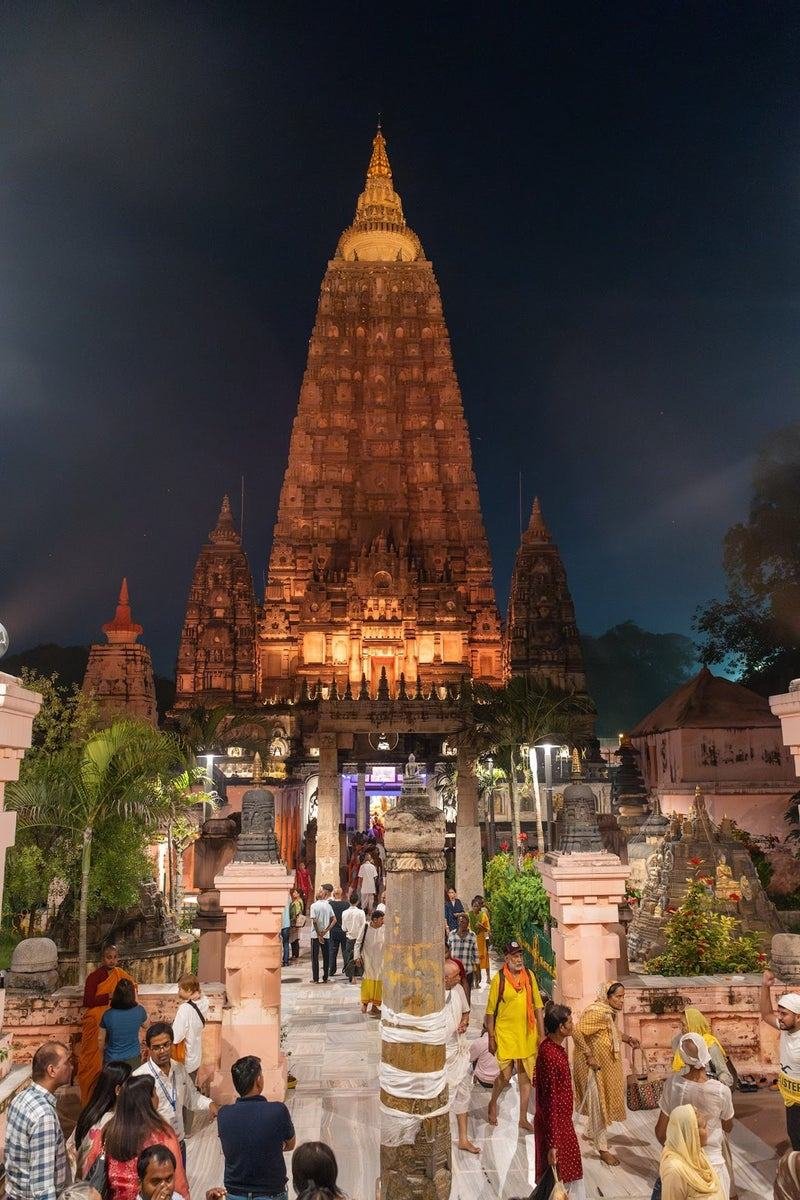
The world's first university and one of the world's first republics stand in the same Indian state — and most travellers have never set foot in either. That is the surprise of Bihar. The best places to visit in Bihar are Bodh Gaya, Nalanda, Rajgir, Patna, Vaishali, Pawapuri, Vikramshila and Valmiki National Park: two UNESCO World Heritage Sites, the tree under which the Buddha attained enlightenment, the ruins of the university that taught Asia, and the only national park in the state. This guide covers all of them, with the best time to go and a five-day route that links them. For the full state picture, see our Bihar state guide.
What are the best places to visit in Bihar?
| Bodh Gaya | Mahabodhi Temple, where the Buddha attained enlightenment — UNESCO site |
| Nalanda | Ruins of the ancient residential university — UNESCO site |
| Rajgir | Five hills, hot springs, the Buddha's sermons and a peace pagoda |
| Patna | Birthplace of Guru Gobind Singh, Golghar and the Bihar Museum |
| Vaishali | One of the world's first republics and the Buddha's last sermon |
| Pawapuri | Jal Mandir, the white temple on a lotus pond where Mahavira attained nirvana |
| Vikramshila | The forgotten Buddhist university on the Ganga near Bhagalpur |
| Valmiki National Park | Bihar's only national park — tigers on the Nepal border |
| Sonepur | Asia's largest cattle fair, 22 November–23 December 2026 |
1. Bodh Gaya — where the Buddha woke up
Every Buddhist in the world knows this address. Under the Bodhi Tree here, Siddhartha Gautama attained enlightenment and became the Buddha, and the Mahabodhi Temple Complex has been a place of pilgrimage for more than 2,000 years. UNESCO inscribed it as a World Heritage Site in June 2002. The great brick temple, about 50 metres high, dates from the 5th or 6th century CE; the first temple on the spot was built by Emperor Ashoka in the 3rd century BCE. The tree you see today is believed to be a descendant of the original Bodhi Tree. Go at dawn, when monks chant and the complex is at its quietest. Then see the Great Buddha Statue, about 80 feet tall, and the monasteries built by Thailand, Japan, Bhutan, Tibet and other Buddhist nations. Across the Niranjana (Phalgu) River stands the Sujata Stupa, marking where Sujata offered the Buddha his first meal after enlightenment. The temple has no entry fee and is open from 5:00 AM to 9:00 PM daily — check timings before you go. See our Bodh Gaya travel guide.
2. Nalanda — the university that taught Asia

Nalanda is often called the world's first residential university, and the ruins make the claim easy to believe. Founded in 427 CE by the Gupta emperor Kumaragupta I, Nalanda Mahavihara flourished for around 700 years. At its height it housed roughly 8,000–10,000 students and 2,000 teachers, drawn from across Asia — China, Korea, Japan, Tibet and Southeast Asia — to study Buddhist philosophy, logic, grammar, medicine, astronomy and mathematics. The Chinese monk Xuanzang studied and taught here in the 7th century and left the most detailed account we have of the place. The university was destroyed around 1193, and its red-brick monasteries and temples lay buried until the Archaeological Survey of India began systematic excavation in 1915. UNESCO inscribed the Archaeological Site of Nalanda Mahavihara in July 2016. Walk the excavated monasteries, then visit the Nalanda Archaeological Museum, the Xuanzang Memorial Hall and the Sariputra Stupa. The legacy lives on in the modern Nalanda University, revived as an international institution, whose first academic year began in 2014. See our Nalanda travel guide.
3. Rajgir — five hills, hot springs and a peace pagoda
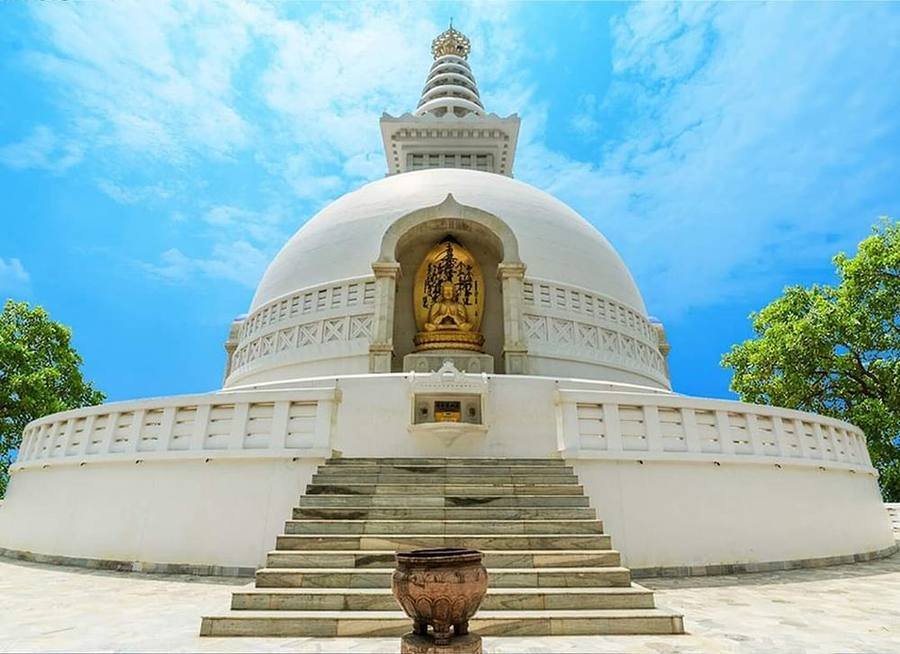
Rajgir was the first capital of the Magadha Empire under King Bimbisara in the 6th century BCE, and the Buddha spent many monsoons here. From Griddhakuta — Vulture's Peak — he delivered some of his most important sermons, and in the Saptaparni Cave nearby the First Buddhist Council met after his death. The town sits in a valley ringed by five hills, with the Cyclopean Wall — some 40 km of unmortared stone, among the oldest surviving fortifications in India — running along their crests. Ride the single-seat chairlift ropeway, said to be India's oldest ropeway, up Ratnagiri Hill to the Vishwa Shanti Stupa, the gleaming white marble peace pagoda built by Japanese Buddhists in 1969, ringed by four golden Buddha statues. Then bathe at Brahmakund, where hot spring water at around 45°C pours from stone spouts into separate tanks for men and women, fed by the seven streams of Saptadhara. A glass skywalk at Rajgir Nature Safari adds a valley view — check timings before you go. See our Rajgir travel guide.
4. Patna — 2,500 years on the Ganga
Patna is the gateway to Bihar, and one of the oldest cities in the world still in continuous habitation — as Pataliputra it was the capital of the Mauryan and Gupta empires. Its holiest site is Takht Sri Patna Sahib, where Guru Gobind Singh, the tenth and last Sikh Guru, was born on 22 December 1666. The gurdwara is one of the five Takhts, the seats of authority of Sikhism, and was rebuilt by Maharaja Ranjit Singh in the early 19th century. Then climb the Golghar, the beehive-shaped granary built by the British in 1786 after the famine of 1770; its spiral staircase leads to a wide view over the Ganga. The Bihar Museum, the Patna Museum and Buddha Smriti Park fill a day, and the river ghats are at their best at sunset. Most travellers enter Bihar through Patna, so it is the natural first stop — see our Patna travel guide.
5. Vaishali — where the republic was born

Vaishali was the capital of the Licchavi republic, governed by an elected assembly some 2,500 years ago — one of the world's first republics, centuries before the word democracy reached Europe. The Buddha delivered his last sermon here, and the site still holds the relic stupa and the Ashokan pillar topped by a single lion. Jain tradition holds that Mahavira, the 24th Tirthankara, was born at Kundalpur, near Vaishali. It is a quiet half-day from Patna — the place to stand where an idea as large as self-rule began. See our Vaishali travel guide.
6. Pawapuri — the Jal Mandir on the lotus pond
Pawapuri is where Mahavira, the 24th Tirthankara of Jainism, attained nirvana and was cremated. The Jal Mandir, a white marble temple, stands in the middle of a wide lotus pond, reached by a stone bridge — one of the most photographed sights in Bihar, and one of the most peaceful. Tradition says devotees collected the ashes so eagerly that a layer of soil was scooped away, leaving the hollow that became the pond. Pawapuri lies about 35 km from Rajgir in Nalanda district, so pair it with Nalanda on the same day.
7. Vikramshila — the forgotten university

Nalanda has the fame, but Bihar built a second great university. Vikramshila was founded by the Pala king Dharmapala in the late 8th or early 9th century, and it stood alongside Nalanda and Odantapuri as one of the three great Buddhist mahaviharas of its time. At its height it had more than a hundred teachers and about a thousand students, and the scholar Atisa — who later carried Buddhism to Tibet — was closely associated with it. Like Nalanda, it was destroyed around 1193. Its ruins stand at Antichak village near Kahalgaon, about 40 km east of Bhagalpur on the Ganga, partly excavated and protected by the Archaeological Survey of India, with a small museum at the entrance.
8. Valmiki National Park — Bihar's wild corner

Valmiki is Bihar's only national park, and its wildest corner. Declared a wildlife sanctuary in 1978, a national park in 1989 and a tiger reserve in 1994, it covers about 899 sq km of sal forest, grassland and riverine country in West Champaran, on the Nepal border. The Gandak River forms its western boundary, and it shares a frontier with Nepal's Chitwan National Park. Bengal tigers are the flagship species, alongside Indian rhinoceros, elephants, leopards and more than 250 bird species. The gateway town is Valmikinagar, on the Gandak. Safaris need permits and run in season, so check timings before you go — and give the park a full day of its own.
9. Sonepur — Asia's largest cattle fair
Time your trip right and Bihar gives you a spectacle. The Sonepur Mela, at the confluence of the Ganga and the Gandak, is described as Asia's largest cattle fair. The 2026 fair runs from 22 November to 23 December. The old saying was that you could buy anything here, "from a needle to an elephant" — but no elephant has been sold since 2004, and the elephant bazaar is now history. What remains is a vast month-long riverside fair of cattle, horses, birds, handicrafts, food stalls and folk performance. Read our full Sonepur Mela 2026 guide for dates, history and how to reach it.
What is the best time to visit Bihar?
October to March. Winter days are pleasant and cool, roughly 8°C–28°C, which is the right weather for walking ruins, climbing Rajgir's hills and sitting through long temple mornings. That window also holds the festival season — Chhath Puja on the ghats and the Sonepur Mela. Summer, April to June, can cross 40°C, so sightsee early and late if you travel then. The monsoon, July to September, turns the countryside green and waterfalls like Kakolat run at their best, but heavy rain can disrupt rural roads — check conditions before you go.
How many days are enough for a Bihar trip?
Five days covers the classic circuit without rushing. Three to four days works for the Buddhist triangle alone, and Bihar Tourism runs a 3-day Bodh Gaya–Rajgir–Nalanda package from Patna — check current prices before booking.
| Day 1 | Patna — Takht Sri Patna Sahib, Golghar, Bihar Museum, Ganga ghats at sunset |
| Day 2 | Bodh Gaya — Mahabodhi Temple at dawn, Great Buddha Statue, monasteries |
| Day 3 | Rajgir — ropeway to the Vishwa Shanti Stupa, Griddhakuta, Brahmakund hot springs |
| Day 4 | Nalanda ruins and museum, then Pawapuri's Jal Mandir |
| Day 5 | Vaishali — the republic, the Ashokan pillar and the relic stupa |
Add one or two days for Valmiki National Park, which is a detour west to the Nepal border, and a day in season for the Sonepur Mela. For the country-wide picture, see our best places to visit in India and the state-by-state guide to India.
What to eat in Bihar
Come hungry. Litti chokha — whole-wheat dough balls stuffed with spiced sattu, roasted and served with a smoky brinjal-tomato chokha — is the dish Bihar is known by. Thekua, the jaggery-wheat cookie, is the prasad of Chhath Puja; Silao khaja, a flaky layered pastry from near Nalanda, has carried a GI tag since 2018; and sattu sharbat, the roasted-gram cooler, is the state's everyday drink. Read our full famous food of Bihar guide, including litti chokha and thekua.
Watch & Feel the Place: Bihar on Film
Videos are by their respective creators.
Bihar FAQs
What are the best places to visit in Bihar?
Bodh Gaya, Nalanda, Rajgir, Patna, Vaishali, Pawapuri, Vikramshila and Valmiki National Park. Bodh Gaya and Nalanda are both UNESCO World Heritage Sites, and the Sonepur Mela runs from 22 November to 23 December 2026.
What is the best time to visit Bihar?
October to March, when days are pleasant and cool, roughly 8°C–28°C. Summer, April to June, can cross 40°C, and the monsoon runs July to September.
How many days are enough for a Bihar trip?
Five days covers Patna, Bodh Gaya, Rajgir, Nalanda with Pawapuri, and Vaishali without rushing. Three to four days is enough for the Bodh Gaya–Rajgir–Nalanda triangle alone; add one or two days for Valmiki National Park.
Is Bihar safe for tourists?
The main tourist circuit — Patna, Bodh Gaya, Rajgir, Nalanda and Vaishali — is travelled by pilgrims and visitors year-round, including families and couples. Travel between towns in daylight, book stays in advance, keep to the main circuit on a first trip, and check current local advice before you go.
How do I reach Bodh Gaya?
Bodh Gaya is about 16 km from Gaya town and about 115 km south of Patna. Arrive by train at Gaya Junction or fly into Gaya, then drive to Bodh Gaya; Patna is the usual entry point for a longer Bihar trip.
When is the Sonepur Mela in 2026?
The Sonepur Mela 2026 runs from 22 November to 23 December 2026 at the confluence of the Ganga and the Gandak rivers. See our full Sonepur Mela 2026 guide for dates, history and how to reach it.
Bihar rewards the traveller who comes for the history and stays for the quiet — start with Bodh Gaya at dawn, then follow the Buddha's road to Rajgir. Next, read our Sonepur Mela 2026 guide and the famous food of Bihar.
Plan your Bihar trip
Two UNESCO sites, the Buddha's enlightenment and the world's first university — in one state.
Bihar state guide →