
Hogenakkal · Dharmapuri · News Corner
Hogenakkal May Get a Glass Bridge — and a Waterfall Built for Visitors Who Can’t Climb Down

By Beauty of Bharat — India travel guide, every place, every flavour.
Guides covering all 36 States and UTs, researched from official sources and checked at publish time. Corrections welcome — see About Beauty of Bharat.
A glass bridge and an artificial waterfall are proposed at Hogenakkal in Dharmapuri district, Tamil Nadu, to draw more tourists — DT Next reported on 21 November 2026, citing Daily Thanthi. The glass bridge would offer panoramic views of the falls and gorge; the artificial waterfall is aimed especially at elderly visitors. But read the status carefully: this is a proposal under a feasibility study, not an approved project. No cost has been announced, no timeline exists, and no work has begun. Here is what is proposed, what Hogenakkal already offers, and what to know before you plan a trip around it.
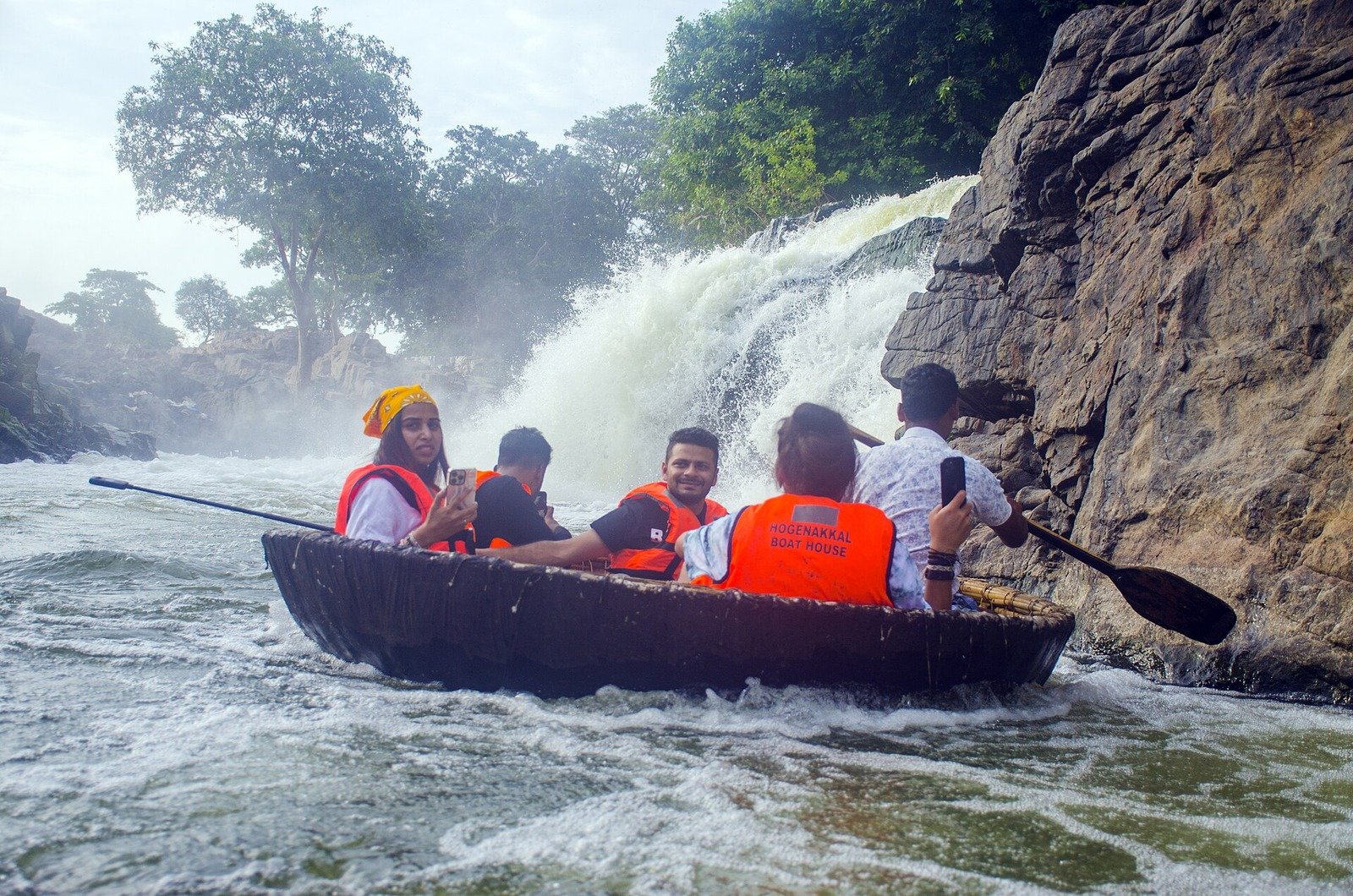
Hogenakkal is often called the “Niagara of the East” — the Cauvery thundering through a rocky gorge in a broad sheet of spray. But you do not admire these falls from a car window: you climb down to the river, and the best of it — the coracle ride, the bath under the falls — happens at water level. For many older visitors, that descent is the hard part. That is what makes this proposal interesting: its most unusual detail is not the glass bridge, but who the artificial waterfall is for — elderly visitors who cannot climb down, so they can still feel the spray without the descent.
Say it plainly: nothing has been built, nothing approved, and no drawing, budget or date exists yet. What follows is the proposal as reported, the place as it is today, and the practical facts for anyone thinking of going.
What is actually proposed?
According to the DT Next report of 21 November 2026, citing Daily Thanthi, two things are proposed at Hogenakkal:
- A glass bridge near the waterfalls, expected to offer visitors panoramic views of the natural landscape — the gorge, the cascades and the river below, seen from above rather than from the water.
- An artificial waterfall, planned as an additional attraction, particularly for elderly tourists who cannot easily reach the river.
- A joint feasibility study by officials from the Tourism, Public Works and Forest departments, assessing whether the projects can be built — including the safety aspects, which matter at a site where the river can turn dangerous in spate.
- Work only after clearances. Work will begin after the necessary recommendations and clearances are obtained — which means the study has to conclude, the departments have to agree, and the permissions have to come through first.
What has not been announced is everything a traveller would want next: no cost, no design, no location within the site, and no date for construction or opening. Until the study reports, there is nothing more to say about either project — and any article that gives you a budget or a completion date is inventing it.
What is already new at Hogenakkal
While the glass bridge is only a proposal, work that has finished at Hogenakkal is worth knowing about. Tourism infrastructure works worth Rs 17.57 crore have already been completed and opened to the public, and DT Next reports they are receiving a good response. The report does not detail what the works comprise, so we will not guess — but the site has recently been upgraded, and the proposal sits on top of investment already in place and already being used.
That puts the proposal in context: Hogenakkal is not a neglected site being rescued by one new attraction, but one of Tamil Nadu’s major destinations, drawing about 15 lakh visitors a year, with the state already spending on it. The bridge and waterfall would be the next step, not the first.
Why 15 lakh people a year come here
Background: the place as it is today, from the Dharmapuri district administration and Tamil Nadu tourism sources.
Hogenakkal sits on the Tamil Nadu–Karnataka border, about 46 km from Dharmapuri town, where the Cauvery enters Tamil Nadu. The name comes from the Kannada for “smoky rocks” — hoge, smoke, and kal, rock — after the spray rising off the stone like smoke. The river spreads across the rocks and drops through the gorge in a series of cascades, and the district administration lists bathing in the falls, cruising on country-made dinghies, and oil massages by local people among the draws.
The two main attractions, as DT Next puts it, are bathing in the falls and coracle rides. The coracle — parisal in Tamil — is a round bamboo boat, paddled by a single boatman through the gorge and often parked right under a curtain of spray. It is the reason most people come. The district administration notes the river flows throughout the year, so Hogenakkal can be visited in any season — but the water, not the calendar, decides what you can do on a given day.
That caveat matters. The falls are most dramatic in and just after the southwest monsoon, roughly July to October — but that is also when the river is most dangerous, and coracle rides are suspended when the water is in spate. In August and September 2026 the rides were stopped for 24 days after heavy rain in the Karnataka catchment raised the inflow. The comfortable window is the post-monsoon stretch, roughly October to February, when the air is cooler and the river is usually full but steady enough for the boats and a bathe. If you are travelling now, in late November, you are in that window — but still check the flow and whether the rides are running before you set out.
How to reach Hogenakkal
Hogenakkal is best reached by road — a favourite day trip from Bengaluru, roughly 130 km away and three to four hours by car, and from Salem and Krishnagiri. The nearest town and railway station is Dharmapuri, about 46 km away on the Bengaluru–Salem line; from there, continue by bus or taxi. Buses run from Dharmapuri and Krishnagiri, and the nearest major airport is Bengaluru’s Kempegowda International.
From Chennai it is roughly 260 km, five to six hours via Krishnagiri and Dharmapuri. Whichever way you come, the last stretch is a single approach road down to the river, where you park and walk in — and those steps down to the water are exactly what the proposed artificial waterfall is meant to spare elderly visitors.
What to know before you go
First, the obvious: do not travel to Hogenakkal expecting a glass bridge. There is none, and there will not be one until the feasibility study, the recommendations and the clearances are all done — a process with no announced end date. What you will find is the falls themselves, the coracles, and the recently completed infrastructure works.
Second, check the river before you go. The falls, the coracle rides and safe bathing all depend on the Cauvery’s level, which changes with the monsoon and with water released upstream. A quick check with the Dharmapuri district administration or local reports will tell you whether the rides are running — in flood they are suspended without much notice, and a wasted journey is the usual price of not checking.
Third, go early. The rides run in daylight hours, the site is at its best in the morning before the heat and crowds build, and the post-monsoon months are the busiest time of year. Carry cash for the rides, wear footwear you can get wet, and remember the descent to the river is steep in places — the very problem the proposal is trying to solve.
What happens next
The next step belongs to the three departments studying the proposal. The Tourism, Public Works and Forest departments are jointly assessing feasibility, including safety, and work can begin only after their recommendations and the necessary clearances. There is no published timetable for the study, and no announcement to expect on any particular date.
That is the honest position: a real proposal, at the earliest possible stage. If the study finds the projects feasible and safe, and the clearances follow, Hogenakkal will get a glass bridge with panoramic views and a waterfall for the visitors who cannot climb down. If not, the proposal stays a proposal. We will update this report when the departments say more.
Frequently asked questions
Is the glass bridge at Hogenakkal being built?
No. A glass bridge and an artificial waterfall are proposed at Hogenakkal, and the Tourism, Public Works and Forest departments are jointly studying feasibility, including safety. Work will begin only after the necessary recommendations and clearances. No cost, design or timeline has been announced.
What is the artificial waterfall for?
It is planned as an additional attraction, particularly for elderly tourists. The falls are reached by climbing down to the river, which many older visitors cannot do; the artificial waterfall is meant to give them the spray and the sound without the descent.
When will the glass bridge and the artificial waterfall open?
There is no opening date. The proposal is still at the feasibility-study stage, and no timeline has been announced. Do not plan a trip expecting to walk on a glass bridge at Hogenakkal yet.
Has a budget been announced for the project?
No. DT Next reported on 21 November 2026 that no cost has been announced for the glass bridge or the artificial waterfall. Separately, tourism infrastructure works worth Rs 17.57 crore at Hogenakkal have already been completed and opened.
What is Hogenakkal famous for?
Hogenakkal is where the Cauvery enters Tamil Nadu, dropping through a rocky gorge in a series of cascades. It draws about 15 lakh visitors a year, mainly for bathing in the falls and coracle rides — round bamboo boats called parisal. Its name comes from the Kannada for “smoky rocks”, after the spray rising off the stone.
What is the best time to visit Hogenakkal?
The comfortable window is roughly October to February, after the monsoon, when the river is usually full but steady enough for coracle rides and bathing. The falls are most dramatic in and just after the monsoon, roughly July to October, but the river is then dangerous and rides are suspended when the Cauvery is in spate. Always check the current flow and whether the rides are running before you set out.
Planning a trip to Tamil Nadu?
Start with our Tamil Nadu guide and our best places to visit in Tamil Nadu. For the wider state, see Madurai, Mahabalipuram, Ooty and Rameswaram, and our Tamil Nadu food guide. For timing, see our best time to visit India guide and our train booking guide. More travel news is on the News Corner.