
Odisha · Food Guide
What to Eat in Odisha: Pakhala, Dalma, Chhena Poda & the Temple Kitchen

By Beauty of Bharat — India travel guide, every place, every flavour.
Guides covering all 36 States and UTs, researched from official sources and checked at publish time. Corrections welcome — see About Beauty of Bharat.

In Odisha, yesterday's leftover rice is so loved it has its own festival day — 20 March is Pakhala Dibasa — and the state's most famous sweet was born when a sweet-maker forgot his cheese in a warm oven overnight. That is the first thing to know about the famous food of Odisha: it is humble, ingenious and older than most of India's celebrated cuisines. The dishes to try are pakhala bhata, dalma, machha besara, santula, chhena poda, Odisha rasagola, khaja, chenna jhili and the Mahaprasad of the Jagannath Temple in Puri.
Odia cooking runs on rice, lentils, seasonal vegetables and mustard — and, along the coast, on fish. It is lighter and less fiery than many Indian cuisines, it leans on panch phoran (the five-spice mix of cumin, mustard, fenugreek, nigella and fennel), and its sweets are built on chhena, fresh curdled cheese. The temple kitchen at Puri has shaped the food for centuries: much of what Odisha eats today began as an offering to Lord Jagannath. Start in Puri or Bhubaneswar, and eat your way outwards.
Odisha food at a glance
| Most famous dish | Pakhala bhata — fermented rice in water, served with badi chura, fried fish or vegetables; see the pakhala bhata guide |
| Everyday staple | Dalma — lentils simmered with seasonal vegetables, tempered with panch phoran; see the dalma guide |
| Sweet to try first | Chhena poda — the caramelised baked-cheese cake from Nayagarh; see the chhena poda guide |
| Temple food | Mahaprasad — the 56-dish offering of the Jagannath Temple, Puri; see the Mahaprasad guide |
| Where to eat | Puri for Mahaprasad and khaja, Bhubaneswar for the full range, Cuttack for dahi bara aloo dum, Pahala for rasagola |
| Best time to eat it | October to February for travelling and eating well; pakhala is at its best in the hot months, and rasagola takes centre stage during Rath Yatra |
1. Pakhala Bhata — the dish with its own day
Pakhala bhata is cooked rice soaked in water and left to ferment lightly — usually overnight — then served cool with curd, green chillies, roasted vegetables, badi chura (crushed lentil fritters) and, often, fried fish. It is the quintessential dish of Odisha and the one Odias are proudest of: refreshing, easy to digest and made for the state's hot, humid summers. A tempered version, chhunka pakhala, gets a hot tadka of mustard seeds, curry leaves and dried red chilli poured over the top. The dish is so central to Odia identity that 20 March is celebrated as Pakhala Dibasa, Pakhala Day. If you eat one thing in Odisha, eat this — in a village home if you can, where the authentic version is still the everyday lunch.
2. Dalma — the soul of the Odia kitchen
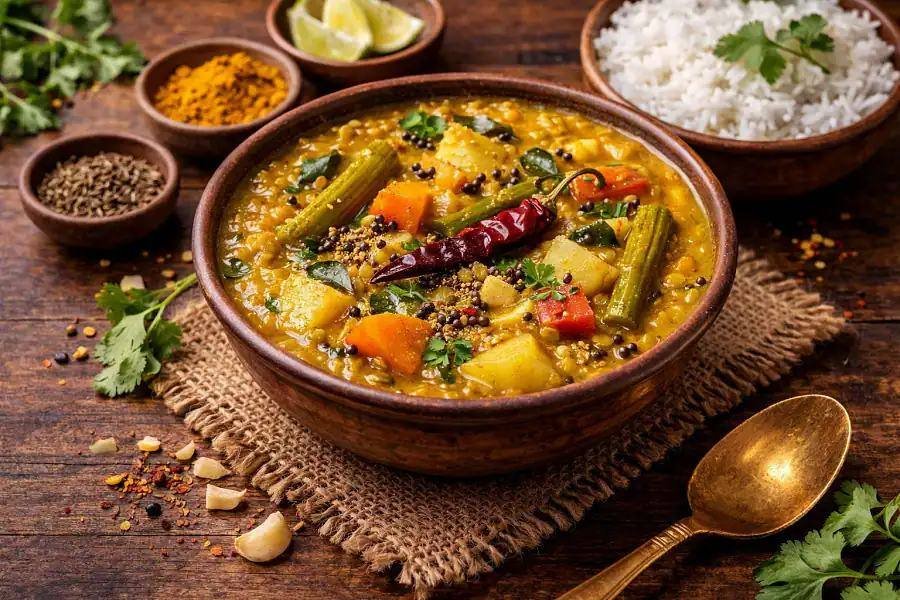
Dalma is the pot that defines an Odia home: toor dal (pigeon pea) or chana dal simmered with the vegetables of the season — pumpkin, raw banana, raw papaya, brinjal, yam, drumstick — tempered with panch phoran, ginger and grated coconut, and finished with ghee. It is nutritious, gently spiced and eaten with steamed rice almost every day. The temple version, served as part of the Mahaprasad in Puri, is cooked without onion or garlic. Dalma is also the dish that shows Odia cooking's character best: simple ingredients, little oil, and flavour built from the vegetables themselves rather than from heat. See the dalma guide for the full story.
3. Machha Besara — fish in mustard
Odisha's long coastline means fish is a staple, not a treat, and machha besara is the classic preparation: fish — often rohu — cooked in a pungent mustard paste with turmeric and green chilli. The mustard gives it a sharp, clean heat that is very different from the creamy curries of the north, and it is eaten with plain rice so nothing competes with the fish. Along the coast, look for the same mustard treatment on prawns and crab, and for sukhua — sun-dried fish — served as a fiery accompaniment to pakhala. See the machha besara guide.

4. Santula — the gentle vegetable stew
Santula is Odisha's quietest dish and one of its most typical: a mixed-vegetable stew, lightly spiced, sometimes finished with a little milk, that lets each vegetable keep its own flavour. It is the dish Odia grandmothers prescribe for a restful stomach, and it is a good reminder that Odia food is not all fish and sweets — much of it is deliberately mild, seasonal and vegetable-led. Order it with rice and dalma for the most traditional Odia thali you can eat outside a home kitchen.
5. Chhena Poda — the accidental cheesecake
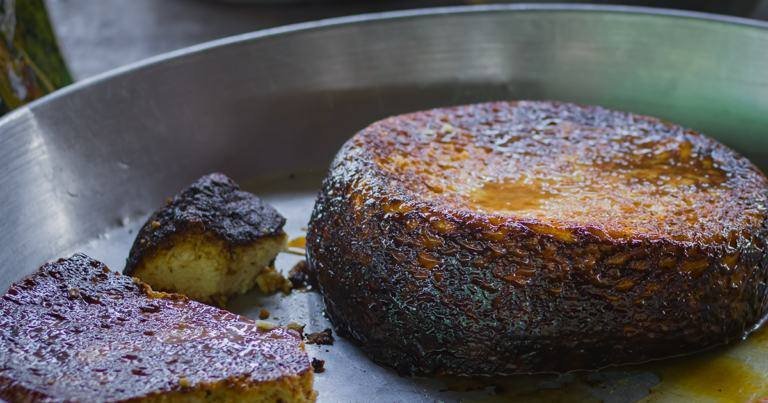
Chhena poda means "burnt cheese", and the name is the story. According to the well-loved legend, a sweet-maker in Nayagarh, in the early twentieth century, left sweetened chhena — fresh cottage cheese — in a warm oven overnight and found, by morning, that it had set into a caramelised cake. The accident became Odisha's signature dessert: chhena mixed with sugar, semolina and cardamom, slow-baked until the top turns dark gold and crisp while the inside stays soft and moist. It is often called India's original baked cheesecake, and it travels well — buy a piece in Bhubaneswar or Puri and eat it the same day. See the chhena poda guide.
6. Odisha Rasagola — the sweet that went to court
No Odia food list is complete without the rasagola — and no honest one can skip the argument. West Bengal and Odisha fought over the sweet's origin from 2015, with West Bengal winning the Geographical Indication (GI) tag for "Banglar Rasogolla" in November 2017. Odisha applied for its own version, and on 29 July 2019 the GI Registry in Chennai granted the tag to "Odisha Rasagola", registered in the name of the Odisha Small Industries Corporation and the Utkala Mistanna Byabasayee Samiti, valid until 22 February 2028. The two sweets are genuinely different: the Odisha rasagola is brownish, softer and less sweet than its Bengali cousin, and Odisha's claim rests on the temple — rasagola has been offered to Lord Jagannath at Puri for centuries, and the state now marks Rasagola Dibasa on Niladri Bije, the day of Rath Yatra when the deities return to the temple. Taste it at Pahala, the village on the Bhubaneswar–Cuttack road famous for its rasagola shops, and decide the argument for yourself. Our Rath Yatra Puri guide covers the festival behind the sweet.
7. Khaja — Puri's flaky temple sweet
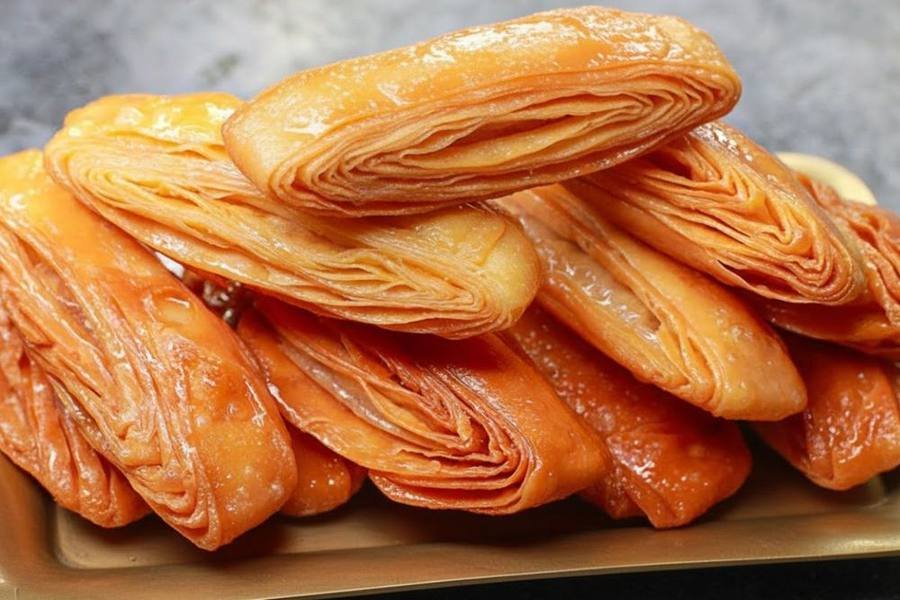
Khaja is the sweet you will see in every shop near the Jagannath Temple: layers of refined flour dough, fried crisp and soaked in sugar syrup until they shatter at the touch. It is one of the sweets offered as Mahaprasad, and it keeps well, which is why pilgrims have carried it home from Puri for generations. Eat it warm if you can find it fresh from the karahi; the layers should flake apart rather than bend.
8. Chenna Jhili & Pahala Rasagola — the sweet-makers' towns
Beyond the famous names, Odisha's sweet map has two small towns worth a detour. Nimapada, near Puri, is home to chenna jhili — golden, fried chhena dumplings soaked in syrup, darker and richer than rasagola. And Pahala, the village between Bhubaneswar and Cuttack, is where the rasagola trade is concentrated: rows of sweet shops, each claiming the softest, brownest rasagola in the state. If you are driving between the two cities, stop at Pahala and eat one standing at the counter — that is how it is meant to be tasted.
9. Abhada — the Mahaprasad of the Jagannath Temple
The most sacred food in Odisha is not sold in a restaurant at all. The Mahaprasad, also called Abhada, is the 56-dish offering — the chhapan bhog — cooked daily in the kitchen of the Jagannath Temple in Puri, in earthen pots stacked over firewood stoves, and served on sal-leaf platters at the Ananda Bazar inside the temple complex. Dalma, khechudi (a temple khichdi), kanika (sweetened rice) and khaja are among the dishes, all cooked without onion or garlic. Pilgrims buy the hot prasad at the Ananda Bazar and eat it sitting on the temple floor — it is, by any measure, one of the great communal meals in India, and the kitchen that makes it is among the largest temple kitchens in the world. See the Mahaprasad guide and our Puri guide.
Where to eat in Odisha
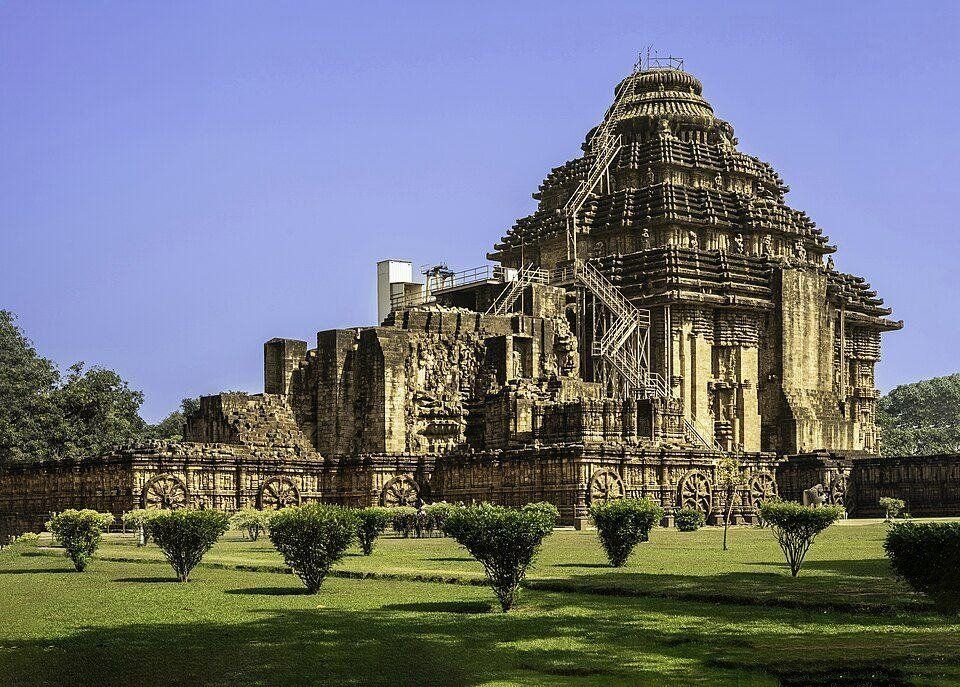
Puri is the first stop: the Ananda Bazar for Mahaprasad, the lanes around the temple for khaja and chenna jhili, and the beach road for fish. Bhubaneswar has the widest range — the food stalls at Ekamra Haat serve pakhala platters, badi chura and chhena poda, and the city's sweet shops are the easiest place to compare rasagola, chhena poda and khaja in one sitting. Cuttack is the home of dahi bara aloo dum — soft lentil dumplings in curd with spicy potato curry — the city's signature street food, best eaten from a busy stall; see the dahi bara aloo dum guide. And if you are travelling onward, our best places to visit in Odisha guide and Odisha in December guide cover the temples, the coast and Chilika Lake — with Konark and Cuttack on the way.
What to eat, and when
Summer (March–June). Pakhala bhata, with fried fish and badi chura — the dish was made for this weather, and Pakhala Dibasa falls on 20 March.
Monsoon and winter (July–February). Dalma, santula and machha besara with hot rice; October to February is the best season to travel and eat your way through the state.
Festival season. Rath Yatra in Puri (June–July) is when rasagola takes centre stage, with Rasagola Dibasa on Niladri Bije. If you are comparing Odisha's food with its neighbour's, our famous food of Bengal guide is the other side of the argument.
Watch & feel the place
Watch pakhala being made the Odia way, then see how chhena poda gets its caramel crust:
Videos are by their respective creators and are embedded for viewing; please check the creators' channels for the latest Odisha food content before travelling.
What to eat in Odisha FAQs
What is the most famous food of Odisha?
Pakhala bhata — fermented rice soaked in water, served with curd, badi chura and fried fish or vegetables. It is so central to Odia identity that 20 March is celebrated as Pakhala Dibasa (Pakhala Day). Dalma and chhena poda are the other two dishes every visitor should try.
What is dalma in Odia food?
Dalma is Odisha's everyday lentil stew: toor or chana dal simmered with seasonal vegetables such as pumpkin, raw banana and brinjal, tempered with panch phoran, ginger and coconut, and finished with ghee. It is served with steamed rice, and the temple version in Puri is cooked without onion or garlic.
What is the difference between Odisha rasagola and Bengali rosogolla?
They are two different sweets with separate GI tags. West Bengal's "Banglar Rasogolla" received its GI tag in November 2017; Odisha's "Odisha Rasagola" received its own GI tag on 29 July 2019, valid until 22 February 2028. The Odisha rasagola is brownish, softer and less sweet, and Odisha's claim rests on the sweet's centuries-old offering at the Jagannath Temple in Puri.
What is chhena poda?
Chhena poda, meaning "burnt cheese", is Odisha's signature dessert: fresh chhena (cottage cheese) mixed with sugar, semolina and cardamom, slow-baked until the top turns dark gold and crisp while the inside stays soft. It is said to have been invented in Nayagarh in the early twentieth century, when a sweet-maker left sweetened chhena in a warm oven overnight.
What is Mahaprasad and where can I eat it?
Mahaprasad (Abhada) is the 56-dish offering cooked daily in the kitchen of the Jagannath Temple in Puri, in earthen pots over firewood stoves, and served on sal-leaf platters at the Ananda Bazar inside the temple complex. It includes dalma, khechudi, kanika and khaja, all cooked without onion or garlic.
When is the best time to try Odia food?
October to February is the best season to travel and eat in Odisha. Pakhala bhata is at its best in the hot months around Pakhala Dibasa on 20 March, and Rath Yatra season in Puri (June–July) is when rasagola takes centre stage, with Rasagola Dibasa on Niladri Bije.
Odisha's food rewards the traveller who eats like a local — rice and dalma at lunch, pakhala in the heat, and a sweet from a temple-town shop at the end of the day. If this guide has you planning the trip, read our best places to visit in Odisha guide next.
Plan your Odisha trip
Start in Puri for the temple kitchen, then eat your way through Bhubaneswar, Cuttack and Chilika.
Odisha state guide →