
Goa · State Guide
Best Places to Visit in Goa: 10 Stops, One Small State

By Beauty of Bharat — India travel guide, every place, every flavour.
Guides covering all 36 States and UTs, researched from official sources and checked at publish time. Corrections welcome — see About Beauty of Bharat.
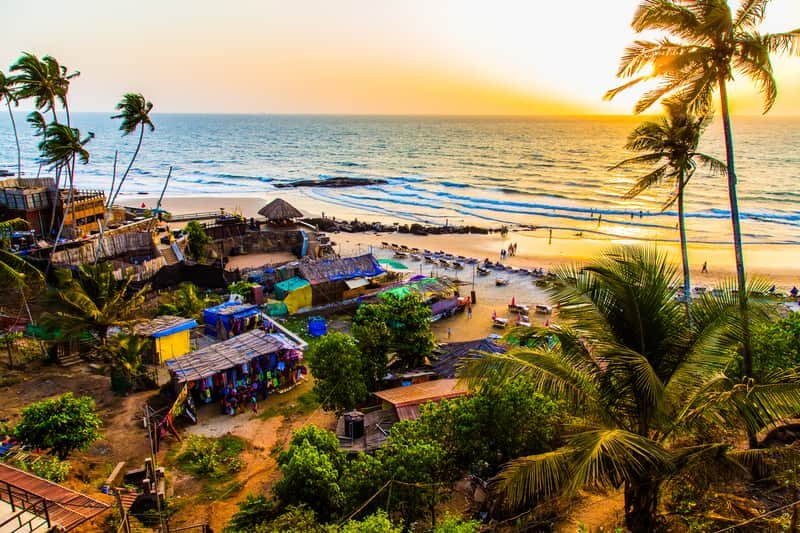
Goa is India’s smallest state — a strip of coast about 105 km long, wedged between the Arabian Sea and the forested Western Ghats — The best places to visit in Goa are Baga and Calangute, Anjuna’s Wednesday flea market, Vagator and Chapora Fort, Fort Aguada, Panaji’s Latin Quarter, the churches of Old Goa, Palolem, Colva and Dudhsagar Falls: ten stops that run from party beaches to a UNESCO World Heritage site and a 310-metre waterfall. The surprise is how much history sits behind the beach shacks. Old Goa was once one of the richest cities in Asia, the seat of Portuguese power in the East, before epidemics and a silting river moved the capital to Panaji. Four and a half centuries of Portuguese rule left churches, forts and painted lanes that no other Indian state has — and a food culture built on fish curry, coconut and feni. This guide takes the ten in order, north to south, with the honest distinctions: which beaches suit families, which suit parties, and when to come.
| Place | Distance from Panaji | Best for | Time needed |
| 1. Baga & Calangute | about 15–16 km | Beaches, water sports, nightlife | Half a day to a day |
| 2. Anjuna | about 18 km | Wednesday flea market, sunsets | Half a day |
| 3. Vagator & Chapora Fort | north of Anjuna | Cliff views, sunset, photos | Half a day |
| 4. Fort Aguada | above Sinquerim | History, lighthouse, sea views | 1–2 hours |
| 5. Panaji & Fontainhas | in the capital | Latin Quarter lanes, cafes | Half a day |
| 6. Old Goa | about 10 km east | UNESCO churches, history | Half a day |
| 7. Palolem | far south | Quiet bay, kayaking, couples | 1–2 days |
| 8. Colva | about 39 km | Family beach, long sands | Half a day to a day |
| 9. Dudhsagar Falls | about 60 km | Waterfall, jungle jeep ride | Full day |
| 10. Mapusa market | north of Panaji | Spices, seafood, shopping | Half a day |
Distances are road distances and vary by route: sources quote about 15–16 km for Baga–Calangute, about 18 km for Anjuna and about 60 km for Dudhsagar. Treat every figure as a planning estimate and check the route before you leave.
1. Baga and Calangute — North Goa’s famous beaches

Baga and Calangute are where most first trips to Goa begin, and the two beaches run into each other along one long stretch of sand about 15–16 km north of Panaji. Calangute — the “Queen of Beaches” — is the bigger, busier sweep, lined with shacks, shops and water-sports operators; Baga, just north of it, is livelier still, with the nightlife of Tito’s Lane spilling out after dark. Come for the energy, the parasailing and the shack dinners, but come early: by late morning both beaches fill up, and by evening they are the loudest strip in the state. Families do better at Calangute in the morning; party-seekers belong at Baga after sunset. See our Calangute–Baga guide.
2. Anjuna Beach and the Wednesday flea market

Anjuna, about 18 km from Panaji, is where Goa’s hippie years never quite ended. The beach itself is rockier and moodier than Calangute, with cliff-top cafes and some of the best sunsets on the north coast — but the reason to time your visit is the Wednesday flea market, which began in the hippie era, when travellers sold their belongings to fund the next leg of the journey. Still the state’s best-known bazaar: spices, textiles, jewellery and handicrafts, with live music drifting over the stalls. Come on a Wednesday, arrive before the midday heat, and bargain the way the market expects you to. See our Anjuna guide.
3. Vagator and Chapora Fort — the sunset cliffs
North of Anjuna, the coast turns dramatic. Vagator’s red laterite cliffs drop to a black-sand cove and a wide sweep of beach, and above it stands Chapora Fort, a ruined Portuguese fort on a headland over the Chapora River — the one film fans know from Dil Chahta Hai. Little of the fort is left beyond its walls — you climb it for the view across Vagator beach and the fishing harbour, best at sunset. Carry water, avoid the midday heat, and wear shoes that grip the laterite. There is no verified photo of Chapora Fort in our library, so this one runs text-only.
4. Fort Aguada — the 1612 fort at the Mandovi’s mouth
Fort Aguada is the fort that guarded Portuguese Goa. Built between 1609 and 1612 on the headland at the mouth of the Mandovi River, it takes its name from the spring inside — aguada means watering place — that gave passing ships fresh water. Inside the walls stand a four-tiered lighthouse and deep freshwater cisterns; outside them, the view runs over Sinquerim Beach and the river mouth. Come early, before the tour buses. There is no verified photo of Fort Aguada in our library, so this one runs text-only.
5. Panaji and Fontainhas — the Latin Quarter
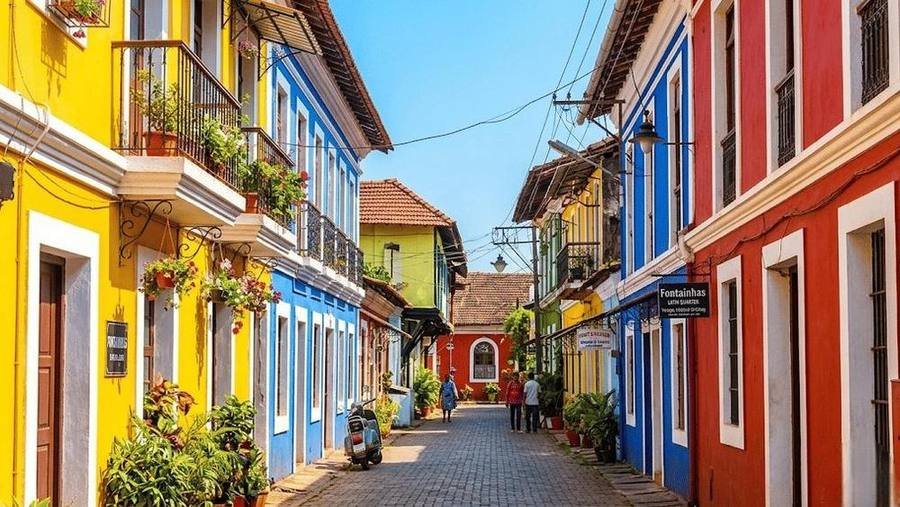
Goa’s capital is the gentlest stop on this list, and the one first-timers most often skip — which is a mistake. Panaji sits on the south bank of the Mandovi, and its most attractive corner is Fontainhas, the old Latin Quarter: lanes of painted, tile-roofed houses in ochre, blue and white, built on reclaimed land in the 19th century. Above the main square stands the white Church of Our Lady of the Immaculate Conception, reached by a double flight of stairs added in 1871. Walk it in the early morning, when the lanes are empty, then take the riverfront promenade and a cafe breakfast. See our Panaji guide.
6. Old Goa — the Basilica, the cathedral and a lost capital
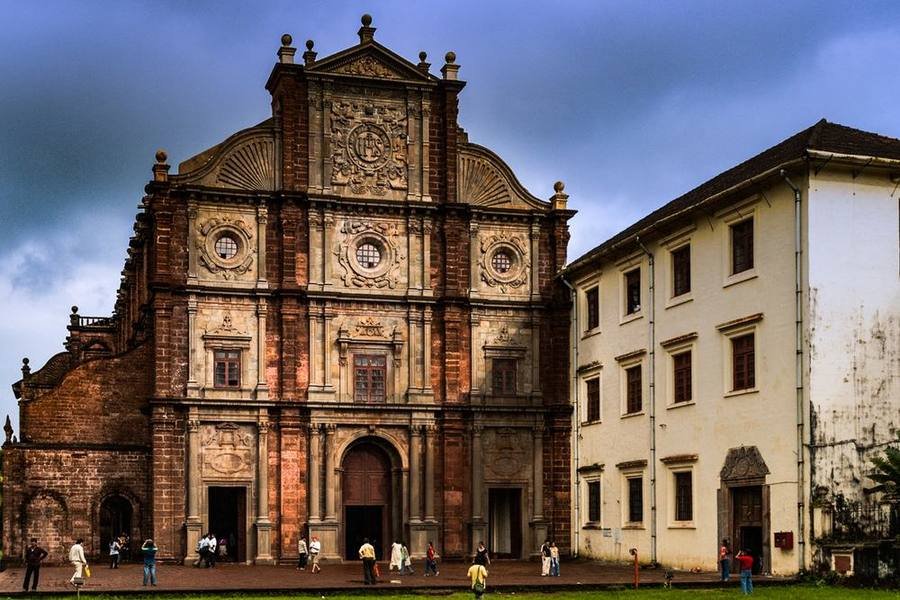
Ten kilometres east of Panaji stands the Goa most visitors never expect. Old Goa was the capital of Portuguese Goa until the mid-18th century, and its churches and convents, built in the 16th and 17th centuries, were inscribed as a UNESCO World Heritage Site in 1986. The Basilica of Bom Jesus, completed in 1605, holds the silver casket with the remains of St Francis Xavier, the missionary who reached Goa in 1542; across the lawn, Se Cathedral is one of the largest churches in Asia. Come in the morning and dress respectfully — these churches still hold services — and if you are here on 3 December, the Feast of St Francis Xavier fills the town. See our Old Goa guide.
7. Palolem — South Goa’s crescent bay
Palolem is the beach people picture when they say “South Goa”: a sheltered crescent of white sand between two headlands, lined with palm-thatched huts and cafes, calm enough for kayaking and dolphin-spotting boat trips. It suits couples and slow travellers far better than the north’s party strip — the pace here is set by the tide, not the clubs. Come for a night or two rather than a day trip: Palolem is at its best at dawn and at sunset, when the huts light up. There is no verified photo of Palolem in our library, so this one runs text-only. See our Palolem guide.
8. Colva and the Salcete coast — the family beaches
If Palolem is South Goa’s romantic beach, Colva is its family beach. About 39 km from Panaji, Colva is the main resort beach of the south, part of a long run of sand that reaches north past Betalbatim and Majorda and south past Benaulim to Varca and Cavelossim. The sand is wide and flat, the water is gentler than in the north, and the shacks are spaced out enough that a family can claim a patch of beach for the day. Benaulim, less than 2 km south, is quieter still and holds the Goa Chitra museum of village life. There is no verified photo of Colva in our library, so this one runs text-only.
9. Dudhsagar Falls — the Sea of Milk
Dudhsagar is the one stop on this list that is not a beach or a church, and it is worth the full day it takes. The four-tiered waterfall drops about 310 metres — the Goa Forest Department gives 306 metres — down the Mandovi River on the Goa–Karnataka border, inside Bhagwan Mahavir Wildlife Sanctuary and Mollem National Park, about 60 km from Panaji. Most visitors reach it in Forest Department-registered jeeps from Collem, a bumpy forest track with stream crossings, and the jeep safaris run October to May: they do not operate in the monsoon, when the sanctuary closes to visitors. Entry gates run 8 am to 3 pm in the 2026–27 season, but timings and permits change — check before you go. There is no verified photo of Dudhsagar Falls in our library, so this one runs text-only.
10. Mapusa market — Goa’s biggest bazaar
Goa’s markets deserve a stop of their own, and Mapusa’s Friday market is the biggest of them: a sprawling town bazaar where Goans themselves shop for fish, spices, pottery, textiles and the week’s vegetables, with none of the tourist markup of the beach markets. Come hungry and early, when the fish stalls are at their best, and pair it with the Saturday Night Market at Arpora in season — live music, food stalls and handicrafts under fairy lights, a very different animal from Mapusa’s working market. There is no verified photo of Mapusa market in our library, so this one runs text-only.
North Goa or South Goa: Which Is Better?
It is the question every Goa planner asks, and the honest answer is that the two halves are different holidays. North Goa is better for a first trip, for nightlife, water sports and groups: Baga, Calangute, Anjuna and Vagator sit close together, with the most shacks, clubs and choices in the state. South Goa is better for couples, families with small children and anyone who wants quiet, cleaner beaches: Palolem, Agonda and Colva move at half the speed, and the resorts are bigger and calmer. If you have five days or more, the best answer is both — three nights in the north, then two or more in the south. The change of pace is the point.
Best Places to Visit in Goa in 3 Days
Three days is enough for North Goa plus the heritage core, if you keep it tight. Day one: Baga and Calangute in the morning, Fort Aguada in the afternoon, and sunset at Vagator with Chapora Fort above it. Day two: Panaji’s Fontainhas lanes in the morning, Old Goa’s churches after lunch, and the Mandovi riverfront at dusk. Day three: choose — Palolem for a slow southern day, or Dudhsagar for the waterfall, leaving before dawn for the jeep stand at Collem. With four or five days, do both: add a night in the south and the markets. See our Goa in December guide for the festive month in detail.
Best Time to Visit Goa
November to February is the window to aim for: dry days of roughly 21–32°C, calm seas and every shack open. December is the peak of the peak — Christmas, New Year, the Feast of St Francis Xavier on 3 December and the Sunburn festival in late December — and also the most expensive and most crowded fortnight of the year, so book stays months ahead and prefer the first half of the month. The monsoon, June to September, is the opposite Goa: lush, green and cheap, but many beach businesses close and Goa Tourism warns that swimming in the monsoon sea can be dangerous. See our Goa in November and Goa in January guides.
How to Reach Goa
Fly into Goa’s airports — Dabolim in the south or Manohar International at Mopa in the north — or take the train to Madgaon, Vasco da Gama or Thivim. Once inside the state, hire a car with a driver or rent a scooter: the distances are short, but the roads are slow and the best places sit at the end of lanes that reward local knowledge. Rent a scooter only if you hold a licence and wear a helmet, and use GoaMiles app taxis or prepaid airport taxis.
What to Eat in Goa

Eat like the coast eats. Goan fish curry — fish simmered in coconut milk soured with kokum, served with rice — leads the table, with prawn balchao, chicken xacuti and the layered Goan sweet bebinca close behind. The beach shacks do the classics well, but the best meals are often in the small family restaurants of Panaji, Mapusa and the fishing villages, where the catch is the day’s and the recipes are grandmothers’. Wash it down with solkadhi, the pink kokum cooler, and treat feni — the local cashew spirit — with respect. For the full table, see our what to eat in Goa and famous food of Goa guides, and the dishes themselves — Goan fish curry, xacuti and bebinca.
Watch & Feel the Place: Goa on Film
Videos are by their respective creators.
Best Places to Visit in Goa FAQs
How many days are enough for Goa?
Three days cover a focused first trip: North Goa’s beaches on day one, Panaji and Old Goa on day two, and Palolem or Dudhsagar on day three. Four to five days cover both halves without rushing — add a night in South Goa and the markets. A week lets you slow down properly, with a day for the spice farms and the inland villages.
What is the best time to visit Goa?
November to February, when days run roughly 21–32°C, the sea is calm and every shack is open. December is the festive peak and the most crowded and expensive time, so book months ahead. The monsoon, June to September, is lush and cheap, but many beach businesses close and swimming can be dangerous.
Which is better, North Goa or South Goa?
North Goa is better for nightlife, water sports, first-time visitors and groups, because the beaches, clubs and sights sit close together. South Goa is better for couples, families with small children and anyone who wants quiet, cleaner beaches and resorts. If you have five days or more, split your stay and do both.
What is Goa famous for?
Beaches, Portuguese heritage, seafood and festivals. Travellers come above all for the north’s party beaches, Old Goa’s UNESCO-listed churches, the forts of Aguada and Chapora, Dudhsagar Falls, the flea markets and the table — Goan fish curry, xacuti, bebinca and feni.
What are the top places to visit in Goa?
Start with Baga and Calangute, Anjuna and its Wednesday flea market, Vagator and Chapora Fort, Fort Aguada, Panaji’s Fontainhas lanes and the churches of Old Goa, then Palolem and Colva in the south and Dudhsagar Falls inland. For a first trip, base yourself in the north, spend a day on Panaji and Old Goa, and give the south at least one night.
Is Goa expensive in November?
November is the start of Goa’s peak season, which runs November to February, so stays cost more than in the monsoon months — but November is cheaper and less crowded than December, the festive peak, so book ahead for the best prices.
Baga’s shacks are the doorway; the churches, the cliffs and the waterfall are the rooms beyond them. Start with the north beaches, give Old Goa a slow morning, and let Palolem set the pace after that. Next, read our Goa in December guide for the festive season, and best places to visit in India and the state-by-state guide to plan the trip beyond Goa.
Plan your Goa trip
Beaches, churches, a waterfall and a flea market — in India’s smallest state.
Goa state guide →