
Rajasthan · Hotels & Stays
Best Heritage Hotels in Rajasthan: Sleep in a Palace

By Beauty of Bharat — India travel guide, every place, every flavour.
Guides covering all 36 States and UTs, researched from official sources and checked at publish time. Corrections welcome — see About Beauty of Bharat.
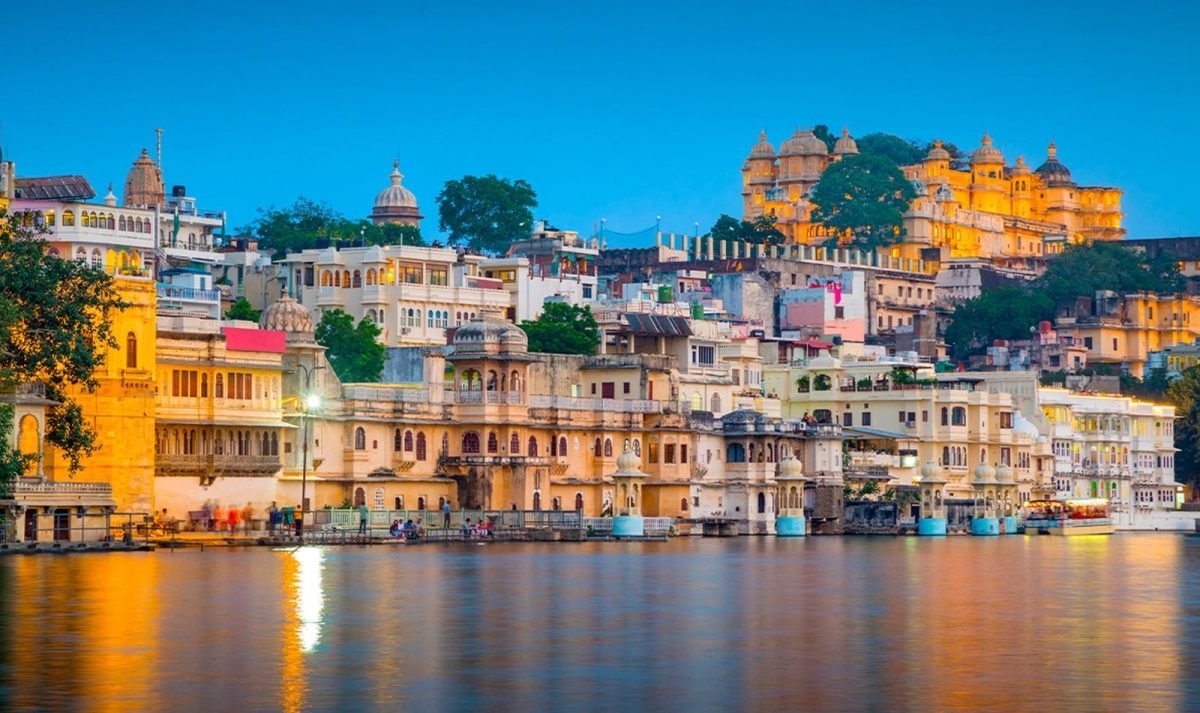
One of Rajasthan's grandest palace hotels was built to give work to famine-struck people. Another began life as a house for a queen's favourite handmaiden. A third was a crumbling ruin bought for ₹7 lakh. Today you can sleep in all three. These are not themed replicas; they are the real palaces, forts and havelis of Rajputana, still standing and open to guests. The best heritage hotels in Rajasthan are the Taj Lake Palace and Taj Fateh Prakash Palace in Udaipur, Rambagh Palace and Samode Haveli in Jaipur, Umaid Bhawan Palace in Jodhpur, Suryagarh in Jaisalmer, Laxmi Niwas Palace in Bikaner, and Neemrana Fort-Palace on the Delhi–Jaipur road. No prices here — palace rates swing with the season, so check current rates before you book.
What are the best heritage hotels in Rajasthan?
| Rambagh Palace | Jaipur | Maharaja's residence, built 1835 | The classic palace stay; gardens and scale |
| Samode Haveli | Jaipur | Nobleman's townhouse, about 175 years old | Intimate old-city stay, a short walk to Hawa Mahal |
| Taj Lake Palace | Udaipur | Jag Niwas, built 1743–1746 | The bucket-list stay; reached by boat |
| Taj Fateh Prakash Palace | Udaipur | 19th-century royal functions palace | City Palace setting, lake views, Mewar art |
| Umaid Bhawan Palace | Jodhpur | Built 1920s–30s as famine relief | Art Deco grandeur; the royal family still lives here |
| Suryagarh | Jaisalmer | Modern "sun fortress", opened 2010 | Desert evenings and the Sam dunes |
| Laxmi Niwas Palace | Bikaner | First wing completed 1902 | Red-sandstone Indo-Saracenic grandeur, off the beaten track |
| Neemrana Fort-Palace | Alwar district | Fort built 1464; hotel since 1991 | India's first heritage hotel; a weekend from Delhi |
The palace hotels of Jaipur: Rambagh Palace and Samode Haveli
Jaipur offers the two opposite ends of the palace-hotel idea. See our Jaipur guide for what to do around each stay.
Rambagh Palace — the Maharaja's own house
Built in 1835, Rambagh began as the home of the queen's favourite handmaiden, then became a royal guest house and hunting lodge, and finally the principal residence of Maharaja Sawai Man Singh II and Maharani Gayatri Devi. The royal family lived here until 1957, when it became a hotel; the Taj group has run it since 1972. Today 78 rooms and suites spread across 47 acres of gardens, and the restaurant Suvarna Mahal sits in the old ballroom. It is the grandest palace experience in Jaipur, and the one to pick if you want to spend a whole day inside the property. The trade-off: it sits in a quiet residential area, so the old city and bazaars are a drive away, not a walk.
Samode Haveli — a nobleman's townhouse in the old city
Samode Haveli is the opposite of Rambagh in almost every way, and that is its charm. Built about 175 years ago by Rawal Sheo Singhji, a nobleman who served as prime minister to the Jaipur court, it was the Samode family's townhouse — and the family still runs it today. You enter up an elephant ramp built in the 1940s for a family wedding, into courtyards ringed by frescoed rooms, mirror work and a Sheesh Mahal suite. With 39 rooms it feels lived-in, and the Hawa Mahal and City Palace are a ten-minute walk away. Pick Samode Haveli if you want to step out of your room and straight into the Pink City, and if a small, family-run haveli appeals more than a grand palace.
Best places to stay in Udaipur near Lake Pichola
Udaipur is the one city where the hotel is the destination. Two palace hotels sit on Lake Pichola, and the best place to stay near the lake is on it, or on its eastern bank inside the City Palace. See our Udaipur guide for the city around the lake.
Taj Lake Palace — the palace that floats
There is no arrival in Indian hospitality quite like this one: you board a boat, and the white-marble palace rises out of Lake Pichola ahead of you. Built as Jag Niwas between 1743 and 1746 for Maharana Jagat Singh II, it became a hotel in 1963 — one of India's first luxury hotels — and the Taj group took over in 1971. Its 65 rooms and 18 suites sit on four acres of island, and it starred in the James Bond film Octopussy. This is the bucket-list stay of the whole list, and the one to book for a honeymoon or a once-in-a-lifetime anniversary. The price of the magic is that you are on an island — every arrival and departure is by boat, and the hotel is a world apart from the city's streets.
Taj Fateh Prakash Palace — the City Palace's own hotel
If the Lake Palace is the dream, the Fateh Prakash is the practical way to sleep inside Udaipur's history. Built in the 19th century under Maharana Fateh Singh, it was the venue for royal functions and the durbar hall of the Mewar court, inside the City Palace complex on Lake Pichola's eastern bank. It is still owned by the Mewar royal family, and the Taj group has run it as a hotel since 1 January 2020. Its 65 rooms and suites face the lake and the Lake Palace, and its corridors carry Mewar-school paintings. It suits travellers who want the palace address and the lake view with the City Palace, the old city and the ghats on their doorstep.
Jodhpur's palace hotel: Umaid Bhawan Palace
Umaid Bhawan is the most extraordinary building on this list, and the one with the most surprising story. It was built in the 1920s and 1930s, in golden-yellow Chittar sandstone, as a vast public-works project to give employment to famine-struck people — a palace raised as relief work. It is one of the largest private residences in the world, set in 26 acres of gardens, with a 45-metre dome, Art Deco interiors and an underground Zodiac pool. It became a hotel in 1972, the Taj group took over in 2005, and the royal family still occupies its own wing, while another wing is a museum open to day visitors. Come for the Art Deco interiors and the scale. See our Jodhpur guide for the blue city below the palace.
Palace hotels in Jaisalmer and Bikaner
West of Jodhpur, the desert cities offer two very different stays: a brand-new fort built to look ancient, and a genuine royal palace most travellers never hear about.
Suryagarh, Jaisalmer — a fort built from scratch
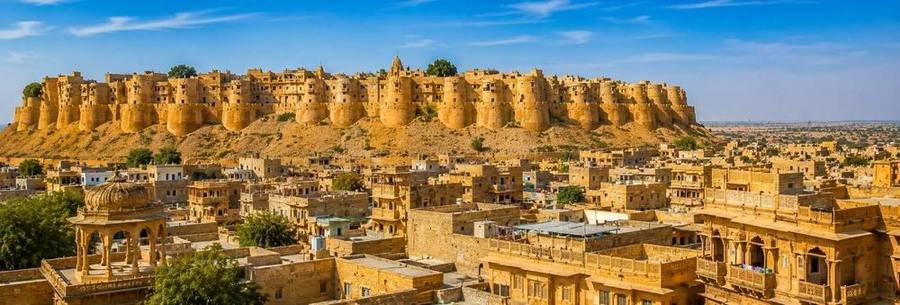
Honesty first: Suryagarh is not a historic palace. It opened in 2010 as Jaisalmer's first boutique hotel, a modern building designed — on 40 acres, with 62 rooms — to look as if it had stood for 300 years: a "sun fortress" of yellow Jaisalmer sandstone, courtyards, turrets and carved doors, on the Sam Road towards the dunes. What it lacks in age it makes up for in intent: this is the stay for desert evenings, with trips to Kuldhara, Gadisar Lake and the Sam dunes arranged from the hotel. Pick it for the fort feeling with modern comfort, and pair it with a day inside the real, living Jaisalmer Fort.
Laxmi Niwas Palace, Bikaner — the palace nobody talks about

Bikaner is the quietest stop on Rajasthan's palace circuit, and its palace hotel is the quietest of all. Laxmi Niwas Palace is part of the Lalgarh Palace complex, designed by the British architect Sir Samuel Swinton Jacob in the Indo-Saracenic style and built for Maharaja Ganga Singh between 1902 and 1926 — the first wing, Laxmi Niwas itself, was completed in 1902. It is a three-storey sweep of red Thar sandstone around two courtyards, commissioned because the regency considered Junagarh Fort unsuitable for a modern monarch. Today it runs as a heritage hotel, for travellers who want the palace experience without the crowds or the price tags of Jaipur and Udaipur — and who are coming to Bikaner for Junagarh Fort anyway.
The fort that started it all: Neemrana Fort-Palace
Every heritage hotel in India owes something to Neemrana. The fort was built in 1464 by the Chauhan Rajputs on a hill above the Delhi–Jaipur highway, 122 kilometres from Delhi, and by the 1980s it was a ruin — ransacked over the decades after Independence, when the royal family moved out. In 1986 two Delhi antiquarians, Aman Nath and Francis Wacziarg, bought the ruin for ₹7 lakh; it opened as a hotel in 1991 with just 12 rooms — India's first heritage hotel. Today it has more than 70 rooms, each different, spread across the hillside levels, with a nine-storey stepwell from around 1700 in the grounds. It is the easiest heritage stay in Rajasthan to reach — a weekend trip from Delhi — and the one to pick if you want history you can walk through, level by level, rather than a polished palace.
How to choose a heritage hotel in Rajasthan
Start with the city, not the hotel: Jaipur for the Pink City and bazaars, Udaipur for the lake, Jodhpur for the blue city, Jaisalmer for the desert, Bikaner for the quiet desert edge. Pick your route first — our Jaipur–Jodhpur–Udaipur 6-day itinerary covers the classic triangle — then choose one palace stay per city, not one per night. Then pick the building: a real palace for scale and ceremony, a haveli for intimacy, a fort for raw history, a modern palace-style hotel for the look with new-build comfort. Check whether the royal family still lives there, whether day visitors can enter, and whether it is in the old city or a drive away — each changes the stay more than the room category. Finally, book one or two nights per palace, not a week: two nights at the Lake Palace or Rambagh, then a modern hotel for the rest of the route.
When to book: the best time for a palace stay in Rajasthan
October to February is the window: cool, dry weather, and the palace courtyards and rooftop restaurants at their best. November to February is peak season — book early, especially for the Lake Palace and Rambagh. March is warm but workable; April to June is very hot, and July to September brings the lowest rates and the greenest desert light. For a month-by-month picture, see our Rajasthan in January guide, and for the food to eat between palace dinners, what to eat in Rajasthan.
Watch & Feel the Place: Rajasthan's Palace Hotels on Film
Videos are by their respective creators.
Best Heritage Hotels in Rajasthan FAQs
What is the best heritage hotel in Rajasthan?
There is no single winner — it depends on the city. For the classic palace stay, the Taj Lake Palace in Udaipur and Rambagh Palace in Jaipur are the most celebrated; for sheer scale, Umaid Bhawan Palace in Jodhpur; for a first heritage stay on a shorter budget, Neemrana Fort-Palace or Samode Haveli. Pick by city first, then by the kind of building you want.
What is the best place to stay in Udaipur near Lake Pichola?
The Taj Lake Palace sits in the middle of Lake Pichola itself, reached by boat, and the Taj Fateh Prakash Palace stands inside the City Palace complex on the lake's eastern bank. Otherwise, look for hotels on the eastern bank near the City Palace and the old-city ghats.
Are heritage hotels in Rajasthan good for weddings?
Yes — palace weddings are one of the main reasons these hotels exist as venues. Umaid Bhawan Palace, Rambagh Palace, the Taj Lake Palace and Samode Palace are all regularly booked for weddings. Book well ahead for the November-to-February wedding season.
Which heritage hotel in Rajasthan is best for couples?
For a honeymoon or anniversary, the Taj Lake Palace is the classic choice — a boat arrival and a palace floating on a lake. Samode Haveli in Jaipur suits couples who want intimacy and old-city walks, and Suryagarh in Jaisalmer suits couples pairing the stay with a desert evening at the Sam dunes.
What is the best time to stay in a heritage hotel in Rajasthan?
October to February, when Rajasthan is cool and dry and the palace courtyards and rooftop restaurants are at their best. November to February is peak season — book early. July to September brings the lowest rates.
The best heritage hotel in Rajasthan is the one whose story you want to wake up inside — a handmaiden's house, a palace floating on a lake, a famine-relief palace, or a ruin bought for ₹7 lakh and brought back to life. Choose the city, choose the building, and let the palace do the rest. Next, plan the route itself with our Jaipur–Jodhpur–Udaipur 6-day itinerary — and for the full picture of the state, start with the best places to visit in Rajasthan.
Plan your Rajasthan trip
Palaces, lakes, blue cities and desert dunes — five cities, eight stays, one royal route.
Rajasthan state guide →