
Diwali 2026 · Amritsar
Amritsar at Diwali: Bandi Chhor Divas at the Golden Temple

By Beauty of Bharat — India travel guide, every place, every flavour.
Guides covering all 36 States and UTs, researched from official sources and checked at publish time. Corrections welcome — see About Beauty of Bharat.
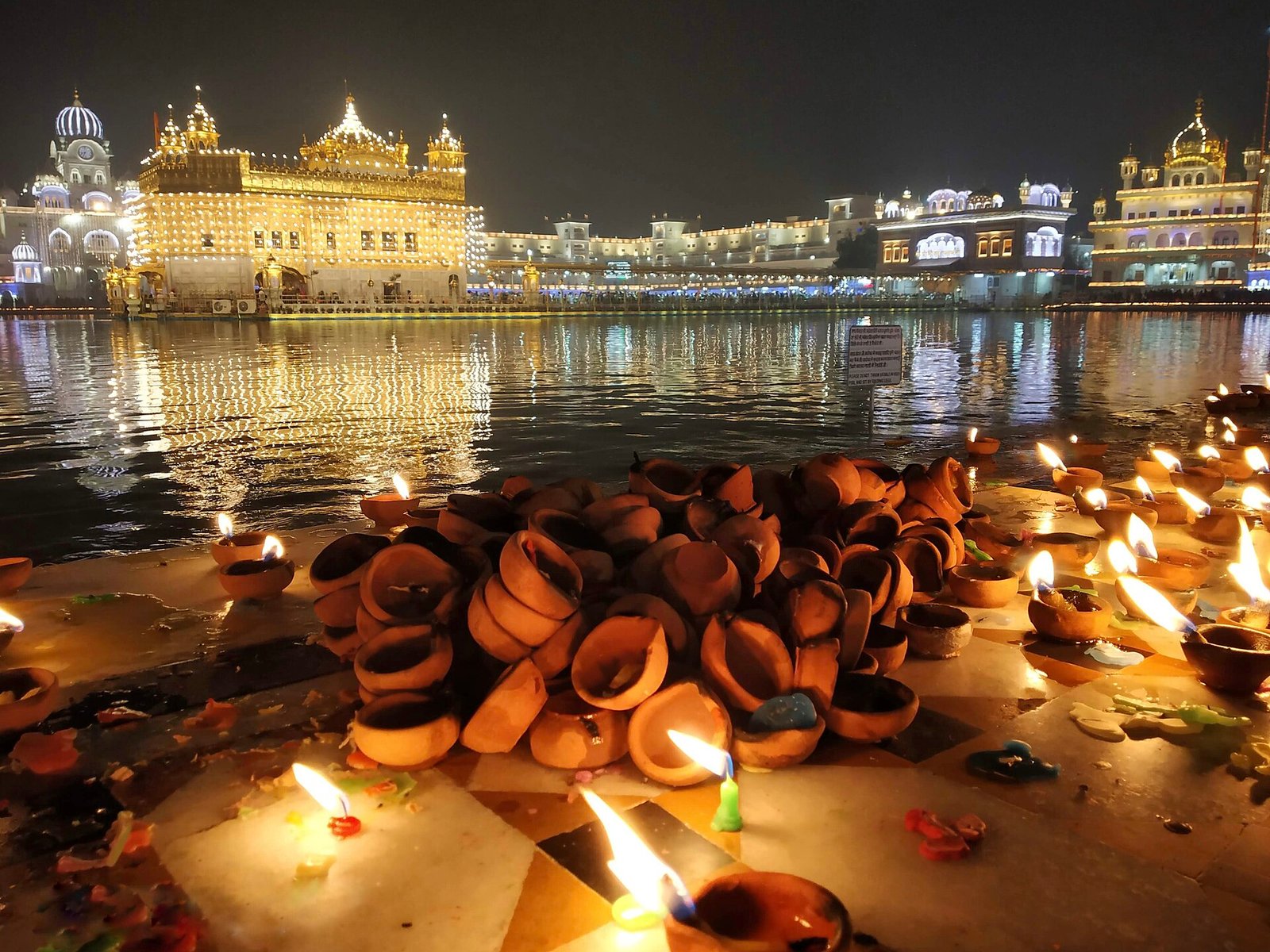
On Diwali night in Amritsar, the lamps around the Golden Temple are not only marking a festival of light. They are retelling a prisoner's release — and a refusal to walk free alone.
Picture the scene the lamps remember. A ruler agrees to free one man from a fort prison, but only on a condition designed to keep almost everyone else inside: only those holding the freed man's robe as he walks out may leave with him. The man answers with a tailor's trick — a robe with fifty-two strings, one for each fellow prisoner, so all of them can hold on and walk out beside him. That is the story Amritsar tells every year on Bandi Chhor Divas, and why Diwali night at Sri Harmandir Sahib — the Golden Temple — carries a meaning all its own. In 2026, Bandi Chhor Divas falls on Sunday 8 November, the same day as Diwali, on 23 Katak in the Nanakshahi calendar. This post explains what the day commemorates, how it is marked, and what a visitor will experience.
The robe with fifty-two strings: what Bandi Chhor Divas commemorates
Bandi Chhor Divas means, quite literally, the day of the release of prisoners. It commemorates the release of Guru Hargobind, the sixth Sikh Guru, from imprisonment at Gwalior Fort under the Mughal emperor Jahangir, in the early seventeenth century. Sikh tradition remembers that fifty-two imprisoned kings were held in the fort with him, and that the Guru refused to accept freedom for himself alone. When the emperor said that only those who could hold the Guru's robe could leave, the Guru had a robe made with fifty-two strings attached, so that each king could hold one and walk out with him. From that act he became known as Bandi Chhor, the releaser of prisoners.
Honesty about the story's edges matters. Sources do not agree on the exact year of the release, nor on how long the Guru was held at Gwalior — accounts range from months to years. What tradition is unanimous about, as the Encyclopaedia of Sikhism puts it, is the heart of it: he would not leave alone. This post follows that shared tradition rather than pinning the story to a single disputed year. Tradition holds that the Guru reached Amritsar at Diwali, and that the city lit lamps to welcome him and the freed prisoners home. That first lighting was a welcome, not a decoration — and every lighting since has repeated it.
The release was not a favour granted to one holy man, but an act of solidarity with men who had no such standing. That is why Bandi Chhor Divas is still described as a day of liberation and justice, not simply of joy: the lamps remember a man who treated other people's freedom as a condition of his own.
Why the same night is Diwali — and why it is not the same story
Visitors sometimes assume the Golden Temple is simply joining in Diwali. In one sense the calendar does join them up: Bandi Chhor Divas is kept on the new-moon night of Kartik, the same night as Diwali, so the two share a date, a season, and a city full of lamps. But they do not share a story. Diwali, in its widely told Hindu telling, celebrates the return of Rama to Ayodhya; Bandi Chhor Divas celebrates Guru Hargobind's release from Gwalior and his return to Amritsar. The lamps look alike from across the sarovar. What they mean to the people lighting them is different.
That distinction took formal shape in 2003, when Sikh religious leaders and the Shiromani Gurdwara Parbandhak Committee (SGPC) adopted the name Bandi Chhor Divas in the Nanakshahi calendar — to mark the Sikh celebration as its own observance, with its own reason for the lights. When homes and gurdwaras across Amritsar are lit on 8 November 2026, you are seeing two festivals coinciding, not one borrowing the other's meaning — and at the Golden Temple, the Sikh story is the one the lamps tell.
What the night looks like at Harmandir Sahib
The heart of the celebration is the Deepmala, the display of lamps at Harmandir Sahib. As darkness falls on Bandi Chhor Divas, earthen lamps and candles are set out around the sacred pool, the Amrit Sarovar, along the parikrama — the marble walkway that circles the water — and around the temple buildings, so that the gilded sanctum in the centre of the pool is ringed with light and doubled in its reflection. Reports of past Bandi Chhor Divas nights describe the complex illuminated with lights and earthen lamps and decorated with flowers: not a single floodlit building, but a whole complex outlined lamp by lamp.
Over that light, after dark, comes the fireworks display above the temple complex, arranged by the SGPC, which also makes the special lighting arrangements for the occasion. The fireworks are the night's exclamation mark rather than its substance. The substance is quieter and lasts longer: continuous kirtan filling the complex through the night, and devotees moving around the pool, offering prayers and taking a dip in the sarovar — reports of past celebrations describe tens of thousands paying obeisance at the complex on the day.
The other thread running through the night is langar, the free community kitchen, and the wider round of prayer that frames the day. Bandi Chhor Divas celebrations traditionally include lighting homes and gurdwaras, processions known as nagar kirtan, and langar, and at Amritsar the Guru Ka Langar beside the temple serves a free meal to tens of thousands daily, as our Amritsar guide notes. On Bandi Chhor Divas, sitting in a row on the floor and eating the same simple vegetarian meal as everyone else is not a side activity. It is the day's teaching made edible: the equality the robe with fifty-two strings insisted on, practised at a table where no one eats apart. Special prayers and kirtan are organised as part of the celebration, and the day's gathering at the Akal Takht within the complex has traditionally been part of the observance.
What a visitor actually experiences
Come expecting a crowd, and expecting that crowd to be part of the experience rather than an obstacle to it. Bandi Chhor Divas is one of the Golden Temple's great gatherings, and the parikrama is packed with devotees and visitors moving slowly around the pool. Allow far more time than for an ordinary visit, keep your party together, and accept that the walk around the sarovar will be a shuffle rather than a stroll. The reward is the view itself — the sanctum lit from every side, its reflection trembling in the water, the lamps stretching away in both directions — and kirtan carrying across the pool without pause.
The etiquette of an ordinary Golden Temple visit applies with particular force on this night, because the complex is at its fullest. Every visitor covers their head, removes their shoes before entering the sacred precinct, and washes their feet at the entrance channel; modest dress is expected, and tobacco and alcohol are not brought into the complex. Follow the directions of the sevadars, the volunteers who manage the flow of people, especially around the causeway to the sanctum, where queues are at their longest. Photography rules are applied strictly near the sanctum, so take your cues from the signs and the sevadars on the night rather than from what other visitors appear to be doing. On a night commemorating a release from prison, that shared discipline — everyone barefoot, covered, and queuing for the same darshan — is itself a small enactment of the equality the day celebrates.
Two rhythms are worth knowing. First, the complex is open through the night, and the hours after the fireworks, when the first surge thins, are often described as the most atmospheric time on the parikrama, with the lit temple reflected in the sarovar and the kirtan continuing. Second, do not compress the night into a single viewpoint: walk the full parikrama, pause at the water's edge as well as at the causeway, and sit for a while in the langar hall. The night is a circuit — light, water, song and shared food — and its meaning builds as you move through all four.
Planning a Bandi Chhor Divas visit in 2026
For 2026, plan around Sunday 8 November, when Bandi Chhor Divas and Diwali coincide. Because the observance follows the lunar calendar, and gurdwaras outside India may keep a nearby date, confirm the date and the SGPC's arrangements close to travel, rather than relying on a single listing months ahead. Our Amritsar guide covers the city's wider sights, food and transport, and the Punjab guide sets Amritsar in the state's full calendar, so the trip can be paired with the rest of Punjab.
Plan the day around the temple, not around a timetable of side trips. Arrive in Amritsar in good time before dark, so that you are already inside the complex — shoes off, head covered, feet washed — when the lamps are lit, rather than trying to enter through the largest crowds at the moment of lighting. Expect the old city around the temple to be busy and lit, and build in buffer time for every movement that evening. If you are travelling with older relatives or small children, the quieter hours after the main fireworks, rather than the peak crush around the display, may suit your party better, and the langar hall offers a seated, welcoming pause at any hour. Above all, remember what the lamps are for. A visitor who knows the story of the fifty-two strings will see something different in the Deepmala from a visitor who only sees a pretty illumination — and that difference, between looking at lights and understanding why they were lit, is the whole reason to come to Amritsar for this night.
Watch the Golden Temple glow
Watch the Golden Temple glow on Bandi Chhor Divas night:
Embedded for viewing from its creator's channel; confirm the latest Golden Temple arrangements locally before travelling for Bandi Chhor Divas.
When is Bandi Chhor Divas in 2026?
On Sunday 8 November 2026, the same day as Diwali. The SGPC calendar lists it as Bandi Chhor (Divali) on 23 Katak, Nanakshahi Samvat 558. Confirm arrangements close to travel; gurdwaras outside India may keep a nearby date.
What does Bandi Chhor Divas commemorate?
The release of Guru Hargobind, the sixth Sikh Guru, from Gwalior Fort under the Mughal emperor Jahangir, together with fifty-two imprisoned kings. Tradition holds he refused to leave alone, and when only those holding his robe could go free, he had a robe made with fifty-two strings so all could hold on and walk out with him. He is remembered as Bandi Chhor, the releaser of prisoners.
Is Bandi Chhor Divas the same as Diwali?
No, although the two coincide on the same night. Diwali and Bandi Chhor Divas share a date — the new-moon night of Kartik — and a city full of lamps, but they tell different stories. Bandi Chhor Divas marks Guru Hargobind's release and return to Amritsar, and the name was formally adopted in the Nanakshahi calendar in 2003 to mark the Sikh observance as distinct.
What happens at the Golden Temple on Bandi Chhor Divas?
The Deepmala lights the complex, with earthen lamps and candles around the Amrit Sarovar and along the parikrama, continuous kirtan through the night, a fireworks display after dark arranged by the SGPC, prayers and processions, and langar, the free meal open to all. Devotees also offer prayers and take a dip in the sarovar.
Can non-Sikhs visit the Golden Temple on Bandi Chhor Divas?
Yes. Sri Harmandir Sahib is open to people of every faith, and visitors of all backgrounds join the Bandi Chhor Divas gathering. Every visitor covers their head, removes their shoes, washes their feet at the entrance, dresses modestly, and follows the sevadars' directions. The langar meal is free and open to all.
What should a visitor plan for on the night?
Large crowds, a slow walk around the parikrama, and a long evening. Arrive before dark, allow generous time in the old city, and consider the quieter hours after the fireworks if travelling with older relatives or small children. Check SGPC arrangements near the date, and see our Amritsar guide for wider sights and transport.
If this leaves you wanting the wider picture, start with our Amritsar destination guide — the temple, the old city and its food in one place.